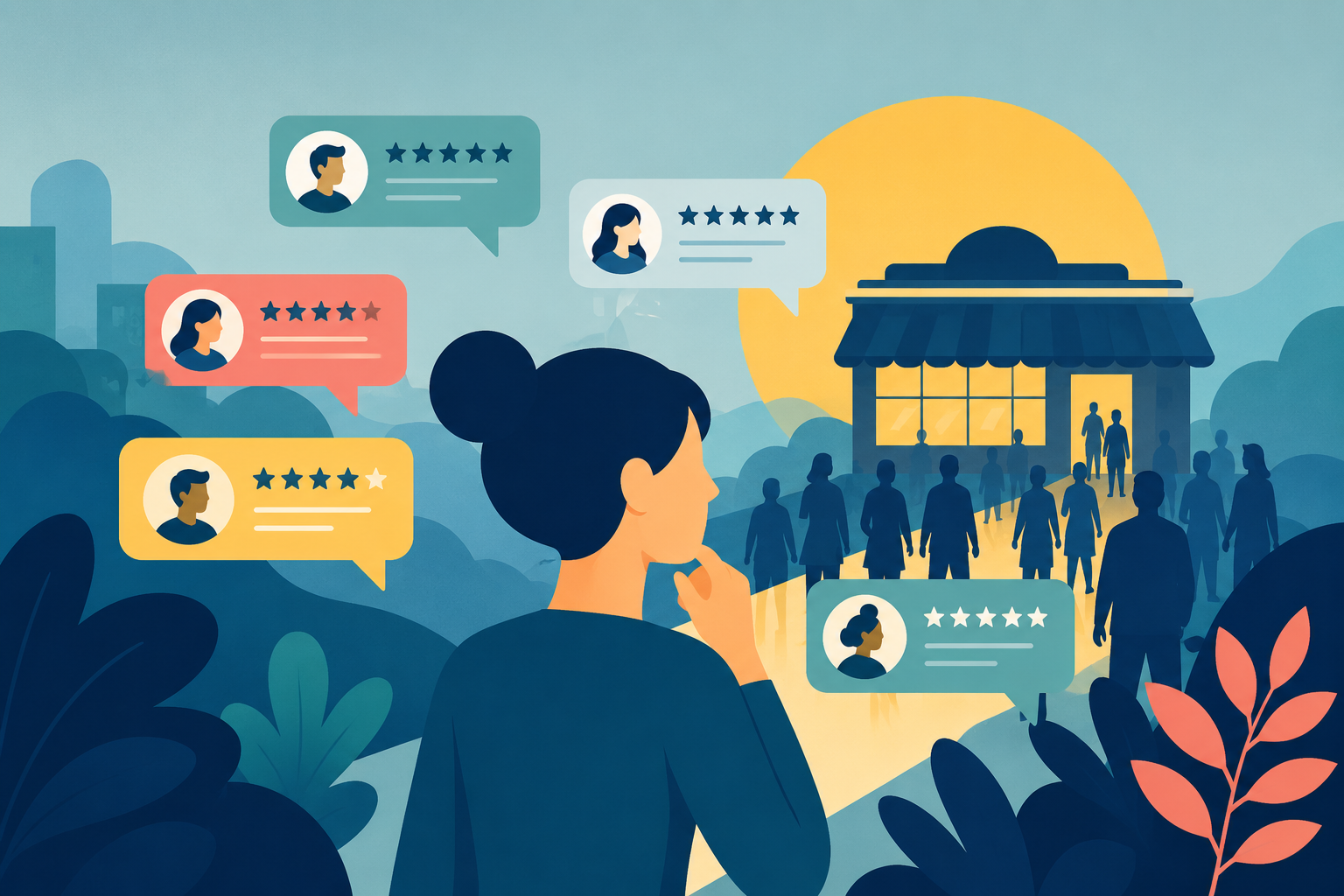
Discover why social proof shapes consumer decisions by reducing uncertainty and building trust through real customer experiences.
Looking for a Shorter Overview?
AI Summary
Key Moments
Social Proof as Natural Behavior
Humans instinctively use others' experiences to reduce uncertainty in decision-making.Evolution from Local to Digital
Ancient practice of asking neighbors evolved into reading thousands of reviews online.Imperfect Reviews Override Marketing
Genuine but flawed reviews influence decisions more than professional promotional content.Borrowing Confidence from Others
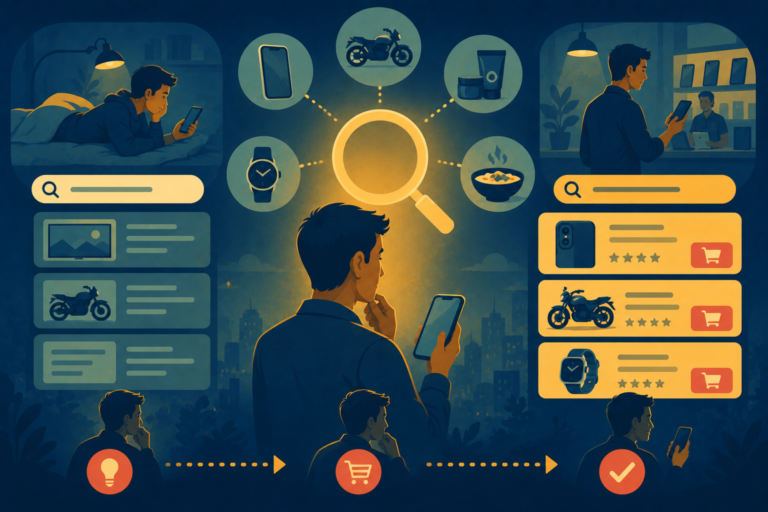
People gain decision confidence by seeing real people have already trusted brands and places.A few weeks ago, my friends and I decided to go out for dinner after what had been a long and exhausting week. Nobody had a particular place in mind, so we did what almost everyone does nowadays. We opened Google Maps and started looking for restaurants nearby.
Within a few minutes, there were dozens of options in front of us. Some had beautiful interiors, some had tempting food photos, and a few were running attractive offers. But interestingly, none of those things became the centre of our discussion.
Instead, we found ourselves reading reviews written by complete strangers. One person pointed out that the food was excellent but the service was slow on weekends. Another mentioned that the waiting time was longer than expected but said it was worth it. Someone had even uploaded ordinary, unedited photos of the dishes they had ordered.
Looking back, I realised that those imperfect photos and honest reviews influenced us far more than the restaurant’s carefully designed promotional posts.
We eventually picked one of the restaurants with consistently positive reviews, and thankfully, it turned out to be a good choice. The food was great, the atmosphere was exactly what we were looking for, and we left feeling happy with our decision.
But while driving home, a thought crossed my mind. If that same restaurant had no reviews, no ratings, and no customer photos, would we have chosen it so confidently? I don’t think we would have. In fact, we probably wouldn’t even have considered it seriously.
It wasn’t that we believed every review was completely accurate. It was simply reassuring to know that hundreds of other people had already been there before us.
That small moment made me notice something about myself. I do this almost every day without giving it much thought. Before booking a hotel, I read reviews. Before ordering something expensive online, I check what previous buyers have said. Before downloading an app, I glance at its rating. Even when choosing a new café or deciding whether a movie is worth watching, I almost instinctively look at other people’s experiences first.
Somewhere along the way, this has become such a natural habit that I hardly realise I’m doing it.
That’s what made me think about social proof.
Why Social Proof Still Matters More Than We Realise
I think most of us like to believe that we make our own decisions independently. We tell ourselves that we aren’t influenced by strangers on the internet and that our choices are based purely on logic.
But the more I observe my own behaviour, the more I realise that isn’t entirely true.
Whenever I’m uncertain about something, I naturally start looking for reassurance. Not because I want someone else to make the decision for me, but because I want to feel a little more confident about the decision I’m already leaning towards.
That’s where social proof quietly enters our lives. It’s less about copying other people and more about reducing uncertainty.
Every purchase comes with a small fear of getting it wrong. We wonder whether the product will be worth the money, whether the restaurant will live up to the photos, or whether there’s another option that’s even better.
Reading someone else’s experience doesn’t eliminate those doubts completely, but it softens them. It makes us feel like we’re not walking into the unknown alone.
I’ve realised that this habit didn’t begin with the internet. Long before online reviews existed, people asked neighbours which mechanic they trusted, relatives where they bought furniture, or friends which coaching institute was actually worth joining.
Human beings have always relied on other people while making decisions. The internet didn’t create that behaviour. It simply made those opinions available on a much larger scale.
Today, instead of asking two friends, we can read the experiences of two thousand people within a few minutes.
Of course, we also know that reviews aren’t perfect. Some are fake, some are overly emotional, and some reflect experiences that may never happen to us.
Yet despite knowing all this, we continue reading them. I certainly do. Even when I tell myself that I’ll make up my own mind, I still find myself scrolling through ratings before clicking the buy button. It’s almost become second nature.
Also read: How Choice Overload Weakens Purchase Decisions
Maybe that’s why social proof continues to influence modern consumers despite all the changes in technology. At its core, it isn’t about algorithms, star ratings, or comment sections. It’s about something much more human.
We feel more comfortable making decisions when we know that someone else has already taken the same path and come back with a story to tell. That story doesn’t have to be perfect. It just has to feel genuine.
Maybe that’s the biggest lesson about social proof. People don’t simply buy products because a company says they’re good. They buy with greater confidence when they see that real people have already trusted the same brand, visited the same place, or had a positive experience before them.
In conclusion, we may think we’re making decisions entirely on our own, but more often than not, we’re quietly borrowing confidence from the experiences of others. And perhaps that’s one of the most human things we do.
– Written by Bhavya Singhal, an Emerging Journalist and Digital Media & Communication student exploring branding, marketing strategy, and consumer psychology through practical observations and real-world examples.