Rebranding Strategy won't fix a broken business. Fix your product and customer experience before changing your brand.
Looking for a Shorter Overview?
AI Summary
Key Moments
Rebranding masks deeper problems
Founders often chase visual redesigns instead of fixing core issues like supply chain and customer support, leading to continued failures.Consumer mental availability is broken by unnecessary rebrand
Changing familiar visual cues forces consumers to rethink, increasing the chance they'll switch to competitors.Snapdeal's costly misstep
A massive rebrand that ignored product quality and refund issues drove customers away despite flashy marketing.Deciding factor question
Ask whether you're rejecting the logo or the product before investing in a new brand identity.When a startup’s sales graph goes completely flat for three consecutive quarters, modern founders usually panic. They do not check their broken supply chain, their terrible customer service resolution times, or why their app crashes at checkout. Instead, an emergency boardroom meeting is called, and everyone blames the brand’s logo.
They decide that their fonts look outdated. Or they convince themselves that their brand colours are no longer resonating with Gen Z. Within a week, an overpriced design agency is hired to execute a massive, multi-million-rupee rebranding strategy.
But here is the brutal truth that advertising agencies will never tell you: changing your packaging or visual identity is not going to fix a fundamentally broken product.
When a company rebrands without fixing its core operational flaws, it is not levelling up. It is unintentionally putting itself on a time bomb. But how?
When you rebrand, you are essentially deleting the space in the consumer’s mind that you have already spent years trying to own.
The Flaws of a Rebranding Strategy
Look at a packet of Parle-G. The yellow wax-paper-style wrapper, the retro illustration of the little girl, the bold red typography. By modern design standards, it is a complete mess. It is objectively outdated, and many design school graduates would probably give it a zero out of five.
But think for a moment. What would actually happen if Parle suddenly decided to execute a modern rebranding strategy? What if it hired a top-class agency to replace the iconic wrapper with a minimalist white design and a sleek font?
It would be commercial suicide.
The daily wage worker at a Mumbai railway station or a student living in a hostel does not read the English text on the packet. They do not care about the typography or the design system. They simply look for that yellow packet, ask for it, open it, and dip the biscuits into their tea. No elaborate branding is involved. It is simply a smooth, effortless transaction.
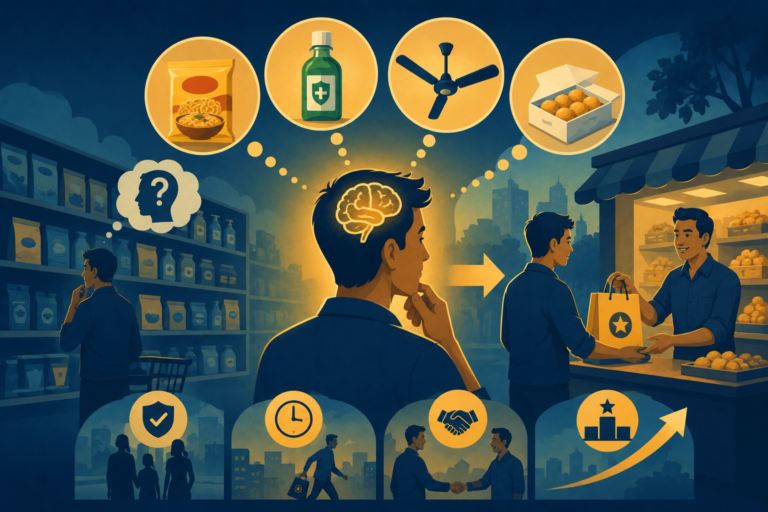
The moment you change that visual anchor, however, you break the cognitive reflex. Now you are forcing the consumer to think. And as we know from the concept of mental availability, the moment a consumer has to pause and think, you have already increased the chances of losing them to Britannia or a local competitor.
This is the ultimate danger of rebranding when you do not need to. It assumes that consumers are deeply emotionally invested in your new logo or colours. In reality, they simply want the same visual cue they have always relied on because it saves mental effort.
Founders love rebranding because it feels like meaningful work. It is incredibly easy to sit in an air-conditioned office debating between two shades of pastel green. It is much harder to walk into a warehouse and figure out why deliveries are consistently delayed by 20 to 30 minutes.
Founders need to understand that a new logo will not make delivery riders faster. A new tagline will not make customer support representatives more helpful. If your brand is failing because your core promise is broken, then a new design is simply a very expensive distraction.
Also read: Why OpenAI Branding Succeeded Before Most AI Companies
Remember the massive rebrand of Snapdeal a few years ago? The company changed everything from its packaging to bright red delivery boxes and launched expensive front-page newspaper campaigns across the country. It even partnered with top Bollywood celebrities to unbox its packages on Instagram.
But it did not fix its counterfeit product problem. It did not fix its frustrating refund process, where customers often had to wait weeks to receive their money. Instead, it tried to buy its way out with a new logo and a new colour palette.
The result?
Consumers migrated to Flipkart and Amazon because they remembered the poor experience they had the last time they shopped on Snapdeal. The rebrand did not save the company. It simply made its failure look much more expensive.
So before you sign a massive cheque for a new identity, ask yourself one simple question:
Are consumers rejecting my logo, or are they rejecting my product?
Because nobody has ever stopped buying a great product simply because they did not like the font on the front.
– Written by Rajnish Singh, a copywriter and strategist with a background in fast-paced journalism, who explores the gap between what brands promise and how consumers actually behave.