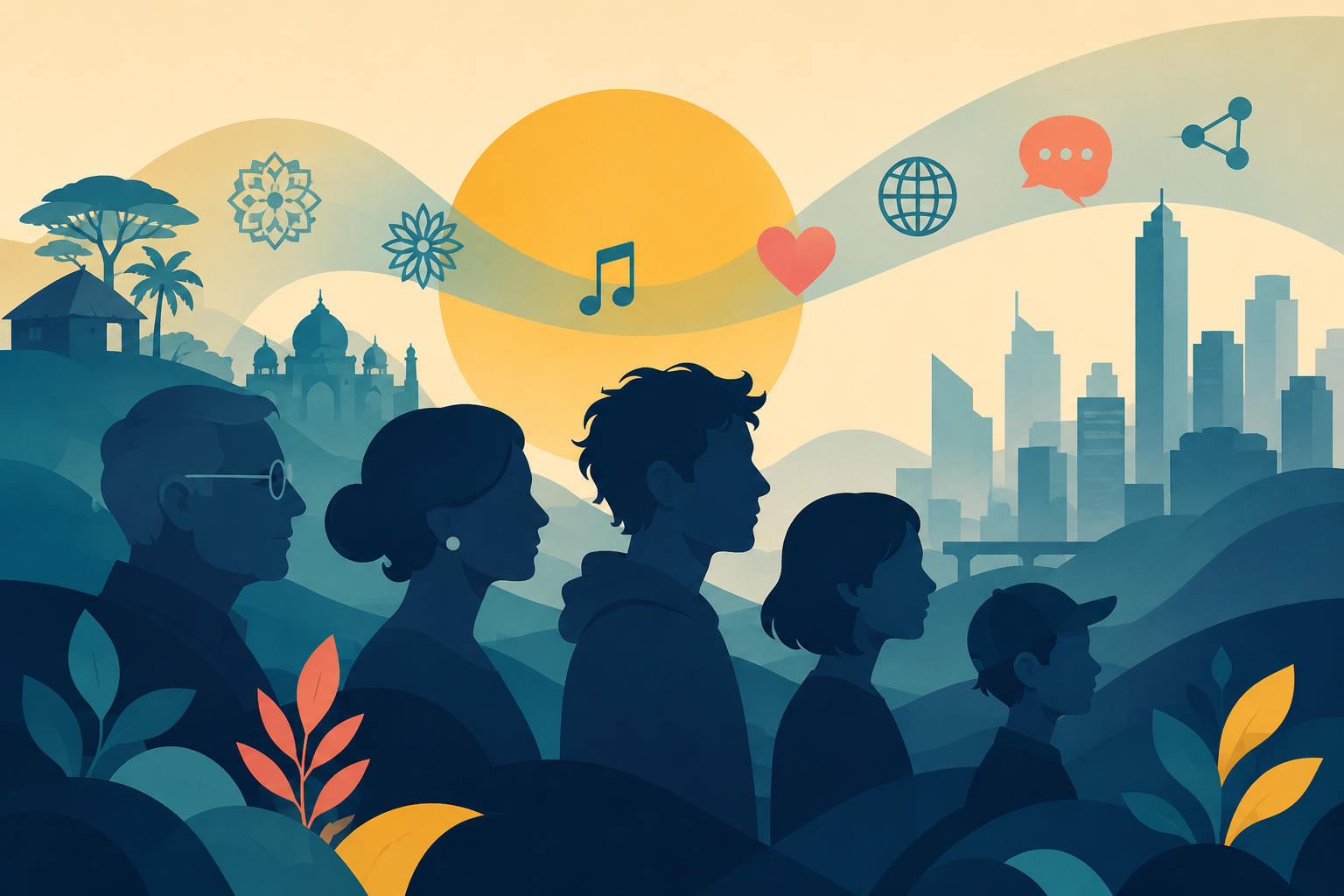
How Cultural Relevance evolves across generations, shaping values, behaviours, brands and the way society understands what matters.
Looking for a Shorter Overview?
AI Summary
Key Moments
Generations Reinterpret Culture
Each generation reshapes inherited traditions through its unique social, economic, and technological context.Value Gaps Between Cohorts
Millennials and Gen Z show measurable differences in egalitarian and fatalistic outlooks compared to older groups.Brands Must Evolve, Not Abandon
Successful organisations preserve timeless identity elements while updating expression to stay culturally relevant.Digital Acceleration of Change
Online platforms accelerate cultural exchange, blurring geographic and age boundaries and speeding relevance shifts.What feels relevant to one generation can feel completely out of touch to another. A phrase that once sounded progressive can eventually feel dated. A workplace norm that was considered professional can become restrictive. Even the brands, traditions and cultural references that people grew up with can lose their meaning as society changes. This is where Cultural Relevance becomes important. It is not simply about understanding what is popular today. It is about recognising how values, experiences and social contexts change over time, and understanding what continues to matter to people as those changes happen.
Culture is not something that is passed down unchanged. It is inherited, interpreted and reshaped. Every generation receives ideas, behaviours and traditions from the generation before it, but it also encounters a different social, economic and technological environment. Those experiences inevitably influence what it believes, values and considers normal. UNESCO describes culture as being in constant flux, adapting across time and circumstances.
Cultural Relevance Is Built Through Change
Generational change is often discussed through stereotypes. Older generations are described as traditional, younger ones as progressive, and the differences are reduced to technology, language, or lifestyle. Reality is more complicated. Generations are shaped by the circumstances in which they grow up, including major economic events, technological changes, social movements and shifts in institutions. These experiences can influence how people communicate, make decisions, spend money and define success.
Research from the Berkeley Initiative for Young Americans, for example, found measurable differences in the value orientations of Millennials and Gen Z compared with older cohorts. The study found that younger generations were, on average, more egalitarian and more fatalistic, although the differences also varied considerably by demographic and ideological background. The finding is useful because it moves the conversation beyond the assumption that generations simply have different tastes. Their underlying perceptions of society can also be different.
But cultural change does not mean everything from the past disappears. Culture survives precisely because some ideas are successfully transmitted across generations. Families are an important part of this process, but they are not the only influence. Research on cultural transmission points to parents, peers, communities, institutions and influential individuals as different forces shaping what people retain and what they change. Some values persist strongly, while others adapt more quickly to their surroundings.
This explains why cultural relevance is rarely about choosing between the old and the new. It is about understanding what has enduring meaning and what has become disconnected from the lives of people today.
Consider something as ordinary as workplace professionalism. Expectations around clothing, communication and personal presentation have changed considerably over time. What was once seen as essential to looking “professional” may now be interpreted differently by younger workers. That does not necessarily mean standards have disappeared. Instead, the definition of professionalism has expanded as workplaces have become more diverse and social norms have shifted.
Also read: How Decision Simplicity Increases Conversion
The same principle applies to brands. A brand can carry decades of heritage and still become culturally distant if it assumes that the values and behaviours of its original audience remain unchanged. Heritage can provide familiarity, but relevance requires interpretation. The challenge is to preserve the parts of the brand that people genuinely value while allowing its expression to evolve with the audience.
Technology has accelerated this process. Digital platforms expose people to ideas, communities, and cultural expressions far beyond their immediate surroundings. UNESCO notes that digital technologies have brought people into contact in unprecedented ways, creating communities that can cross geographical and cultural boundaries. This means cultural change can travel faster, overlap more freely, and become harder to define by age or geography alone.
For marketers and business leaders, the lesson is simple but important: never assume that yesterday’s relevance will automatically survive tomorrow. Cultural relevance requires curiosity. It requires listening to different generations without reducing them to stereotypes, understanding the experiences shaping their worldviews, and being willing to question assumptions that once seemed obvious.
The strongest brands and organisations do not abandon their identity every time culture changes. They learn which parts of that identity are timeless and which parts need to evolve. That is ultimately what makes cultural relevance sustainable. It is not about chasing every new trend. It is about staying close enough to society to understand why people’s expectations are changing, and having the confidence to change with them.