Learn why successful brands win by owning one mental shortcut in consumers' minds instead of competing on endless features.
Looking for a Shorter Overview?
AI Summary
Key Moments
Define Mental Availability
It differentiates mental availability from simple awareness, positioning it as the brand that instantly pops into mind during a purchase need.Brand as Mental Shortcut
ENO turns a digestive emergency into a one‑word recall, showing how a single cue can dominate consumer behavior.Emotional Cue Overrides Logic
Dettol uses a familiar sting and hospital scent as a psychological guarantee, proving feelings often trump facts.Brand Simplicity Wins
Startups are advised to choose one core idea, letting the brain latch onto a single, unforgettable shortcut.The human brain is a remarkably lazy piece of biological hardware. It hates wasting energy on making decisions.
Every day, the average Indian consumer is bombarded with thousands of notifications, banners, and advertisements. Our brains are constantly overwhelmed. They simply do not have the cognitive capacity to logically evaluate a brand’s detailed list of features. That is exactly why most advertising fails to build true mental availability.
Many agencies assume buyers make rational, mathematical decisions. They believe that if they highlight a better price-to-weight ratio or a faster processor, consumers will logically switch brands.
But that is not how purchasing decisions work.
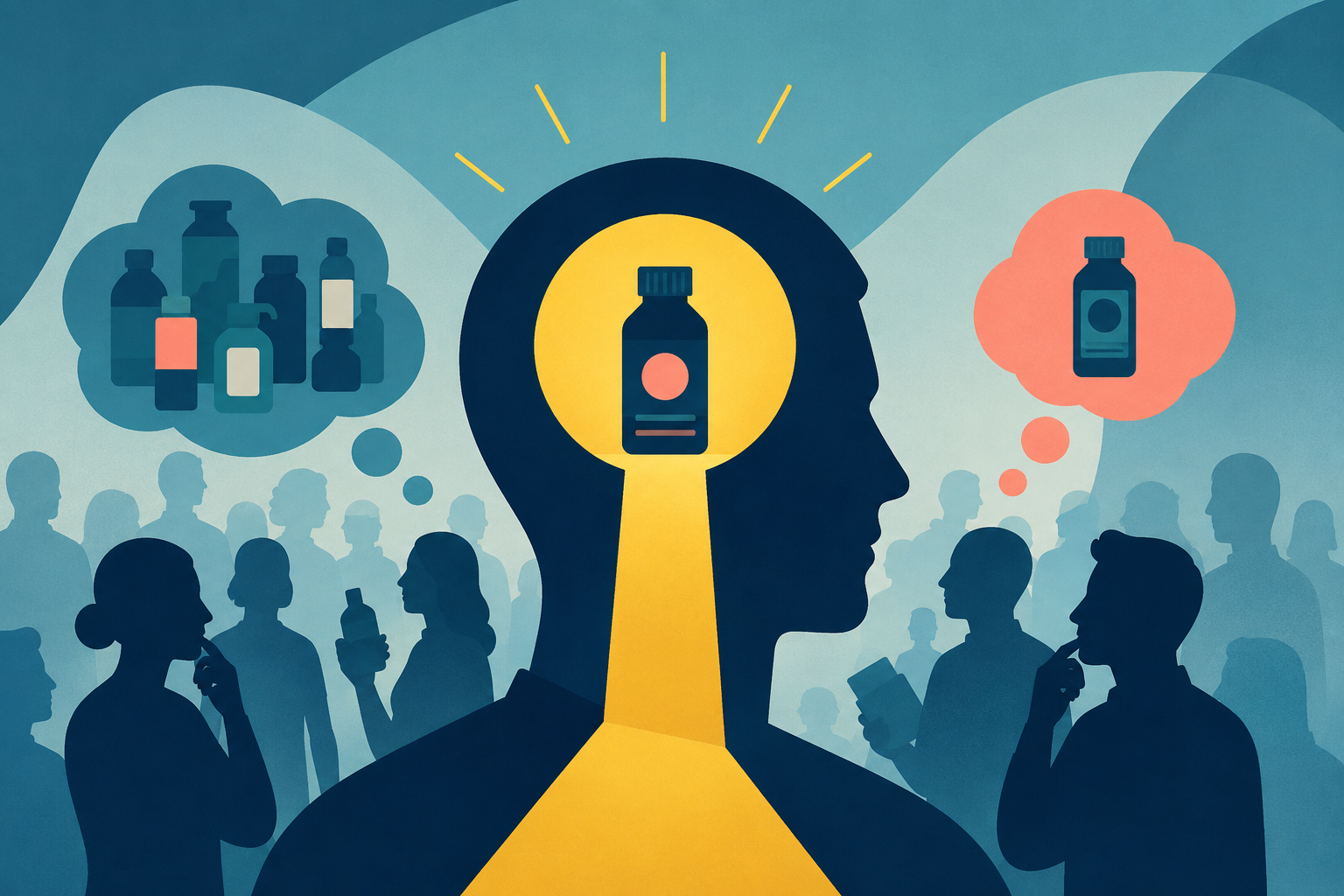
To survive the daily chaos of choices, the brain relies on mental shortcuts. That is where mental availability comes in.
When an accountant suffers a sharp headache at three in the afternoon, they do not compare the chemical differences between ibuprofen and paracetamol. They do not evaluate which pill has a faster-release coating. Their brain triggers an automatic reflex, and they ask the office boy for a Saridon.
The brand that makes consumers think the least is usually the one that wins.
The Raw Mechanics of Mental Availability
What many modern founders and venture capitalists get wrong is confusing brand awareness with mental availability.
Awareness simply means people recognize your logo when they see it on a billboard or an IPL jersey. That may be good for a brand’s visibility, but it does not necessarily lead to a purchase.
Mental availability is something entirely different. It means your brand is the first one that comes to mind in a specific buying situation. It is a psychological trigger directly linked to a moment of need.
Take the Indian antacid market.
When someone eats three oily samosas or an entire plate of chole bhature and immediately suffers from acidity, what do they do next? Do they start researching the chemical composition of different antacids?
The answer is no.
Their brain simply recalls one word: ENO.
ENO does not just occupy shelf space in supermarkets. It owns the moment when someone experiences acidity after overeating. For decades, the brand reinforced this association with one simple promise: “Kaam shuru sirf 6 seconds mein.”
It created a mental shortcut so powerful that it bypassed the consumer’s need to compare alternatives.
The same principle applies to Dettol.
Dettol smells like a hospital. It stings when poured onto an open wound. There are plenty of antiseptics available today that disinfect just as effectively without causing discomfort.
Yet many Indian mothers continue to trust Dettol.
Over the years, the brand established a deeply rooted psychological shortcut: “If it burns, it means it is working.”
That distinctive smell and the familiar sting became symbols of safety and hygiene. Once that emotional association is established, it becomes incredibly difficult for competitors to overcome it with logical arguments about better ingredients or gentler formulations.
Also read: What the Liquid Death Brand Teaches About Category Disruption
Today, many startup founders are afraid to stand for one thing. They want their brand to appeal to everyone.
A new beverage brand wants to be healthy, energy-boosting, vegan, locally sourced, affordable, and sustainable—all at the same time. It fills its packaging with multiple claims and launches aggressive advertising campaigns, hoping at least one message resonates.
But that approach rarely works.
When you try to be five different things, consumers struggle to remember what you actually stand for. You become a blur.
The human brain cannot easily remember a paragraph. It remembers a shortcut.
If you want to build a brand that lasts, you must make a difficult choice. Stop listing features and start creating a mental shortcut. Sacrifice being known for three good things so you can become unforgettable for one.
– Written by Rajnish Singh, a copywriter and strategist with a background in fast-paced journalism, who explores the gap between what brands promise and how consumers actually behave.