Why trust, not technology, will determine the success of India's digital healthcare revolution, from AI to ABDM adoption.
Looking for a Shorter Overview?
AI Summary
Key Moments
Trust Over Tech
Trust is the costly, non‑negotiable foundation of India's digital healthcare revolution, more valuable than any technology.Adoption Is Emotional
Doctors and nurses reject systems they perceive as surveillance tools, making trust the true driver of adoption rather than features or training.Four Critical Relationships
Patient‑provider, provider‑institution, institution‑insurer, and all users‑platform relationships rely on consent‑linked interoperability and clear accountability.AI With Human Oversight
AI should reduce patient uncertainty while preserving clinician accountability, backed by explainability and audit trails.Eighteen years ago, when we started building hospital software, the hardest problem was never the code. It was the conversation that happened after the demo, the medical superintendent leaning back and asking, quietly, “But what happens to my data?”
That question has not gone away. It has only grown louder. Today, having worked with over 1,000 hospitals across India, I have come to a conclusion that sounds unfashionable in an industry obsessed with AI: technology is the cheapest part of digital healthcare. Trust is the expensive part. And it is the only part that cannot be bought, licensed, or downloaded.
Adoption is an emotional decision, not a technical one
We have all seen it. A hospital buys a world-class HIS. Six months later, the doctors are still writing on paper, and a clerk is entering it into the system at midnight. The software works perfectly. The transformation never happened.
Why? Because the doctor was never convinced that the system was on her side. She suspected it existed to audit her, not assist her. The nurse suspected it would add twenty minutes to a twelve-hour shift. The patient suspected his diagnosis would end up in a telecaller’s spreadsheet. Every one of those suspicions is a trust deficit, and no feature list closes it.
I tell my team something often: adoption is not a training problem. It is a trust problem wearing a training problem’s clothes.
Four relationships, not one
The Indian healthcare ecosystem runs on four fragile relationships — patient to provider, provider to institution, institution to insurer, and now everyone to the platform sitting in the middle. Digital health does not automatically strengthen these. Done badly, it accelerates distrust.
Interoperability is the clearest example. ABDM has given India something rare: a national framework where a patient’s records can genuinely follow her. Our own ABDM certification journey has been slow, unglamorous work — milestone by milestone, record type by record type. It would have been easy to treat it as a compliance checkbox. But consent-linked interoperability is not a checkbox. It is the first time in Indian healthcare that the patient, not the hospital, owns the record. That single shift does more for trust than any feature we could have shipped.
The same is true of security. We hold CMMI Level 5, ISO 27001, and PCI DSS certifications not because they look good on a slide, but because when a 500-bed hospital hands us its patients’ lives in database form, “trust me” is not an acceptable answer. Evidence is.
Where AI must be careful
AI in healthcare is real, and we are building with it — including a cancer second-opinion platform where the stakes could not be higher. But I have a rule I keep returning to: AI should reduce the patient’s uncertainty, never the clinician’s accountability.
The moment a patient cannot tell whether a human or a model made the call, and the moment no one will own the answer, we have not innovated. We have laundered responsibility. Explainability, an audit trail, and a named doctor at the end of the chain are not brakes on innovation. They are what make innovation survivable.
Also read: The Most Valuable Asset Isn’t on Your Balance Sheet. It’s Your Reputation. Invest in It Like CapEx
The leadership balance
We bootstrapped Caresoft for eighteen years. That taught me something about pace: when you cannot buy trust with a marketing budget, you have to earn it one hospital at a time, and you learn not to break it for a quarter’s growth.
India will build the world’s largest digital health system. The technology is not in doubt. The only real question is whether a patient in Bhagalpur or Bhayandar believes it is working for her.
Get that right, and everything else is just engineering.
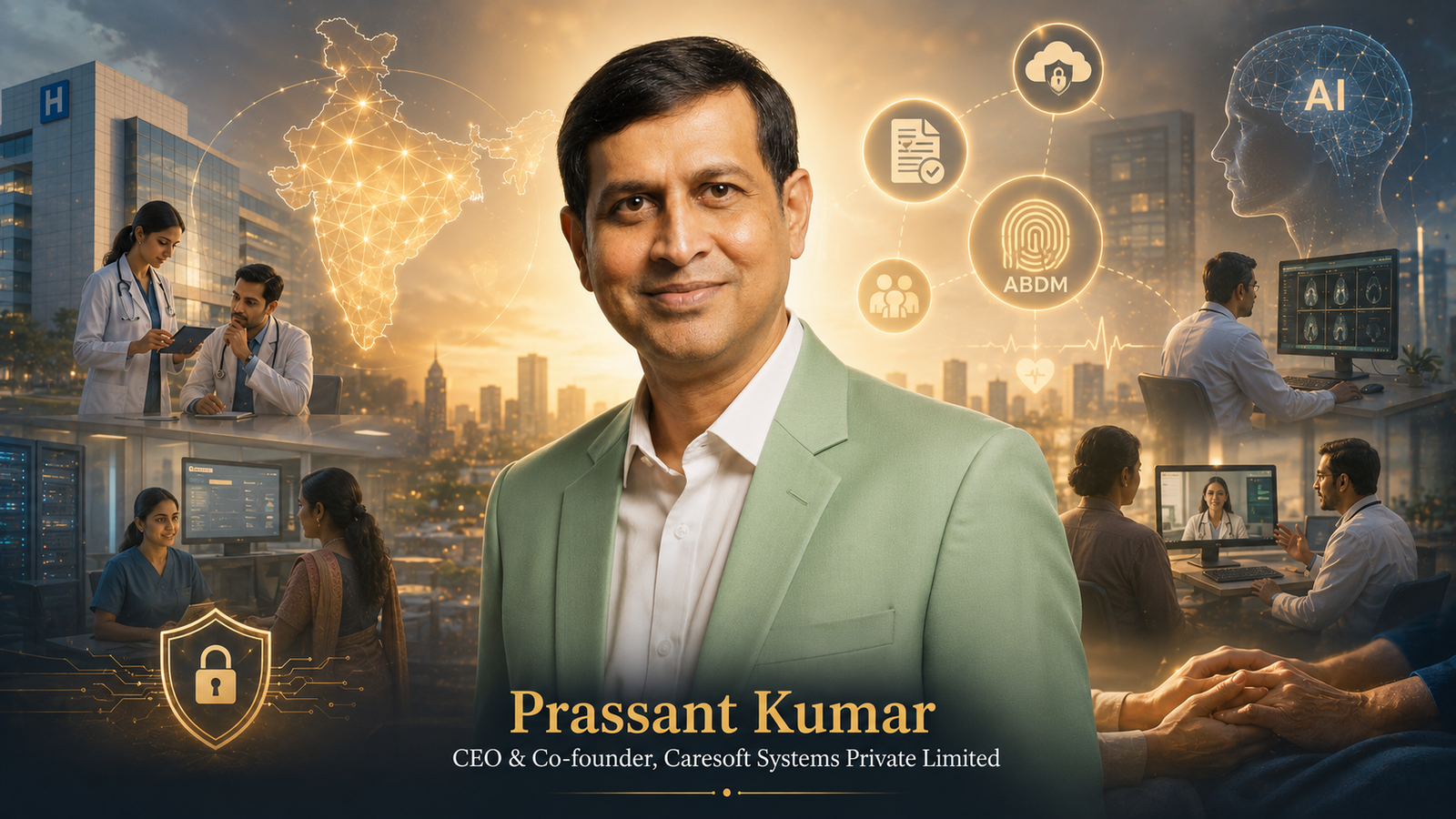
– Written by Prassant Kumar, Co-founder & CEO of Caresoft Systems Private Limited, helping over 1,000 hospitals across India accelerate their digital transformation. He is also building Vertana, an independent cancer second-opinion platform, and Medicircle. Having bootstrapped Caresoft over the past 18 years, he writes about the future of Indian healthcare, digital transformation, and the role of trust in health-tech.