India's digital healthcare future depends on trust, not technology. Here's why trust will define adoption and lasting impact.
Looking for a Shorter Overview?
AI Summary
Key Moments
Trust Over Technology
Trust, not technology, is the foundation that determines the success of India’s digital healthcare.Patient Data Ownership
Federated systems shift control to patients, but institutions resist, creating a power imbalance.AI Accountability
AI must reduce patient uncertainty while clinicians keep responsibility for clinical decisions.Leadership for Trust
Transparent, user‑focused leadership that publishes failures builds lasting trust in digital health.India is not short of digital health technology. We have hospital information systems, teleconsultation platforms, AI-powered diagnostics, wearables, e-pharmacies, claims automation, and a national health stack that much of the world is studying. What we are short of is trust, and no amount of technology can compensate for its absence.
I have spent close to two decades working with hospitals, and the pattern repeats with almost predictable consistency. A hospital deploys an excellent system. A year later, doctors are still writing on paper, and someone is entering the data after hours. The software works. The transformation doesn’t happen.
We usually blame inadequate training, poor change management, or the technology vendor. The real reason is much simpler: no one in the chain is convinced the system is working in their best interest.
Adoption is an emotional decision disguised as a technical one.
The doctor suspects the system exists to audit her rather than assist her. The nurse worries it will add twenty minutes to an already exhausting twelve-hour shift. The hospital owner fears that valuable patient data is quietly becoming someone else’s asset. The patient wonders whether a diagnosis shared today will become tomorrow’s telemarketing call.
Each of these concerns is rational, and none of them can be resolved with a feature list.
Trust is a Four-Way Relationship
Indian healthcare rests on four fragile relationships: patient to doctor, doctor to institution, institution to insurer, and now everyone to the digital platform sitting in the middle.
Digital tools do not automatically strengthen these relationships. When implemented poorly, they accelerate distrust through faster claim rejections, quicker data leaks, and the gradual erosion of the one thing that kept healthcare functioning even when resources were limited.
For generations, the trust between patients and doctors was the foundation of the entire system. It survived poor infrastructure, overcrowded hospitals, and impossible patient ratios. We should be extremely careful not to undermine that trust in the pursuit of digital transformation.
Interoperability Is a Trust Challenge, Not Just a Technical One
The most important contribution of ABDM is not technological.
Federated architecture and consent artefacts are engineering achievements. The real shift lies in ownership. For the first time, a patient’s medical history is designed to follow the patient instead of remaining locked within the hospital that first captured it.
That is a redistribution of power, and it explains much of the resistance.
Many institutions still treat patient data as a competitive advantage. Insurers often seek more information than they genuinely require. Platforms aim to increase user lock-in. When a patient in Bhagalpur must repeat an MRI simply because a hospital in Patna refuses to share records, it is not a technology failure. It is a trust failure that technology is being asked to conceal.
Consent-based data sharing works only when consent is meaningful. It must be informed, easily revocable, and never buried behind a checkbox that people click simply to reach the next screen.
We are not there yet.
AI Must Reduce Uncertainty, Not Accountability
AI already has an important role in Indian healthcare. It can improve triage, support medical imaging, simplify coding, and provide second opinions where specialists may be hundreds of kilometres away. Given India’s shortage of medical specialists, refusing AI is not an ethical position.
My principle is simple: AI should reduce the patient’s uncertainty, never the clinician’s accountability.
The moment a patient cannot tell whether a diagnosis came from a doctor or a model, and no one is prepared to take responsibility for the outcome, we have not innovated. We have merely shifted accountability.
Explainability, audit trails, and a clearly identified doctor at the end of the decision-making chain are not barriers to innovation. They are what make innovation sustainable at national scale.
Also read: How India’s Watch Market Is Evolving and Why Marketing It Has Never Been More Interesting
What Leadership Must Do
Trust compounds slowly but collapses instantly. That asymmetry should shape every decision healthcare leaders make.
Be transparent about what data you collect and why. Design systems for the tired nurse working at 2 a.m., not for the demonstration room. Publish failures alongside successes. Treat cybersecurity as something to be demonstrated through evidence, not presented on a PowerPoint slide.
India will build one of the world’s largest digital healthcare ecosystems. The technology has never been the real question.
The real question is whether a patient in a district town believes the system is working for her.
If we get that right, everything else is just engineering.
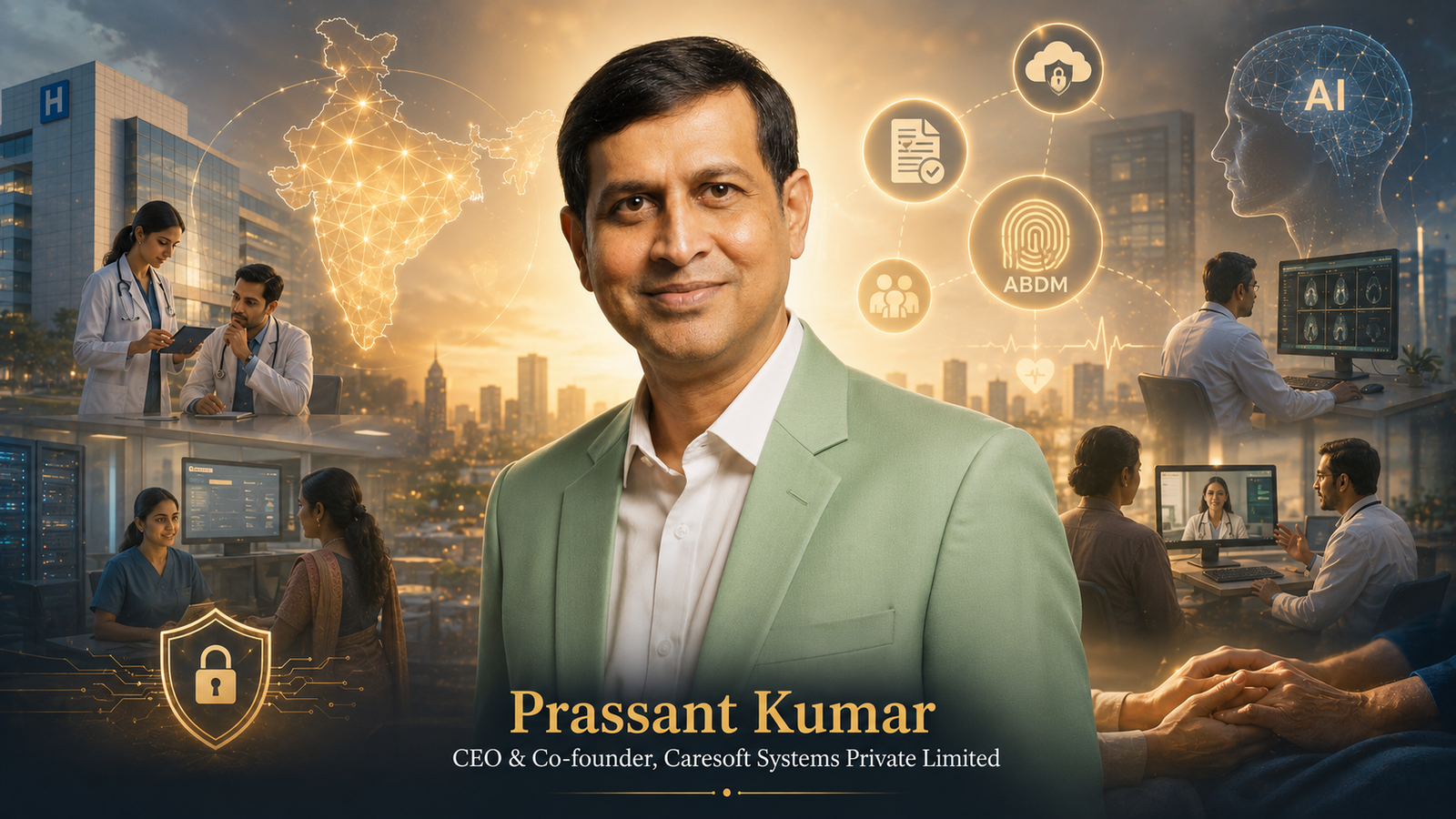
– Written by Prassant Kumar, Co-founder & CEO of Caresoft Systems Private Limited, helping over 1,000 hospitals across India accelerate their digital transformation. He is also building Vertana, an independent cancer second-opinion platform, and Medicircle. Having bootstrapped Caresoft over the past 18 years, he writes about the future of Indian healthcare, digital transformation, and the role of trust in health-tech.