What Tata Nano marketing got wrong and why one branding decision changed the fate of a revolutionary car
Looking for a Shorter Overview?
AI Summary
Key Moments
Fatal Marketing Flaw
Tata positioned the Nano as the world’s cheapest car, turning a practical solution into a status‑symbol failure.Social Stigma of Cheapness
Buyers shunned the Nano because owning a ‘cheapest’ car signaled low dignity and invited social ridicule.Missed Rebranding Window
Tata’s five‑year rebranding push arrived too late; the cheap perception was already entrenched.Core Business Lesson
Marketers must sell aspiration, not price—protecting buyer pride outweighs technical excellence.Let’s go back almost two decades and look at one automotive industry move that made the industry hold its breath. In 2008, the late Ratan Tata unveiled a one-lakh rupee miracle. It was supposed to be the first memory for millions of Indian families on four wheels. Instead, it became the ultimate case study of how to kill a brilliant product with a single word.
If you ask most people why it failed, they all have many reasons, like production delays, engine fires, or a lack of basic features. But the real failure wasn’t engineered in a factory.
The fatal flaw was baked directly into the Tata Nano marketing strategy before the first car even hit the showroom floor.
The company built an absolute engineering marvel to solve a practical problem, but they forgot they were selling it in the Indian market, where a vehicle is more than just a mode of transport; it’s a STATUS SYMBOL.
And nobody wants to drive a SYMBOL that screams they settled for the CHEAPEST.
The Tata Nano Marketing Trap
Look at the original pitch. “The People’s Car.” That was a great start. But the media and the PR machinery immediately latched onto a different phrase: “The world’s cheapest car.”
And the brand didn’t fight it. They leaned into it.
That was the exact moment the product died.
In the Indian market, you don’t upgrade from a two-wheeler to a four-wheeler just to stay dry in the monsoon. You do it to show your relatives, your neighbors, and your colleagues that you are moving up in life.
Purchasing your first car is a landmark event. It involves distributing sweets in the neighborhood and taking the vehicle to the temple for a blessing.
When your entire messaging revolves around the one-lakh price tag, you aren’t selling a car. You are selling a compromise.
Let’s talk about the Maruti 800 and the Alto. They were fundamentally the Nano’s biggest rivals in spirit. The guy balancing a family of four on a Bajaj scooter would gladly take out a high-interest loan to buy a heavily used Alto rather than pay cash for a brand-new Nano.
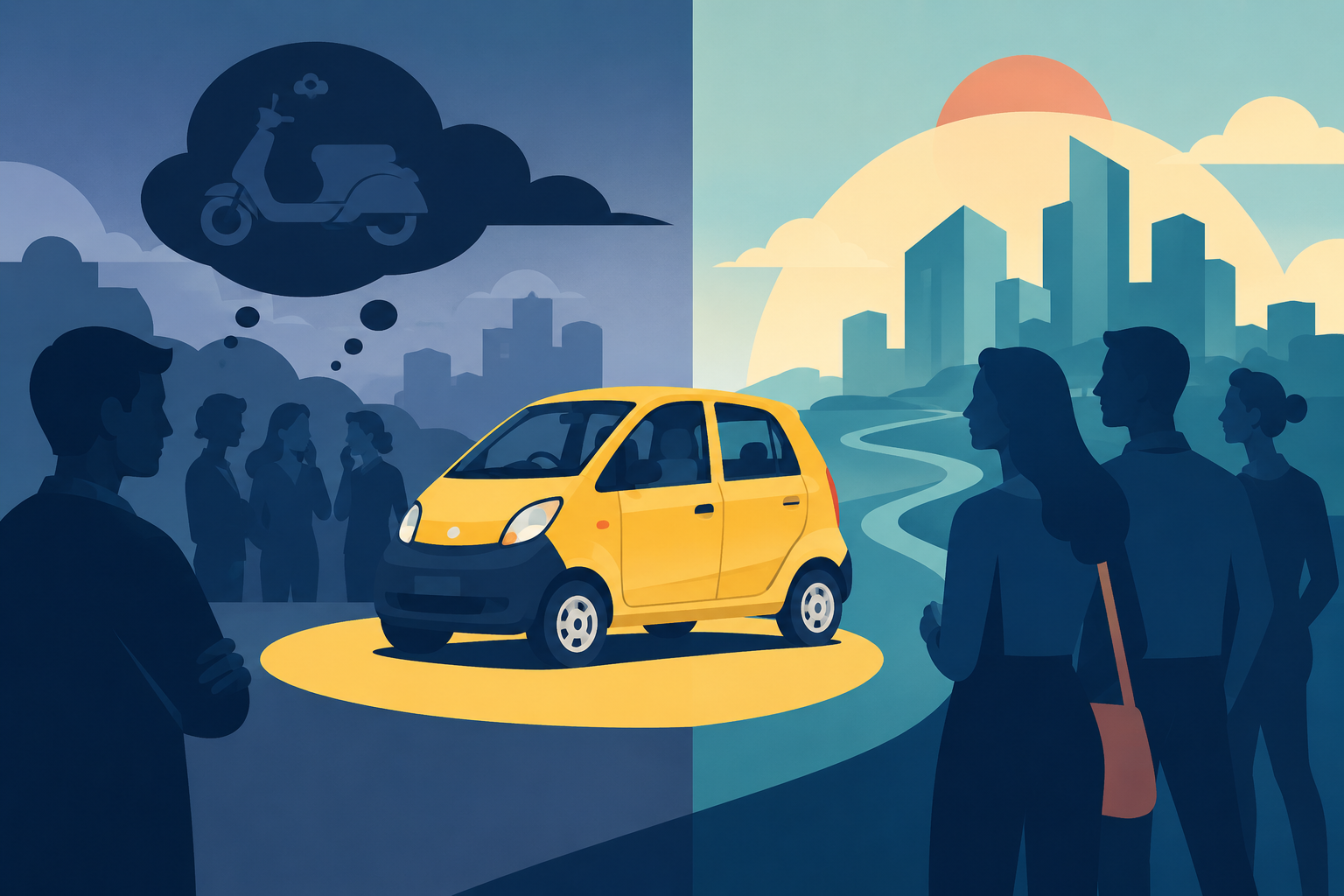
Why? Because the Alto was positioned as a legitimate car. The Nano was positioned as a scooter with doors.
The Pivot That Came Too Late
Tata Motors realized the branding disaster a few years in. They desperately tried to fix it.
They launched the Nano Twist. They added power steering, an openable tailgate (boot lid), and Bluetooth stereos. They painted it in vibrant colors like “Damson Purple” and rolled out expensive television advertisements featuring young, energetic college kids navigating urban traffic.
The goal was to reposition the vehicle as a smart, peppy city car for the youth or a convenient second car for wealthy families.
It was a brilliant strategy. But it was also five years too late.
The market had already made up its mind. In consumer psychology, once you anchor a product to a specific identity, breaking that anchor is nearly impossible. Look at KTM bikes, which got associated with funky teenage boys and people who wanted to look mature or profession ignored that bike instead of having the best specs in the segment.
So for Nano, the “cheap” label was super-glued to the bumper, and no amount of neon paint was going to cover it up. Young buyers didn’t want to be seen in it because their friends would joke that they were driving a four-wheeler auto.
The Real Takeaway for Brand Managers
Most business schools still teach the Nano as a pricing and supply-chain case study. That completely misses the point.
The lesson isn’t about pricing. It is about dignity.
You can build the most efficient, cost-effective product in your category. You can solve a massive logistical problem for your target audience. But if your messaging strips away the buyer’s pride, they will walk away.
Consumers buy products to solve problems. They buy brands to build identities.
Never market the price. Market the aspiration.
– Written by Rajnish Singh, a copywriter and strategist with a background in fast-paced journalism, who explores the gap between what brands promise and how consumers actually behave.