What does Urban Company teach about service branding? Learn how extreme operational trust builds long-term consumer loyalty.
Looking for a Shorter Overview?
AI Summary
Key Moments
From Chaos to Consistency
Urban Company replaced unreliable, hidden-cost service interactions with standardized uniforms, toolkits, and transparent pricing to build predictable trust.Uniform as Trust Signal
Clean uniforms and customized toolkits became visual guarantees that technicians were background-checked, trained, and under corporate oversight.Financial Certainty
Fixed, upfront pricing and an automated rework policy removed haggling over parts and labor, eliminating transaction anxiety.Trust-Driven Expansion
Operational trust from repairs enabled seamless entry into at‑home beauty and wellness services.Before platforms like Urban Company existed, getting a leaking pipe fixed or a broken air conditioner repaired was a psychological battle. You had to ask a neighbour for a reliable phone number.
You had to call a stranger who promised to arrive at noon but casually showed up at four in the afternoon. Once the work was finally done, you then had to aggressively negotiate the final price.
There was no accountability whatsoever. If the technician left and the next morning the pipe started leaking again, your money was gone. The unorganised service sector was defined by hidden costs, endless delays, and total unreliability.
How Urban Company Engineered Predictable Trust
This chaotic environment is exactly why the platform became a massive success. The business originally started in 2014 under the name UrbanClap.
Abhiraj Bhal, Raghav Chandra, and Varun Khaitan built an app that connects customers with local professionals for household repairs and personal care. But the three founders quickly realised that being just a digital phonebook was not enough. To truly fix the industry, they had to completely re-engineer how physical services are bought and sold.
By January 2020, they officially dropped the startup label and changed their name to ‘Urban Company’. The new title sounded settled and strictly professional, matching the exact operational direction the business was already taking.
They understood that in the home services sector, consumers were not looking for luxury or flashy advertising. They were desperately looking for consistency.
The brilliance of their strategy is rooted entirely in physical standardisation. Think about the traditional local plumber who usually shows up missing a specific wrench, forcing the homeowner to run to the hardware store halfway through the job.
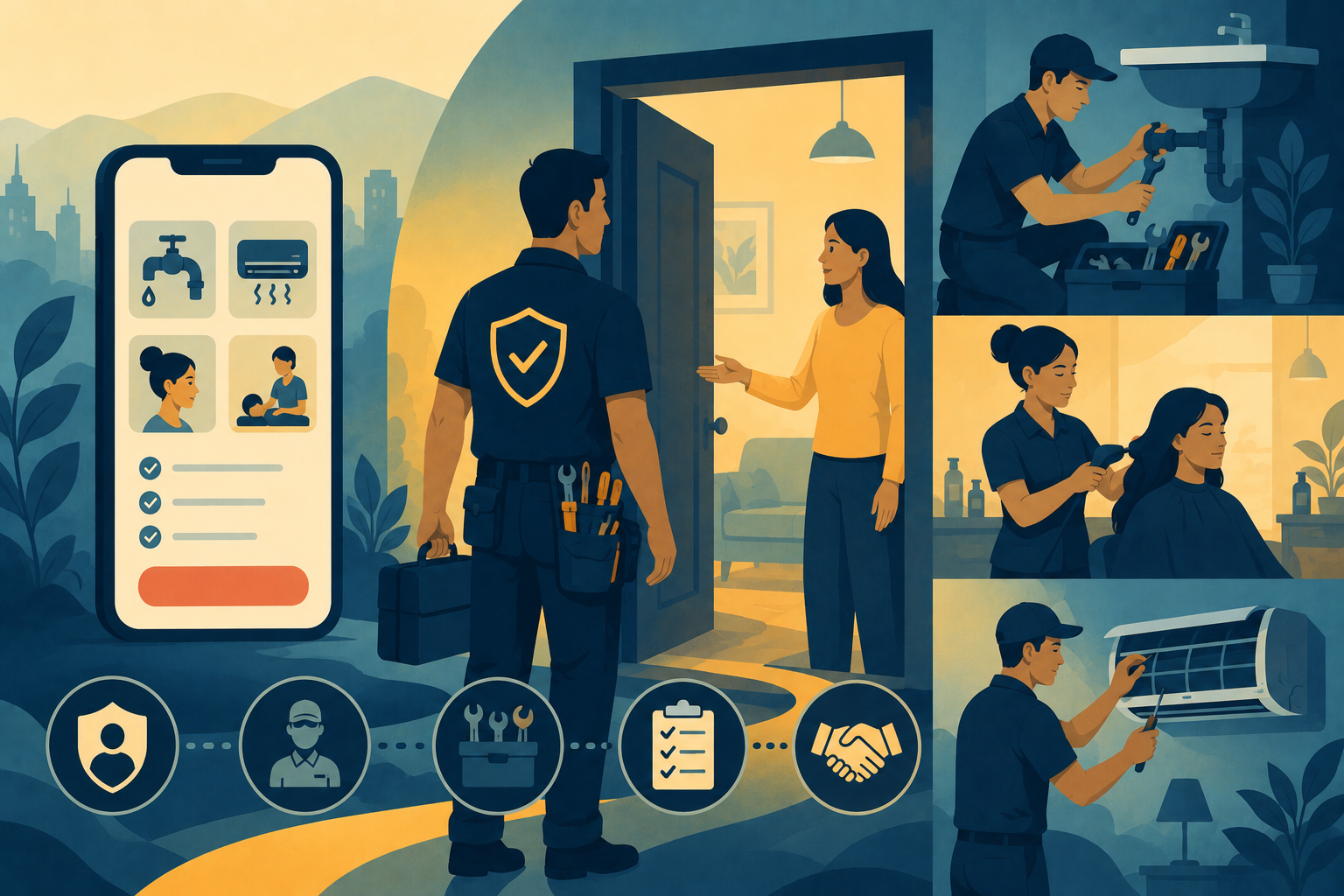
Urban Company eliminated that entire headache. When a customer books a service, the professional arrives wearing a clean uniform and carrying a customised corporate toolkit that contains exactly what is needed for that specific job.
That uniform and that toolkit are not just operational details. They are the core of the brand identity. They act as a visual guarantee that the person standing at your door has been background-checked, formally trained, and is operating under strict corporate oversight.
The business took a highly unpredictable real-world interaction and made it feel as safe and routine as ordering some clothes online.
They also completely removed the financial anxiety of the transaction. You do not have to haggle over the cost of spare parts, and you do not have to argue about labour charges. The pricing is completely transparent on the screen before the worker even leaves their house.
If an appliance repair fails a week later, the customer does not have to argue with the mechanic on the phone. There is a clear, automated rework policy built directly into the app. The brand successfully replaced neighbourhood anxiety with corporate accountability.
Expanding Through Operational Trust
This foundation of operational trust is exactly why they could successfully push into the beauty and wellness sector. Allowing a stranger into your home for a haircut, a facial, or a massage requires a tremendous amount of personal trust.
A traditional lead-generation website could never pull that off. But because customers already trusted the repair side of the business to be safe, professional, and accountable, they naturally extended that same trust to the at-home salon services.
Many tech startups try to disrupt traditional industries by simply building a faster app or a prettier website. But a slick digital interface cannot fix a broken physical transaction. If you want to dominate an unorganised service industry, you have to take total control of the messy, real-world variables.
Also read: Why Parle Branding Has Endured for Generations
True service branding does not happen on a billboard. It happens the exact moment the doorbell rings. If a business can remove the anxiety from a physical transaction, the customer will never go back to the old way of doing things.
—Written by Rajnish Singh, a copywriter and strategist with a background in fast-paced journalism, who explores the gap between what brands promise and how consumers actually behave.