Most companies chase trends, but Parle branding thrives on consistency. Learn why refusing to rebrand is their ultimate strategy.
Looking for a Shorter Overview?
AI Summary
Key Moments
Refusal to Change
Parle dominates by staying unchanged, refusing price hikes and product updates for decades.Price Stability
Management kept the Parle‑G price at five rupees for over 25 years, even reducing biscuit weight to protect affordability.Visual Consistency
The unchanged yellow‑white wrapper and design build deep consumer trust and emotional connection.Crisis Reliance
During the 2020 lockdown, Parle‑G sales surged, proving its role as an essential household utility.The legacy of Parle branding began in 1928 when Mohanlal Dayal set up the House of Parle. A year later, he opened his first factory in the Vile Parle neighbourhood of Mumbai, making basic confectionery with exactly twelve family members as employees. The ‘Parle’ name was taken from the local area.
Today, that same business produces the highest-selling biscuit on the planet. Most modern executives assume that reaching global dominance requires constant reinvention, massive acquisitions, and expensive advertising campaigns.
But the foundation of Parle branding is built on a completely different set of rules. They dominated the market by simply refusing to change.
Quiet Usefulness of Parle Branding
The company spent its first decade making sweets, but in 1939, they used ovens to bake the first batch of biscuits and called them Parle Gluco. Over time, as buyers naturally shortened the name, it settled as Parle-G.
The “G” originally stood for glucose. Later marketing campaigns cleverly linked the letter to the idea of “genius”, but they never tried to make the physical product clever, and they kept it simple.
Even as the parent company expanded aggressively into premium sweets, modern wafers, and other branded snacks over the decades, that simple glucose biscuit remained the absolute centre of their corporate identity.
Newer variants appeared on the market, yet the original kept selling in massive numbers. The brand did not need constant reinvention because its original promise still matched exactly what people wanted: something affordable, highly familiar, and physically available everywhere.
Most fast-moving consumer goods companies operate in a state of desperation. They are terrified of boring their buyers. To stay relevant, they constantly change their packaging dimensions or introduce limited-edition seasonal flavours.
Parle proved this corporate anxiety completely wrong. Instead of chasing market trends, the company turned their primary biscuit into a fixed economic anchor.
For over twenty-five years, management refused to raise the base price of a standard Parle-G pack above five rupees.
When global inflation hit and the raw costs of wheat, sugar, and packaging rose, they did not pass that financial burden on to customers. Instead, the company quietly reduced the biscuit’s physical weight by just a few grams over time.
That operational decision is brilliant consumer psychology. A daily wage worker or a college student does not weigh a biscuit pack on a scale. They just know they can hand a single five-rupee coin to a local shopkeeper and get their morning snack.
By protecting that specific price point for decades, Parle stopped being just a commercial product and became a dependable utility.
Visual Trust and Emotional Connection
This stubborn consistency applies directly to their visual identity. If you look closely at the packaging, the font is basic, and the illustration of the little girl is outdated. A modern advertising agency would beg the company to update it and make it look premium.
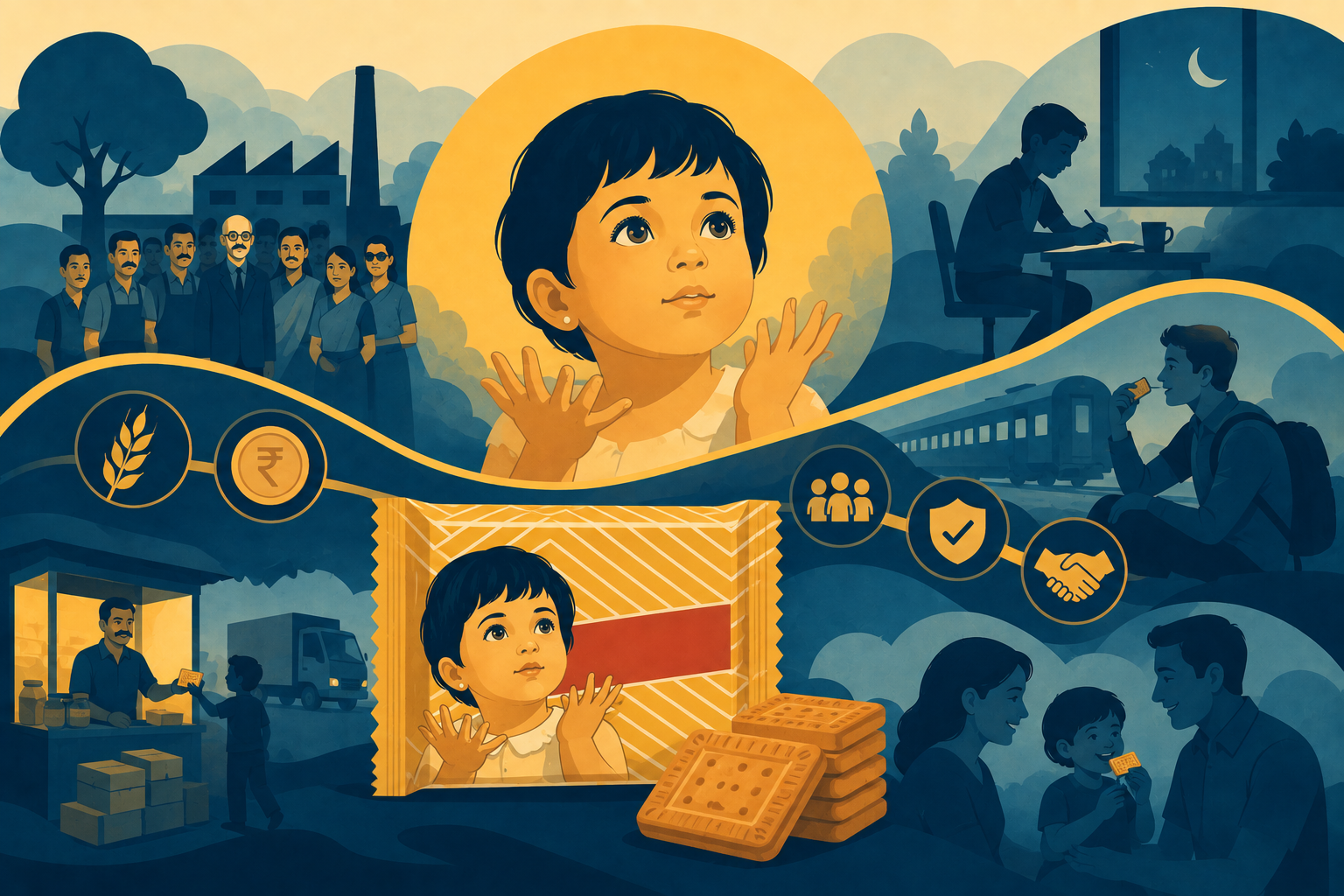
But changing that yellow and white wrapper would instantly destroy over eighty years of built-in visual trust.
That untouched visual identity created absolute consumer trust. For millions of Indians, the biscuit is permanently linked to simple moments. It is the default snack for studying late into the night, long train journeys, recovering from an illness, or simply sharing something small with the family.
Parle branding never claimed to be a luxury lifestyle choice. It simply stayed useful and present. That kind of quiet, reliable usefulness creates a completely different sort of consumer loyalty than flashy, trend-driven products.
You saw the exact power of this strategy during the 2020 national lockdown. When global supply chains collapsed and grocery stores emptied, Parle-G recorded its highest sales volume in its 82-year history.
People did not stockpile the biscuit because of a clever digital campaign. They bought it because they trusted it completely and because the company had spent decades building a vast distribution network to the deepest parts of the country.
Also read: When Brand Migration Is Better Than Rebranding
Modern executives often waste millions trying to disrupt their own industries just to grab a headline. But true brand endurance rarely comes from flashy innovation. It is built on extreme operational discipline.
Once you figure out exactly why a customer relies on you, you lock that variable in place and protect it against every passing trend. Sometimes, the most profitable marketing decision a company can make is simply refusing to change.
–Written by Rajnish Singh, a copywriter and strategist with a background in fast-paced journalism, who explores the gap between what brands promise and how consumers actually behave.