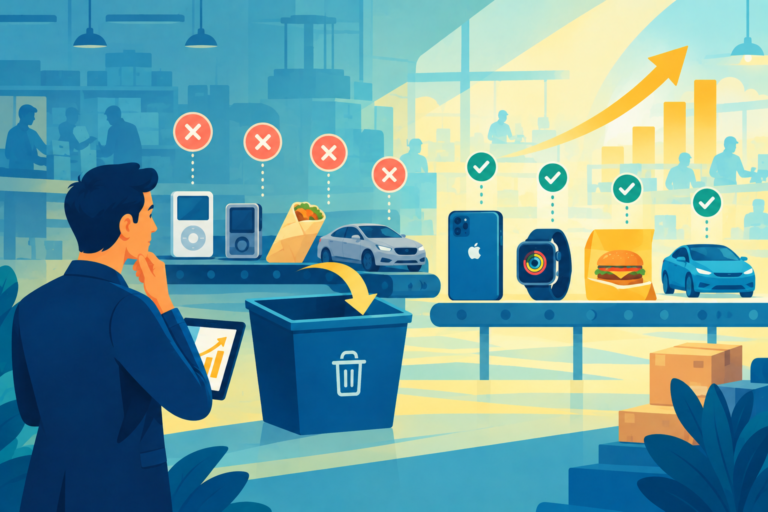
Why do buyers choose "new" even when the tech is identical? See how perceived innovation drives massive market share.
Looking for a Shorter Overview?
AI Summary
Key Moments
Perceived Innovation Boosts Sales
Small visual upgrades make users feel a product is newer and superior, driving higher purchase willingness.Consumer Psychology at Play
Buyers assume advanced features signal overall product quality, leading them to choose the upgraded version.Maintain Core Quality
Brands must ensure real product performance remains strong while adding perceived innovations.Continuous Freshness Required
Regular, visible updates keep a brand exciting and attract customers without major tech overhauls.People love buying the latest version of their favourite gadgets, even when there is no major upgrade. Buyers happily pay lakhs of rupees for a new smartphone even if the only real difference from last year’s model is a slightly bigger camera lens or a 10% better processor. This is perceived innovation in action.
Yet, the buyer proudly shows it off to friends, feeling completely satisfied. The phone did not go through a massive technical upgrade, but it feels fresh to the user. This psychological reaction is what marketers call ‘perceived innovation’. When a company masters perceived innovation, it does not need to invent completely new technology every year to stay successful.
Psychology Behind Perceived Innovation
The Indian car market shows exactly how this strategy works. A family decides to buy a mid-size SUV and takes test drives from two different brands. Both cars have identical engine power, similar mileage, and the same safety ratings. But one car has a huge digital screen on the dashboard and a button that opens the sunroof with voice control.
Even if the driver never uses the voice command in daily life, he will choose that model. The brand wins the sale purely through perceived innovation. The buyer automatically assumes that a company making advanced touch screens must also be building better, safer engines. That simple visual upgrade creates a feeling of total superiority without changing the car’s actual specs.
This same logic applies to basic daily grocery items, like liquid hand wash. For a long time, people bought standard liquid soap in normal plastic bottles. Then, a brand introduced a special pump that turned the liquid into thick white foam when it came out. The actual cleaning chemical inside the bottle did not change at all. It was just a smart mechanical pump.
However, this small change created perceived innovation in the minds of the buyers. Parents get the feeling that they are buying a superior, more hygienic product for their children. Sales of that hand wash increased because the product seemed highly advanced. It proved that how a product looks and dispenses matters just as much as what is inside.
Service companies also use this method to keep their young customers happy. Consider a traditional bank. The basic software that transfers money remains exactly the same. But if the bank updates its mobile app with a sleek dark mode, smooth animations, and a colourful monthly spending tracker, users are highly impressed.
They feel their bank is a modern tech leader. This perceived innovation stops them from leaving that app for any other simple app.
A business that ignores this psychology often struggles, even when its product is excellent. A strong, durable mixer grinder may look the same for twenty years, and it may even have the best motor in the market. But if a rival brand adds a stylish touch panel and a digital timer, the modern buyer will quickly switch over.
Families buying appliances for a new kitchen want everything to look modern, and they’ll happily pay extra for that digital display. The old brand starts losing customers because it completely lacks perceived innovation. Consumers naturally assume that old packaging means old, outdated technology inside.
Creating perceived innovation is not about deceiving customers with poor quality. The product itself still has to work perfectly well. Companies just need to understand that buyers get bored very quickly. People want to feel smart and up to date when they spend money. By adding a small, visible modern feature, a brand signals that it is always improving.
Also read: Why Consumer Confidence Cycles Affect Brand Growth
A company does not need a huge research budget to stay a top choice. It only needs to show buyers something fresh on a regular basis. Consistently delivering perceived innovation keeps the brand exciting, ensuring the business keeps attracting buyers year after year.
Loved this article? Read more insightful articles on Brand Custodian.
–Written by Rajnish Singh, a copywriter and strategist with a background in fast-paced journalism, who explores the gap between what brands promise and how consumers actually behave.