Stop worrying about your competitors. Learn how Amazon used relentless customer obsession to build a trillion-dollar empire.
Looking for a Shorter Overview?
AI Summary
Key Moments
The Empty Chair Symbol
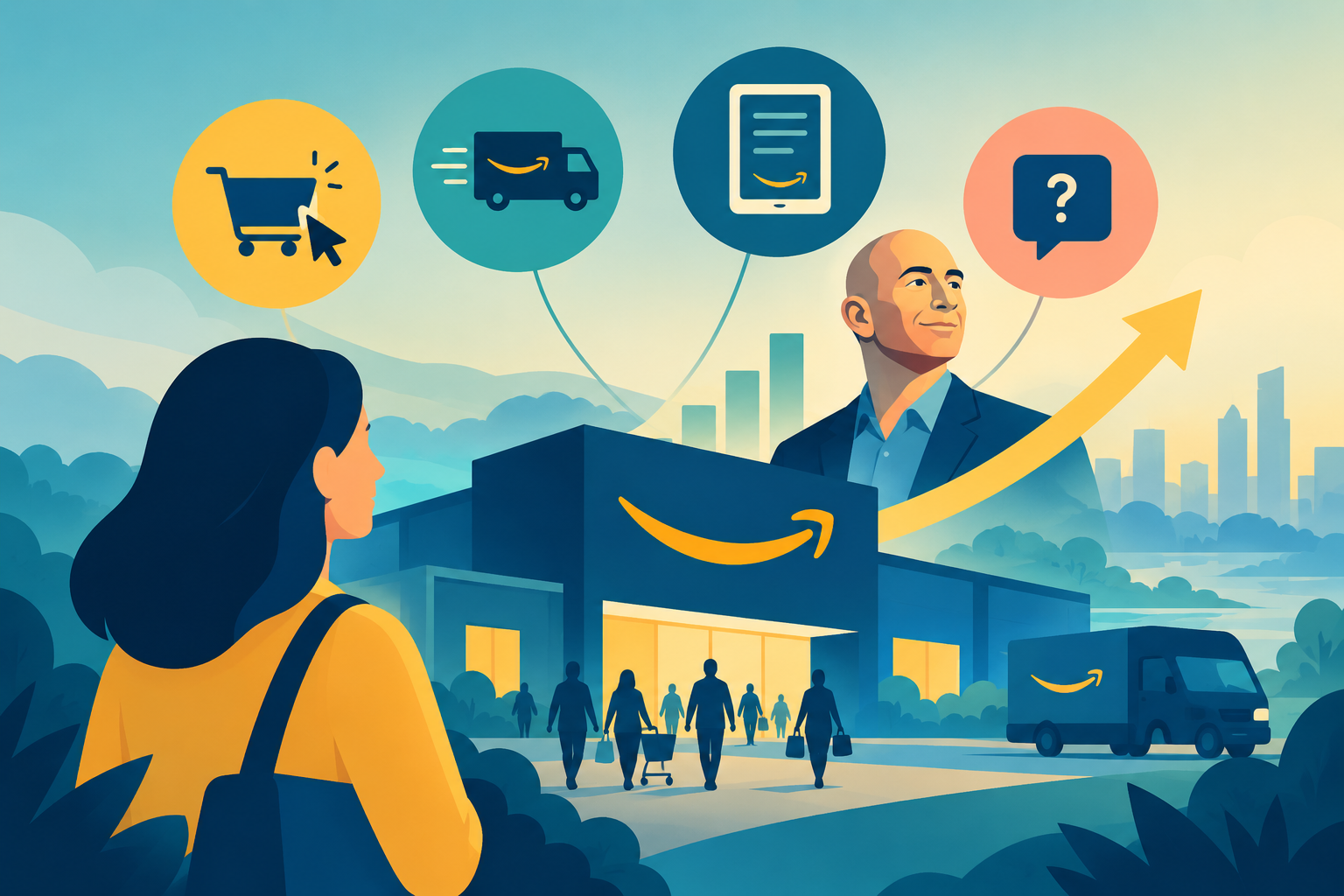
Bezos leaves a seat for the customer, making customer focus the core principle.One-Click Checkout
Amazon introduced a single-click purchase button to eliminate checkout friction.Amazon Prime Free Shipping
A $79 yearly fee unlocked two-day free delivery, solving cost concerns and driving massive subscription growth.Kindle Instant Access
The Kindle device aimed to let users start reading any book within 60 seconds, embodying rapid customer gratification.Amazon founder Jeff Bezos always kept an empty chair at high-level executive and strategy meetings. He made it clear to his team that the chair belonged to “the most important person in the room”—the customer. This simple office habit reflects the true meaning of customer obsession.
A smart shop owner makes every business decision by first considering what the buyer actually wants. Many years ago, Bezos built this giant digital shop on that simple rule. He did not look at rival shops. Instead, he focused only on that invisible customer sitting on that chair.
How Customer Obsession Brings In More Money
In 1994, Amazon sold only paper books. Buyers had to manually enter their home address and bank numbers, which made buying a book take a very long time. Bezos hated making buyers wait, so he asked his employees to fix the slow process. In 1997, they built a digital button that bought the book with just one click.
This simple digital button was an early sign of customer obsession. Its owner paid a huge sum for the legal rights to this one-click button. He knew that requiring buyers to type fewer words would make them buy more books. And slowly, Amazon moved into selling almost everything online.
By 2005, buyers began complaining about delivery costs. One person hated paying extra to have a cardboard box delivered to his home. Other digital shops ignored these complaints because shipping heavy boxes is very expensive.
But the Amazon owner used strict customer obsession to solve the problem. He asked buyers to pay seventy-nine dollars once a year. In return, factory workers would deliver the products to the buyer’s house in exactly two days for free.
Office accountants thought the two-day shipping rule was a terrible idea. They said the company would lose millions of dollars by paying for fast delivery trucks. But Bezos ignored the math. He knew that Customer Obsession meant giving buyers exactly what they wanted right away, and he was completely right.
Buyers knew that Amazon Prime for $79 was well worth it. They stopped going to physical supermarkets and began buying nearly every household item directly on their phones. Today, more than 200 million people pay for this fast-shipping service each year.
The bosses also looked closely at how people read paper books. A buyer holding a thick paper book enjoys the feel of the pages. But he hates driving to a physical shop in the rain to buy a new one.
The managers used a strict rule to solve this problem. In 2007, they built a small, tablet-like screen called a Kindle. Bezos gave his workers a very challenging job: a user must be able to buy a digital book and start reading it in exactly sixty seconds. They built the machine to connect to phone towers for free just to meet this exact time limit. This sixty-second rule is pure Customer Obsession.
Jeff also keeps a public email address, so any regular buyer can send a complaint directly to him. If a buyer or third-party merchant points out a real flaw in the Amazin network, the boss reads the message and then forwards it to his office workers with a single question mark, “?”. That simply means, “Can you look into this? Why is this happening?” This small office habit shows that Customer Obsession is real.
A company using this rule does not hide from angry buyers. It forces the workers to take the negative reviews seriously.
Many new computer shops try to build websites with bright colours. They waste money trying to copy rival websites. But Amazon hired thousands of workers and made billions in cash by ignoring other shops altogether.
Also read: Reddit: How User Communities Became the Product
This huge financial success shows exactly why Customer Obsession works better than anything else. A business can attract millions of daily buyers simply by putting the buyer in an empty office chair. Amazon makes money today because strict Customer Obsession pushes workers to give the buyer exactly what they want.
Loved this article? Read more insightful articles on Brand Custodian.
–Written by Rajnish Singh, a copywriter and strategist with a background in fast-paced journalism, who explores the gap between what brands promise and how consumers actually behave.