What is a mental shortcut? Learn how the human brain relies on quick emotional decisions to make everyday purchases.
Looking for a Shorter Overview?
AI Summary
Key Moments
Price as Quality Signal
Consumers automatically associate higher prices with superior product quality, driving purchasing decisions.Anchoring Effect
Showing premium-priced items first makes subsequent options seem like better value comparisons.Urgency Creation
Limited stock indicators trigger fear of missing out, compelling immediate purchase decisions.Social Proof Influence
Crowded spaces and positive reviews lead consumers to assume better quality through collective validation.A normal person makes thousands of choices every single day. If someone actually thought and analysed every single decision, their brain would shut down from exhaustion.
To survive this daily overload, the human brain relies on a quick decision-making mechanism called mental shortcuts. While these shortcuts help people get through a busy schedule, they also secretly drive almost every shopping habit.
Marketers know exactly how these mental shortcuts work, and they build entire business strategies around them.
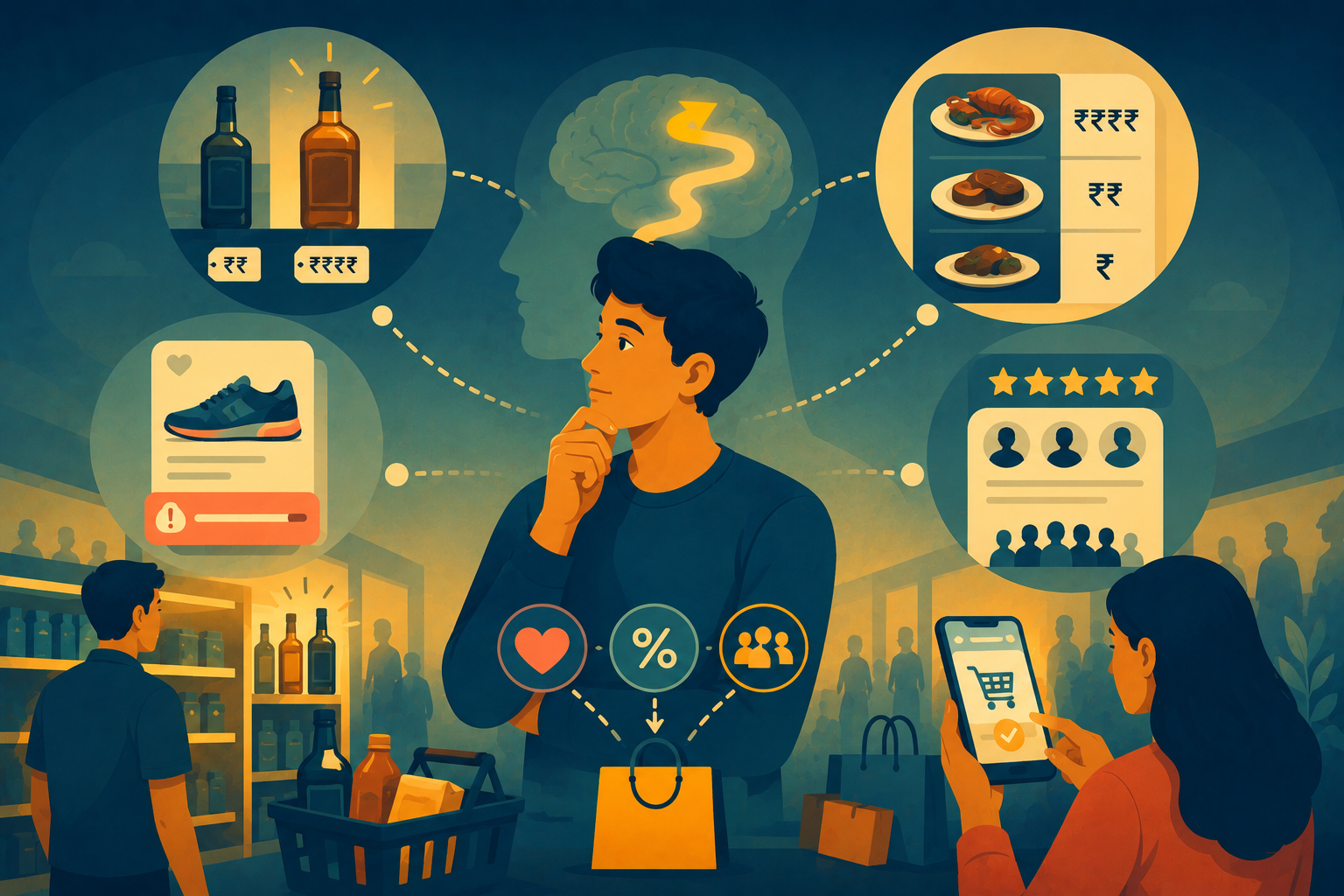
To see how this works in real life, visit any liquor store. Most shoppers know very little about ageing, soil types, or regional climates. When buyers face a massive wall of glass bottles, they need a quick way to choose a good one. Instead of comparing two whisky bottles on a phone, they rely on one of the most common mental shortcuts: the price tag.
If one bottle costs 1000 rupees and another costs 5500 rupees, the brain assumes the expensive one tastes much better. Many cosmetics and beverage companies set higher prices just to trigger this exact reaction, knowing that people naturally link a high cost with high quality.
How Mental Shortcuts Control Buyers
Another major driver of consumer behaviour is anchoring. This happens when a business shows a very high price first, making everything else seem cheap by comparison. Look at a menu in a fancy restaurant. They will often place an expensive seafood platter at the top of the menu.
Very few people actually order it. But seeing that high price creates a starting point in the mind. Suddenly, a normal steak sitting lower down the page feels like a smart bargain.
This works in electronics stores too. A retailer will place a lakh-rupee television right at the entrance. After seeing that huge price tag, a 40,000-rupee television feels like a highly responsible financial decision. The business intentionally uses this visual trick to make customers feel comfortable spending a bit more than they originally planned.
Online shopping platforms rely heavily on a different set of mental shortcuts related to fear and urgency. When a shopper looks at a pair of sneakers online, a tiny line of red text often appears saying there are only a few items left in stock. This creates instant panic.
The brain stops thinking about whether the item is actually needed or fits the budget. Instead, the fear of missing out takes over completely and forces a quick click of the buy button before it gets out of stock.
Social Proof and the Crowd Effect
Crowds also influence people’s buying decisions on a daily basis. If two coffee shops sit right next to each other, and one has a line out the door while the other is empty, a new customer will naturally join the long line. The brain assumes the crowded shop makes better coffee.
This dependence on the crowd is one of the strongest biases in human psychology. This is why websites highlight best-selling items or show thousands of five-star ratings next to a product picture.
When a person feels unsure about a product, these mental shortcuts provide assurance by showing that hundreds of other people have already made the same choice.
Also read: Why Tanishq Branding Rebuilt Consumer Trust
Businesses do not need to trick people into buying things. They simply need to design their stores and websites to align with how the human brain naturally works. The smartest brands know that shopping is rarely a logical process. It is almost entirely emotional and impulsive.
By understanding how mental shortcuts operate, a brand can gently guide a buyer toward the checkout without relying on heavy discounts.
Loved this article? Read more insightful articles on Brand Custodian.
–Written by Rajnish Singh, a copywriter and strategist with a background in fast-paced journalism, who explores the gap between what brands promise and how consumers actually behave.