Why Marketing Funnels no longer reflect real consumer behaviour and what brands should understand about modern buying journeys.
Looking for a Shorter Overview?
AI Summary
Key Moments
Funnels No Longer Reflect Reality
Traditional marketing funnels don't match how consumers actually research and buy products today.Dynamic Multi-Channel Journeys
Consumers constantly move between devices, platforms, and information sources during their buying process.AI and Information Overload
Artificial intelligence and endless online content have made buying journeys non-linear and unpredictable.Shift to Customer-Centric Strategies
Marketers must focus on being present when consumers are ready rather than forcing them through predefined stages.For decades, Marketing Funnels have been one of the most widely used frameworks in marketing. The logic is simple: consumers first become aware of a brand, then consider it, develop intent, and eventually make a purchase. It is easy to understand, easy to present in boardrooms, and useful for organising marketing activities.
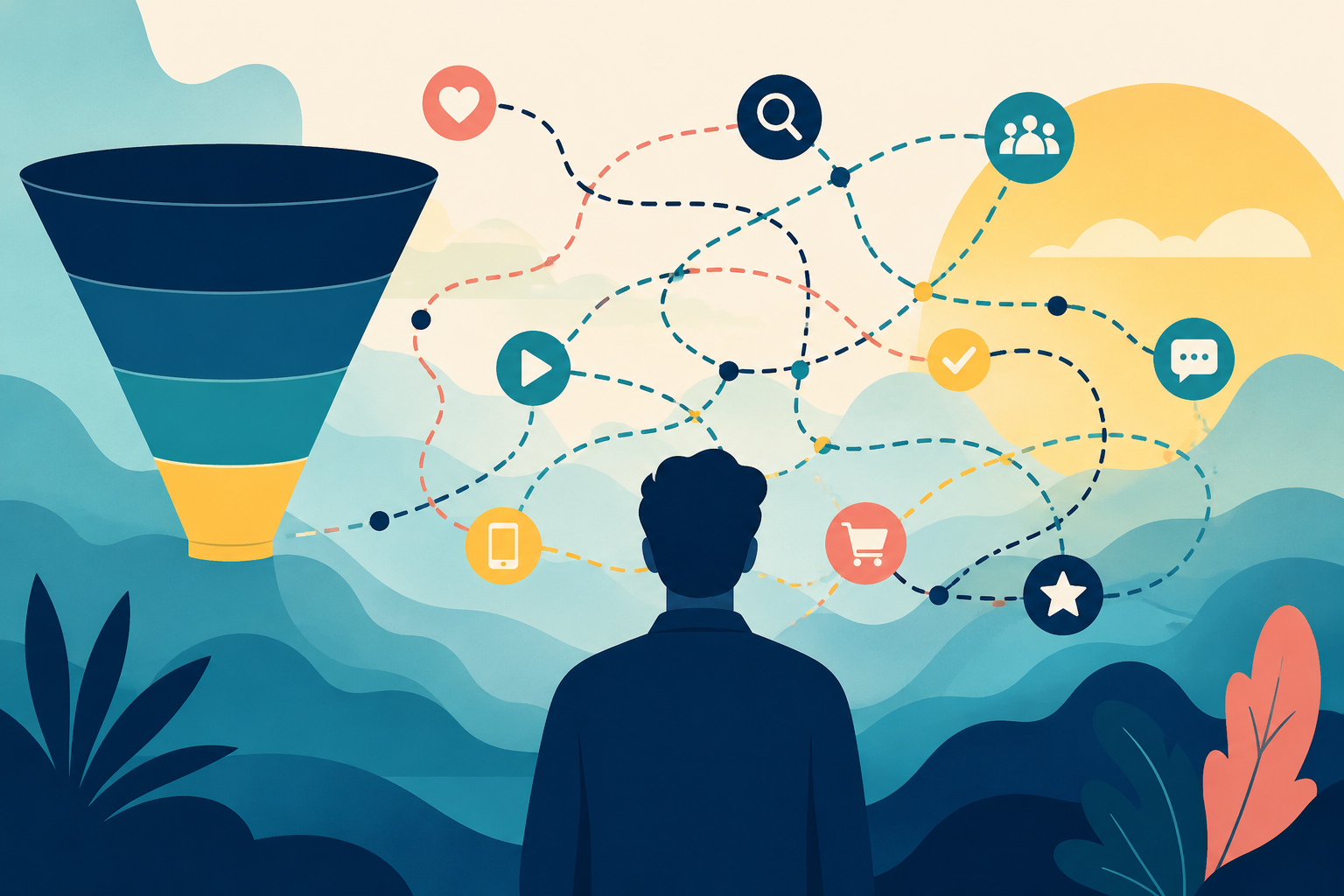
The problem is that consumers rarely behave this way anymore. The digital age has fundamentally changed how people discover, research and buy products. Someone may see a product on Instagram, ignore it, encounter it again through an influencer, read reviews a week later, compare prices on multiple websites, ask ChatGPT for recommendations and only make a purchase months afterwards. Others may purchase after a single recommendation from a trusted friend without following any recognisable sequence at all.
That doesn’t mean the funnel has become useless. It remains a valuable planning framework. However, treating it as a literal representation of consumer behaviour can lead marketers to misunderstand how buying decisions are actually made.
Why Marketing Funnels No Longer Match Consumer Reality
Traditional marketing funnels assume that consumers move forward in a predictable order. Real purchasing behaviour is far more dynamic.
Today’s buyers constantly move between channels, devices and information sources. They pause their research, return weeks later, compare competitors, abandon shopping carts, revisit earlier content and often repeat this process several times before making a decision. Rather than progressing neatly from awareness to purchase, they create their own path based on their needs, timing and circumstances.
The sheer amount of information available has changed the balance of power. Consumers no longer rely primarily on what brands tell them. They consult online reviews, YouTube videos, Reddit discussions, comparison websites, AI assistants, social media creators and recommendations from friends before reaching a conclusion. Every one of these interactions can influence their decision, regardless of where marketers believe they sit in the funnel.
The rise of AI has made these journeys even less linear. Instead of visiting multiple websites, consumers increasingly ask conversational AI tools for product recommendations, comparisons, and summaries. This compresses parts of the traditional buying journey while expanding others, making it even harder to identify a fixed sequence of steps.
Another reason the funnel falls short is that buying decisions are rarely rational from beginning to end. Emotion, trust, convenience, price changes, availability, and even timing influence whether someone buys. A consumer may be fully convinced about a product but delay the purchase until payday. Another may abandon a purchase after discovering a better review moments before checkout. These behaviours do not fit neatly into predefined stages.
Also read: What Duolingo Brand Voice Teaches About Standing Out
This doesn’t mean marketers should abandon marketing funnels altogether. Their real value lies in helping teams organise campaigns, align messaging and measure broad business performance. They provide a shared language for planning, but they should not be mistaken for an accurate map of how every customer behaves.
Increasingly, marketers are shifting towards customer journeys, influence maps and behavioural flows rather than rigid funnels. These approaches recognise that consumers can enter at any point, revisit previous interactions and move between channels without following a prescribed order. The objective is no longer to push people through stages but to be present whenever they are ready to engage.
This shift also changes how success is measured. Instead of focusing solely on moving people from one funnel stage to the next, marketers are placing greater emphasis on understanding intent, creating consistent experiences across touchpoints, and building long-term relationships. The question is becoming less about where customers are in the funnel and more about what information or reassurance they need at that moment.
Ultimately, consumers have never cared about marketing frameworks. They simply look for solutions when a need arises. Sometimes the decision takes minutes. Sometimes it takes months. Sometimes it begins with a social media post and ends with an AI recommendation or a friend’s opinion.
Marketing funnels remain useful as a strategic model, but they are no longer an accurate reflection of real consumer behaviour. Brands that recognise the complexity of modern buying journeys and build flexible, customer-first experiences will be far better positioned than those still expecting every customer to move through a perfectly shaped funnel.