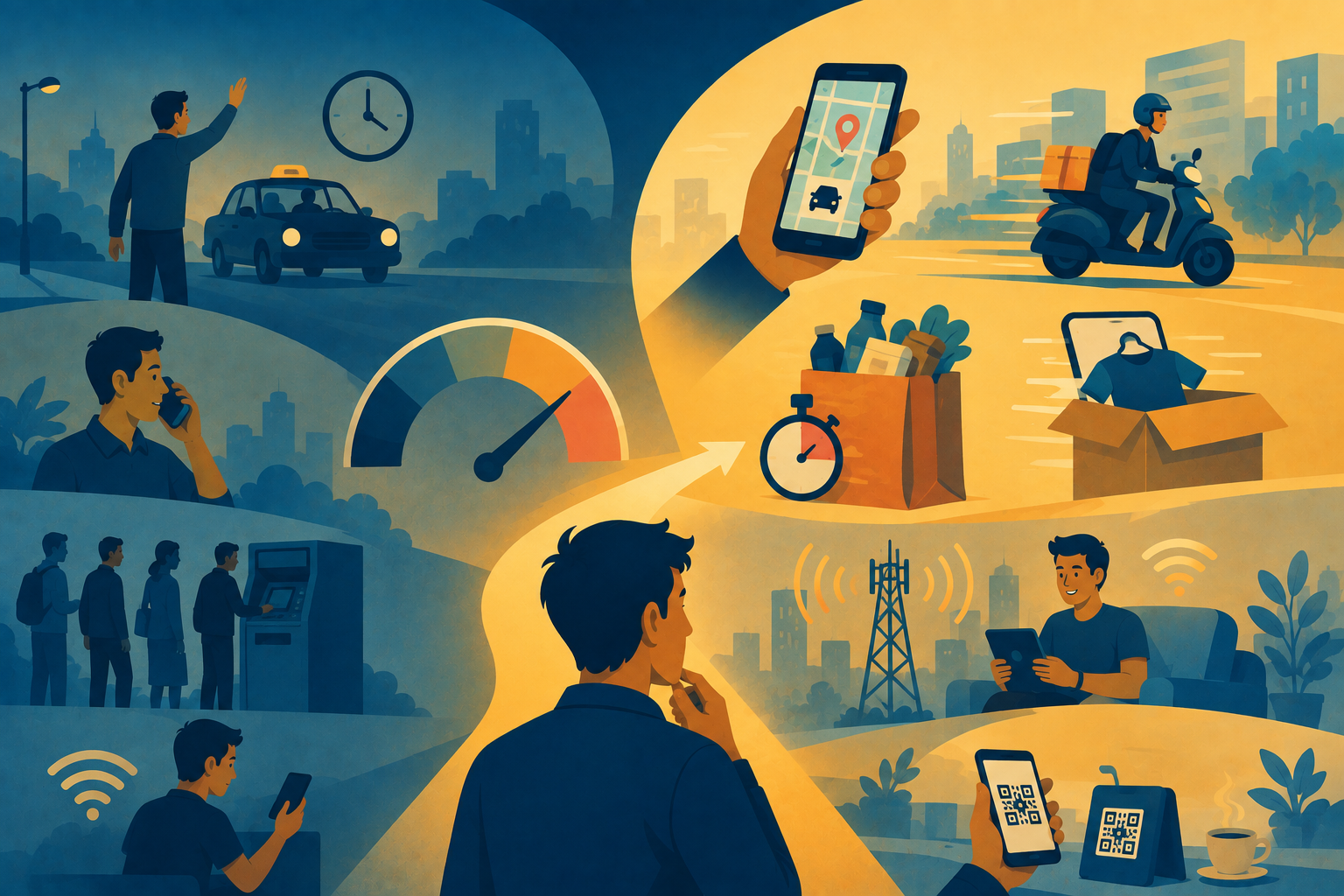
Faster delivery and instant payments are the new standard. See why consumer expectations dictate your business survival.
Looking for a Shorter Overview?
AI Summary
Key Moments
Fast Delivery Redefines Speed
Grocery and other delivery apps now arrive within minutes, raising consumer patience thresholds.Jio’s Free High‑Speed Data Erases Data‑Saving Habits
The Reliance Jio launch made limited data plans seem absurd, forcing telecom price wars.QR Payments Replace Cash in Daily Life
UPI QR codes at even tea stalls become mandatory, making cash‑only outlets unattractive.Brands Must Continuously Upgrade or Risk Obsolescence
Companies that cling to old features lose relevance as buyers compare with the fastest apps.Waiting for a cab once was completely normal. A person would call a local taxi stand, agree on a price, and still wait for thirty minutes without getting upset. It was the norm. But then consumer expectations got a reset.
Now, if a booking app shows that the driver is eight minutes away, that same person may feel uneasy and cancel the ride to find a closer one. The actual wait is much shorter than it was in the old days, but still people feel far more restless.
This sudden impatience is not a personality problem. It appears because a completely new standard has been set in the buyer’s mind. When a brand introduces a faster or easier way to do things, an expectation reset happens immediately. If a business does not understand how an expectation reset changes daily habits, it will quickly lose its customers.
Why Consumer Expectations Change Everything
Look closely at India’s fast grocery market right now. When someone orders through these delivery apps, it arrives within 8-10 minutes. And it’s not just grocery items; almost anything, from clothes to gadgets, can be delivered within hours. That’s how fast deliveries have become these days.
Because deliveries are so fast now, the buyer goes through an expectation reset. Now, if another shopping app says delivery will take two days, people will simply close the app. Items are exactly the same in both places. However, any basic tolerance for waiting is completely gone.
We saw a major shift in mobile internet back in 2016. Before then, the average smartphone user would quickly switch off mobile data just to save a few megabytes. Watching a full movie or a long YouTube video on a phone without Wi-Fi felt impossible for most people. Then, Reliance launched ‘Jio’, which offered free, high-speed internet to everyone.
Almost overnight, the habit of being extra cautious to save internet data disappeared. This move triggered an expectation reset across the entire country. Suddenly, offering someone 1 GB of data for an entire month seemed like a bad joke. Rival telecom operators had to lower their prices immediately because customers simply refused to return to the old days.
The same behavioural shift happened with daily payments. Standing in a long line at the local ATM to withdraw cash was once a normal weekend routine. Today, people confidently travel anywhere in the country without their wallets.
If a roadside tea stall does not have a UPI QR code scanner on the counter, customers will just walk to the next stall. A quick scan from a smartphone caused a massive expectation reset in the retail market.
Nobody wants to carry cash in their pockets anymore. Dealing with this expectation reset means a business must adapt to this new, easy way of paying or lose its daily sales completely.
Trap of Past Achievements
Many older brands struggle to survive because they ignore consumer expectations. They proudly advertise features that were impressive five years ago. But buyers do not care about past achievements. They judge every service by the fastest app on their phone.
A customer naturally thinks, if my groceries arrive in ten minutes, why does my bank transfer take two hours to process? Once a buyer goes through an expectation reset, they get addicted and demand the same speed everywhere.
A smart business never fights consumer expectations. It watches the market closely and upgrades its own systems before customers start complaining. Every time any competitor introduces a better feature, a fresh expectation reset happens in the buyer’s mind.
Also read: How Customer Participation Strengthens Brands
A successful brand accepts that what was special yesterday is a basic need today. By preparing for the next expectation reset, a company ensures it never gets left behind.
Loved this article? Read more insightful articles on Brand Custodian.
–Written by Rajnish Singh, a copywriter and strategist with a background in fast-paced journalism, who explores the gap between what brands promise and how consumers actually behave.