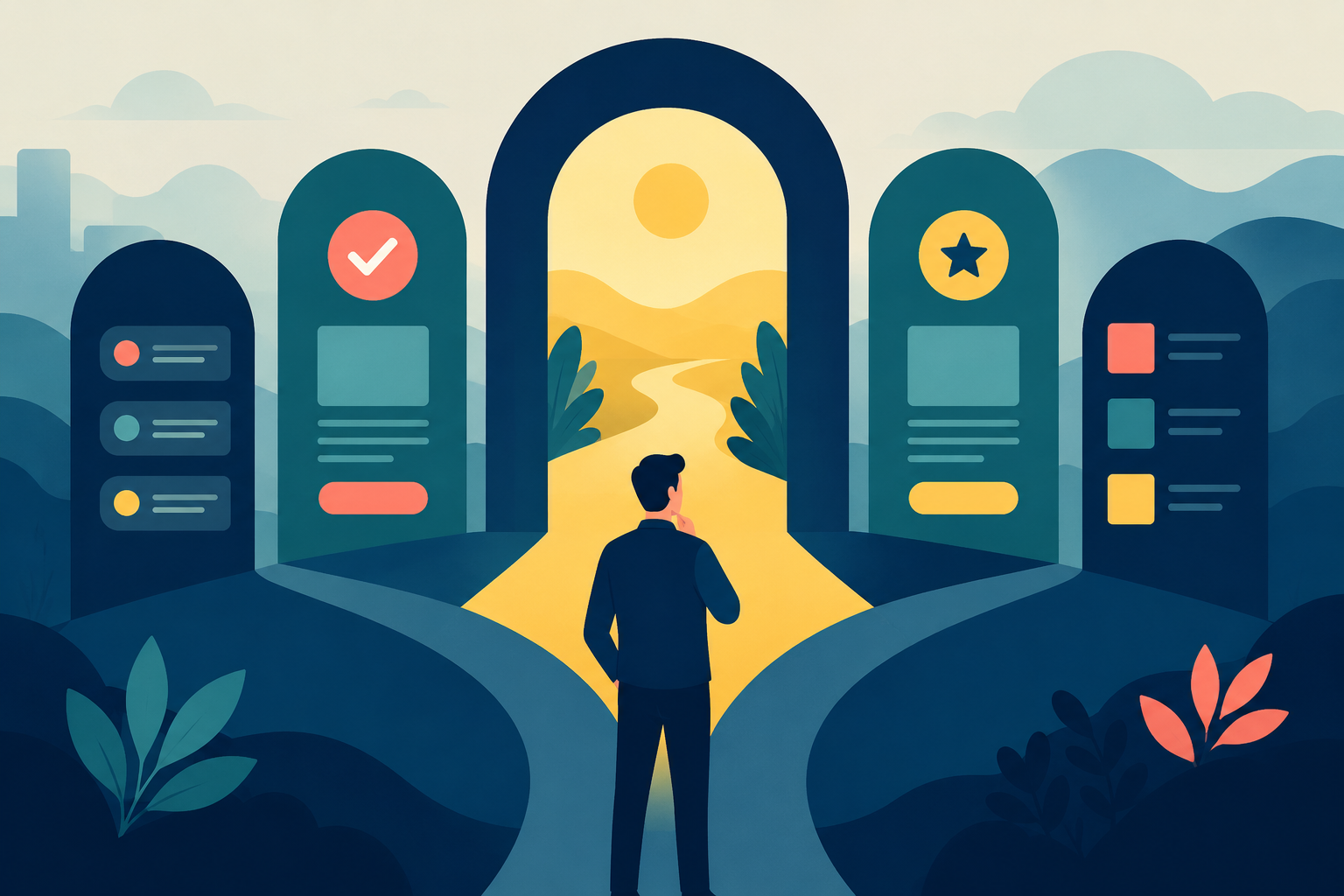
Choice Architecture helps brands simplify decisions, reduce friction and create customer journeys that make choosing easier.
Looking for a Shorter Overview?
AI Summary
Key Moments
Reducing Decision Complexity
Too many options overwhelm customers, making decisions harder and causing delays in choice-making.Power of Defaults
Pre-selected options act as starting points that make decisions easier, especially for uncertain customers.Framing Influence
How information is presented affects interpretation and decision outcomes, even when core content remains unchanged.Ethical Boundaries
Choice Architecture must avoid dark patterns and ensure clear information, keeping decisions genuinely customer-centric.Customers make decisions all day, but not every decision is as rational or deliberate as businesses often assume. The way options are presented, the order in which they appear, the information customers see first, and even the number of choices available can influence what they ultimately choose. This is where Choice Architecture becomes important. It is not about taking choices away from people. Instead, it is about designing the environment around a decision so that customers can understand their options, feel less overwhelmed, and move towards a decision with greater confidence.
How Choice Architecture Makes Decisions Easier
At its simplest, Choice Architecture is the deliberate design of how choices are presented. Every business is effectively a choice architect, whether it realises it or not. A retailer decides how products are arranged on a shelf. An e-commerce brand decides which products appear first. A streaming service determines how plans are compared. A financial company decides which information customers see before selecting a product. These decisions can influence behaviour because people respond not only to the options themselves, but also to the way those options are structured and framed.
One of the biggest benefits is reducing unnecessary complexity. More choice can appear to give customers greater freedom, but too many options can also make decisions harder. When people have to compare an excessive number of products, features, or prices, they can become uncertain or simply postpone the decision. A carefully designed selection of relevant options can reduce this cognitive burden without removing meaningful alternatives.
Defaults are another powerful part of the process. A pre-selected option can act as a starting point and make the decision feel easier, particularly when customers are uncertain about what to choose. Similarly, labels such as “most popular” or “recommended” can provide useful signals when several options appear broadly similar. Research from Columbia Business School highlights how defaults, sorting, and the placement of options can affect the likelihood of a particular choice.
Also read: What Zerodha Branding Reveals About Trust-Led Growth
Framing matters too. The same information can be presented in different ways, and that presentation can affect how people interpret an option. A product described in terms of what customers gain can create a different response from one framed around what they might miss. Pricing is another familiar example. Showing an original price alongside a discounted price creates a reference point against which the customer evaluates the current offer. In each case, the product itself has not necessarily changed; the decision environment has.
This has significant implications for customer experience. A well-designed journey can help people find what they need without making them work unnecessarily hard. Clear navigation, sensible product categories, straightforward comparisons and a visible next step can remove friction from the buying process. In digital experiences especially, visual hierarchy and progressive disclosure can help customers focus on the information that matters at each stage rather than confronting them with everything at once.
However, there is an important line between helping customers decide and manipulating them. Choice Architecture becomes problematic when businesses hide important information, make alternatives unnecessarily difficult to access or use misleading urgency to push people towards an outcome that does not serve their interests. These practices are often associated with dark patterns rather than genuinely customer-centric design. Ethical Choice Architecture should make decisions easier while keeping the available options, consequences and relevant information clear.
The most effective approach, therefore, is not to ask, “How can we get customers to choose what we want?” It is to ask, “How can we make the right decision easier for them?” That shift changes Choice Architecture from a persuasion tactic into a customer experience discipline.
When businesses understand how customers encounter choices, they can remove unnecessary complexity, organise information more intelligently and create journeys that feel intuitive rather than demanding. Good Choice Architecture may not be noticed by customers at all. In many cases, its greatest success is simply making someone think, “That was easy.”