Hermès shows how craftsmanship, controlled scarcity and exclusivity can protect luxury demand and sustain desire for premium products.
Looking for a Shorter Overview?
AI Summary
Key Moments
Craftsmanship-Led Scarcity
Hermès ties scarcity to high-skill artisanship, making limited supply credible and valuable.Birkin & Kelly Symbolism
Iconic bags become status symbols whose desirability stems from heritage, exclusivity, and difficult access.Controlled Retail & Pricing
Hermès resists mass distribution and discounting, preserving brand positioning and pricing power even in downturns.Enduring Demand Formula
By combining scarcity with heritage and quality, Hermès sustains luxury desire without constant marketing pushes.Luxury brands often spend millions trying to make people want their products. Hermès took a different route. Instead of making its products as widely available as possible, it built much of its appeal around the idea that getting one is not always easy. That tension between desire and availability has become central to the brand’s identity, particularly around its iconic leather goods. In a market where changing consumer sentiment can quickly affect luxury sales, Hermès offers an interesting lesson in how scarcity can protect Luxury Demand rather than simply create short-term hype.
How Hermès Uses Scarcity to Protect Luxury Demand
The first thing that makes Hermès’ approach different is that scarcity is closely connected to how its products are actually made. The company has continued to place craftsmanship at the centre of its leather-goods business, with artisans trained in traditional techniques and production capacity expanded carefully rather than simply scaled to meet every increase in demand. Hermès itself describes its leather goods as the result of a close relationship between designers and craftspeople, with traditional savoir-faire passed down through generations.
This matters because scarcity feels more credible when it comes from the product itself. A brand can create artificial urgency through a limited-edition launch, but that effect can disappear once consumers realise another batch will arrive next month. Hermès operates differently. When a product takes significant time and specialised skill to make, supply is naturally constrained. The limitation therefore becomes part of the value proposition rather than a promotional trick.
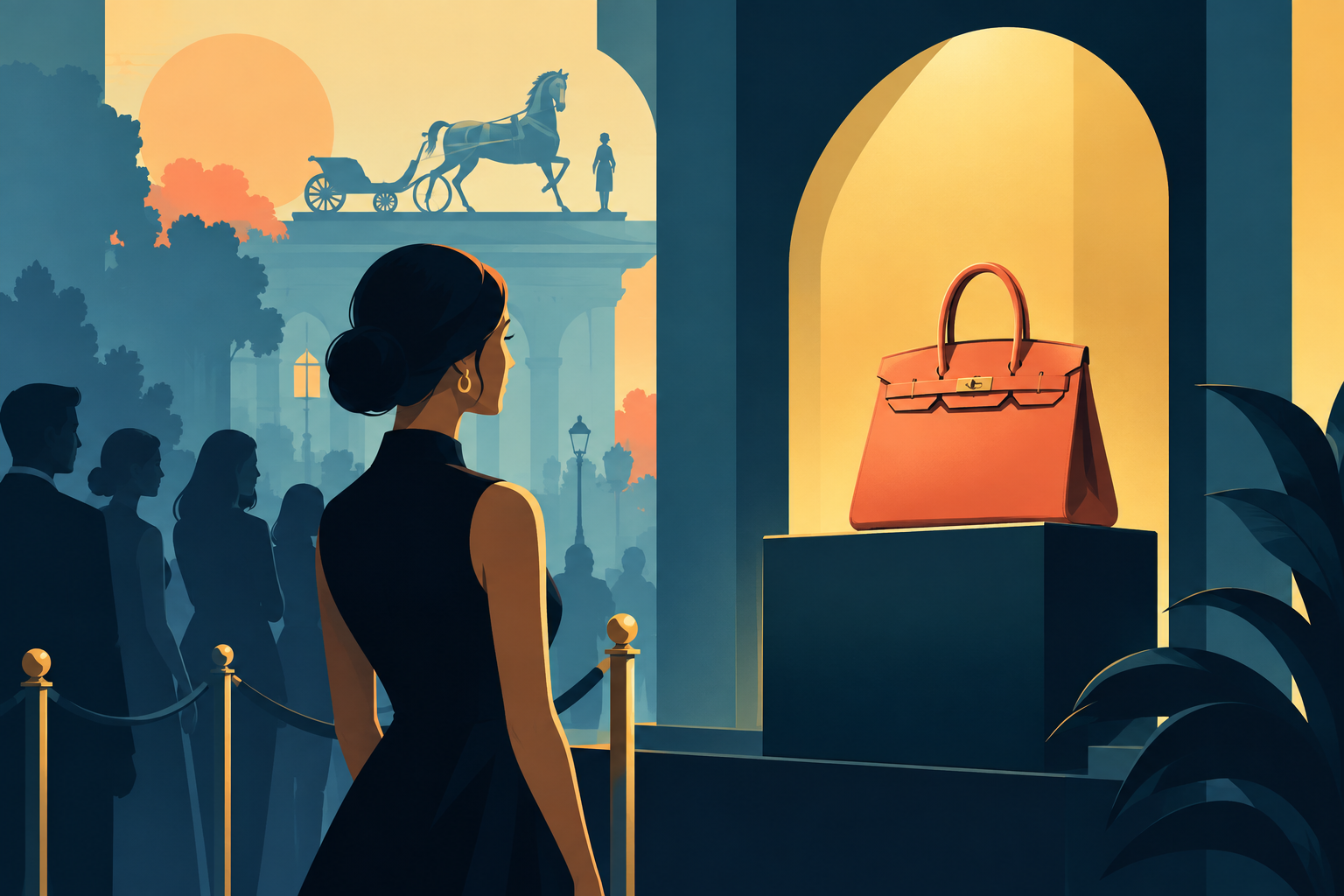
The Birkin and Kelly bags illustrate this particularly well. Their desirability is not simply the result of advertising. They have become symbols of the house’s craftsmanship, heritage and exclusivity, while access to particular combinations of styles, colours and leathers can be difficult. That difficulty changes the psychology of the purchase. Consumers are not simply deciding whether they like a handbag; they are considering whether they can obtain a particular piece at all.
Hermès has also been unusually disciplined about protecting the environment around its products. The brand has resisted the kind of aggressive expansion, broad distribution and discounting that can make luxury goods feel increasingly commonplace. Instead, it has maintained tight control over its retail network and continued to emphasise the quality of the product and the experience around it. The result is a sense that Hermès does not need to chase the customer at every turn.
That restraint becomes especially important when the wider luxury market slows. If a brand has trained consumers to expect frequent promotions, constant newness and widespread availability, weaker demand can quickly become visible through excess inventory and discounting. Hermès has historically had more room to protect its pricing and brand positioning because its strategy is built around controlled supply and strong perceived value. Recent results reinforce this. In 2025, Hermès generated €16 billion in revenue, with leather goods and saddlery accounting for €7.07 billion and growing 13% at constant exchange rates.
Also read: Canva: How Simplicity Opened Design Accessibility to Everyone
There is another important lesson here: scarcity works because Hermès gives consumers a reason to value what is scarce. Limited availability alone cannot create lasting Luxury Demand. If the underlying product is ordinary, making it difficult to buy may create frustration rather than desire. Hermès combines scarcity with craftsmanship, heritage, distinctive design, and consistency. Each element strengthens the others.
That is why the brand’s strategy is more nuanced than simply “making fewer products.” Hermès continues to invest in workshops and production capacity, but it does so without abandoning the standards that make its products distinctive. Its 2025 reporting points to this balance, describing an “exclusive and qualitative network” and strong vertical integration as important parts of its model.
The broader lesson for luxury brands is straightforward. Luxury Demand does not always have to be stimulated by louder communication, bigger campaigns or greater availability. Sometimes, the stronger strategy is to give consumers fewer opportunities to buy while giving them more reasons to want what is available.
Hermès has spent decades building exactly that equation. Scarcity creates tension, craftsmanship gives that tension credibility, and heritage gives the product meaning beyond its immediate function. When those pieces work together, the brand does not have to manufacture desire from scratch. It simply has to protect the conditions that allow desire to endure.