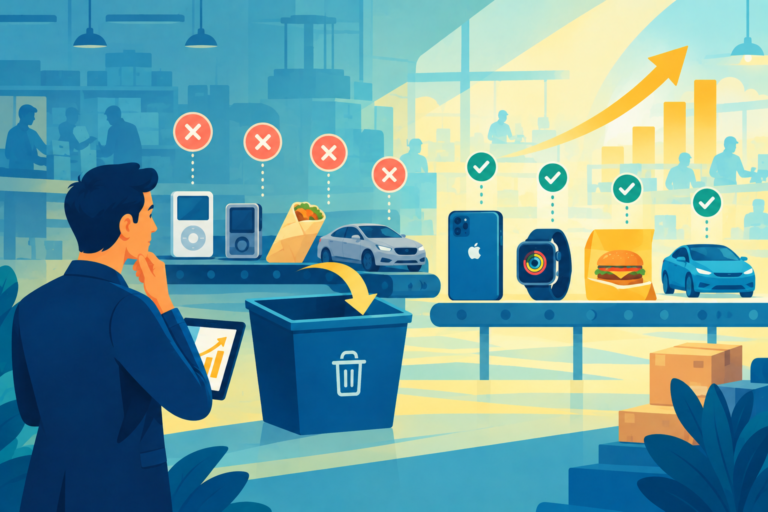
Ecosystem Strategy helps brands build lasting loyalty by connecting products, services and experiences into a system customers value.
Looking for a Shorter Overview?
AI Summary
Key Moments
Ecosystem Value Creation
Brands gain strength by connecting products, services, and partners so the total experience exceeds what any single offering can provide.Brand Lock‑In Through Interdependence
Lock‑in emerges when leaving an ecosystem becomes less attractive due to accumulated data, preferences, and network effects.Hard‑to‑Copy Advantage
Years of relationships, integrations, user habits, and partner networks create durable barriers that competitors cannot easily replicate.Partner‑Centric Orchestration
Successful ecosystems require a brand that also attracts and supports partners, not just customers, to sustain the network.A strong brand is no longer built only through a great product, memorable advertising, or consistent communication. Increasingly, brands are becoming part of a wider network of products, services, platforms, partners, and experiences that make them more useful over time. This is where Ecosystem Strategy becomes important. Instead of asking customers to repeatedly choose a brand, an ecosystem gives them more reasons to stay because different parts of the experience work better together. The result can be deeper engagement, stronger loyalty, and, eventually, a form of brand lock-in that competitors find difficult to replicate.
Ecosystem Strategy Turns Products Into Connected Experiences
Traditional brand building often revolves around a simple relationship: a company creates something, markets it, and a customer buys it. An ecosystem changes that relationship. It brings together multiple offerings and participants to create value that a single product could not provide on its own. Research on business ecosystems describes this as value being created through the interaction and interdependence of multiple actors, including customers, suppliers, partners, and complementors.
Apple is an obvious example. The value of an iPhone does not exist independently of the App Store, iCloud, Apple Pay, developers, accessories, and other connected services. Each element makes the broader experience more useful. A customer who uses several of these services is not simply buying another Apple product; they are participating in a connected system. William Blair similarly notes that next-generation brands are extending beyond individual offerings to create interconnected networks of products, services, experiences, and commerce.
This is where lock-in starts to emerge. Importantly, lock-in does not necessarily mean forcing customers to stay. It can happen because leaving becomes less attractive. Customers may have accumulated preferences, data, familiarity, subscriptions, connected devices, or relationships that make an ecosystem more valuable than an isolated alternative. Academic research identifies mechanisms such as loyalty, switching costs, and network effects as important forms of lock-in, while ecosystem structures can add another layer by creating interdependence between multiple participants.
The strength of an ecosystem is therefore not simply the number of products a brand offers. It is the relationship between them. A poorly designed collection of products is just a portfolio. An ecosystem creates additional value because the parts complement one another. The research literature describes complementarity as a situation where the value of one offering increases in the presence of another.
That distinction matters for brands. Adding a new product does not automatically create greater loyalty. The product needs to make the overall customer experience better. This could mean greater convenience, more personalisation, easier access, better integration or a stronger sense of continuity across touchpoints.
There is also another side to ecosystem building that brands sometimes overlook: partners. An ecosystem needs businesses, developers, suppliers and other participants who see value in being part of it. Emerald’s research on Haier’s ecosystem brand makes this point clear: brands must appeal not only to customers and employees but also to ecosystem partners. Without a brand that attracts partners, the ecosystem itself cannot function.
Also read: How Choice Architecture Improves Customer Decisions
This makes ecosystem strategy as much about orchestration as it is about marketing. Companies need to decide whether they should lead an ecosystem, become a complementor within someone else’s ecosystem, or build strategic partnerships. Strategy+business argues that companies should not automatically assume the role of orchestrator, because doing so requires significant capabilities, resources and an understanding of both customer and partner needs.
The strongest ecosystems also become increasingly difficult to copy. A competitor can replicate a product feature, match a price or imitate a campaign. Replicating years of relationships, integrations, user behaviour, partner networks and accumulated data is considerably harder. This is why ecosystem-based competitive advantage can become more durable than product differentiation alone.
Ultimately, the goal of an Ecosystem Strategy should not be to make customers feel trapped. It should be to make the connected experience genuinely better than the alternatives. When every additional interaction adds value, customers have a reason to remain, partners have a reason to participate, and the ecosystem has a reason to grow. That is when brand loyalty moves beyond preference and becomes part of the way the customer lives, works, or solves a problem. In a market where individual products can be copied quickly, building the system around the product may be the more defensible strategy.