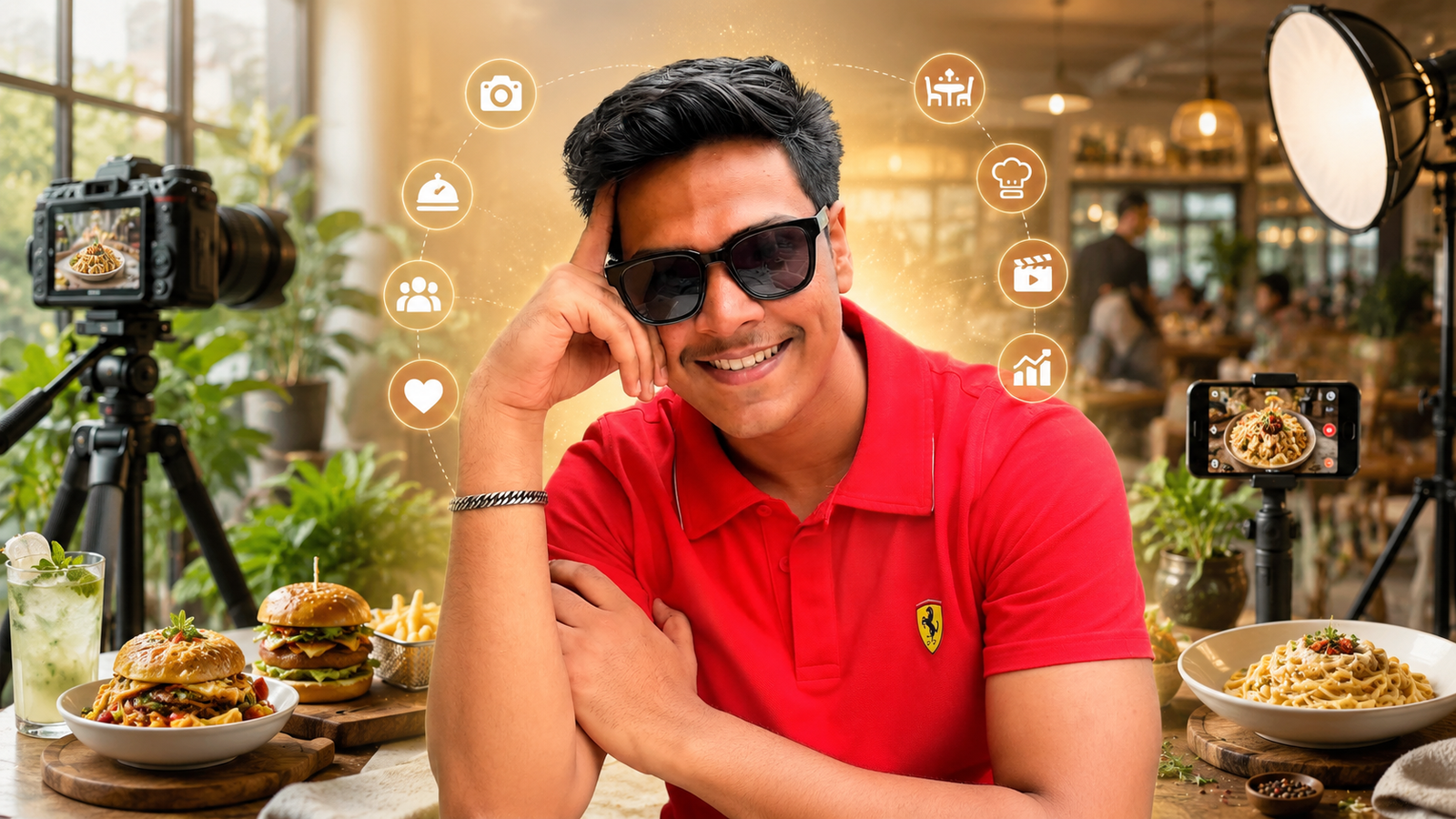
A restaurant's success depends on more than great food. Learn why branding, storytelling, and authentic visuals drive modern F&B marketing.
Looking for a Shorter Overview?
AI Summary
Key Moments
Restaurant Identity Beyond Food
Restaurants have evolved from just serving food to becoming brands, personalities, and communities.The Problem with AI-Perfect Food
AI-generated food images look too perfect, lacking the authentic emotions that make people want to eat.Shift from Posting to Purpose
Restaurants need to ask why they matter to people rather than what content to post daily.Authentic Food Experiences
Real food emotions like mess, steam, and dripping sauce create craving that perfect images cannot.Three years ago, when I started shooting content for restaurants, the brief was fairly simple:
“Make the food look good.”
Today, that is not enough.
I am Aayush Lath, a Food Stylist, Photographer, and Videographer. Over the last three years, I have shot for more than 400 restaurants through my two businesses, Dine & Discover and Plated Stories. I have seen restaurants go from completely empty spaces to packed rooms. I have also seen some genuinely great restaurants struggle because nobody really knows they exist.
The difference is rarely just the food.
F&B has entered an interesting phase where a restaurant is no longer just a place where you go to eat. It is a brand, a personality, a community, and in some cases, it is almost a cult.
Think about the places people constantly talk about. They do not just have a good menu. They have a certain feeling attached to them. You know what kind of people go there, you know what kind of content they put out, you recognise their interiors, their language, their music, and sometimes even the way their food is photographed. That is what makes people want to belong to the brand.
Yet a lot of restaurants are still approaching social media like a digital menu. A picture of the pasta. A picture of the burger. “Now available.” “Visit us today.” And repeat. Or worse, a badly lit video where the food looks pale, flat, and completely different from what arrives at the table.
I have nothing against showing the product. In fact, the product should always be at the centre. But there is a massive difference between showing food and making someone crave it.
And now we have another problem.
AI has made it incredibly easy to create a “perfect” food photograph. Perfect cheese pulls, perfect textures, perfect lighting, perfect everything. Except sometimes it looks so perfect that it stops looking real.
Food is an emotion; a little bit of mess, steam coming off a dish, a hand picking up a fry, sauce dripping onto a plate. These things make people feel something. When everything looks artificially perfect, the food starts looking like a render instead of something you would actually want to eat.
Also read: Attention Isn’t the Problem. Relevance Is
This is where I believe the next phase of F&B marketing is heading.
Restaurants need to stop asking, “What should we post today?”
They need to ask, “Why should someone care about us?”
Maybe it is the chef and his story. Maybe it is the neighbourhood the restaurant belongs to. Maybe it is the people who sit there every Friday night. Maybe it is the music, the staff, the rituals, the inside jokes, or even the way a particular dish is served.
The best restaurants are not just selling food anymore. They are selling an identity that people want to be associated with.
As someone who spends most of my working life looking at food through a camera, I have realised that my job is not really to make a dish look good. My job is to make someone stop scrolling, imagine themselves sitting there, and think,
“I want to be a part of this.”
And I think that is what great F&B marketing should ultimately do.
– Written by Aayush Lath, Food Stylist, Food Photographer & Food Videographer, Co-founder of Dine & Discover and Founder of Plated Stories. With over three years of experience working with 400+ restaurants, he brings an on-ground perspective on F&B, food marketing, and the growing importance of visual storytelling in building restaurant brands.