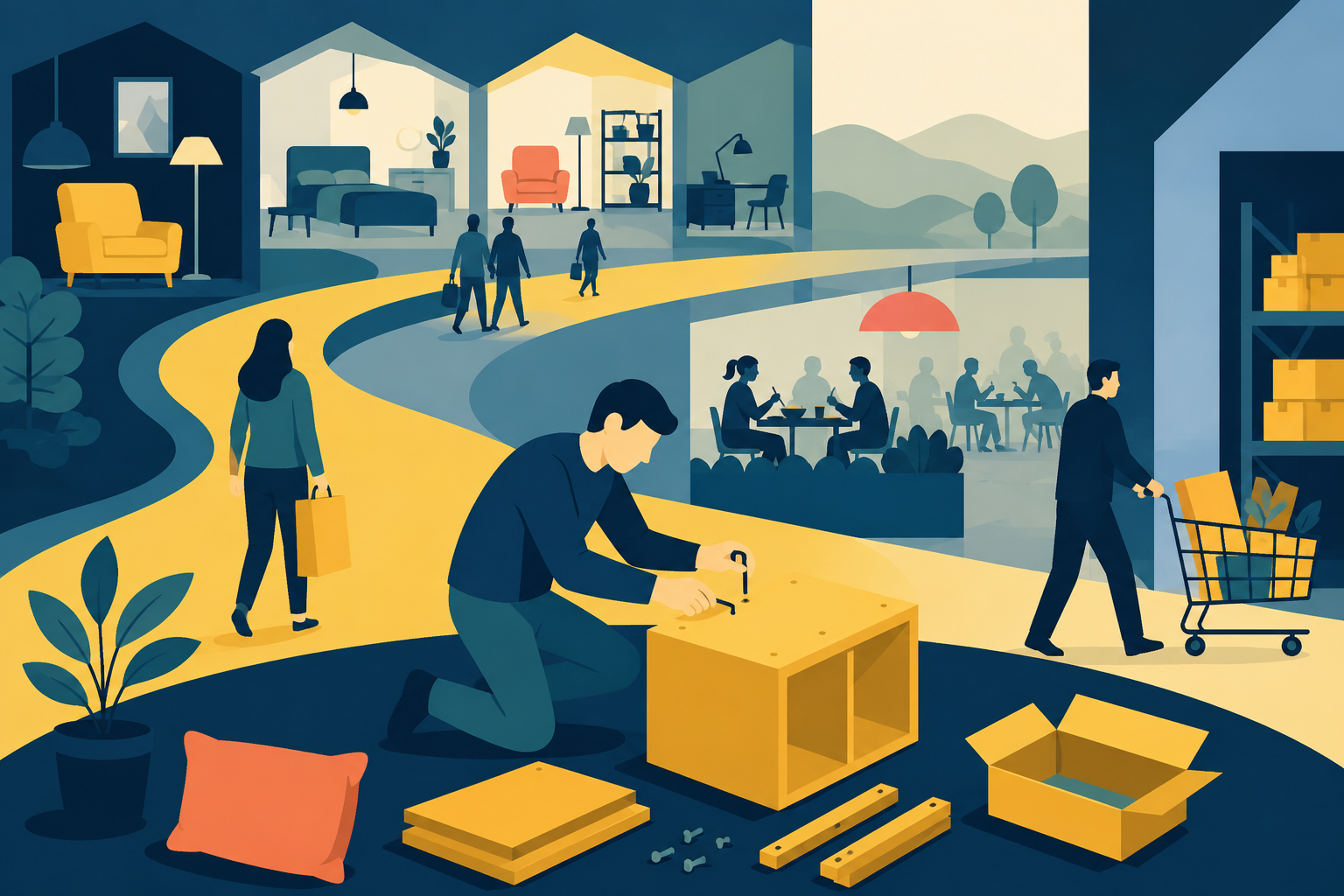
Discover how IKEA's business model uses consumer psychology, self-assembly, and store design to build one of the world's strongest brands.
Looking for a Shorter Overview?
AI Summary
Key Moments
IKEA Effect Psychology
Customers value products they build themselves, creating emotional attachment through assembly effort.Strategic Store Design
Maze-like layouts and strategically placed food stations encourage longer shopping trips and impulse purchases.Customer as Unpaid Employee
IKEA transforms shoppers into brand advocates through the challenging assembly process.Psychological Advantage
The struggle and frustration become the competitive advantage that traditional retailers miss.Most furniture companies believe their job is incredibly simple. The traditional model is straightforward: a brand designs a comfortable sofa, places it in a well-lit showroom, and the customer pays an additional fee to have it delivered safely to their living room.
If a hinge is broken or the wood chips, the customer immediately calls the store to complain. That is how the industry has worked for decades. The entire transaction is built around convenience.
But when a shopper walks into an IKEA store in Hyderabad or Mumbai, they experience the exact opposite.
IKEA forces you to walk through a confusing maze, often called the Long Natural Path, just to find a simple chair. You have to write down complicated Swedish product names with a tiny pencil on a yellow notepad. Then you have to navigate a massive warehouse and carry the heavy cardboard boxes to your car yourself.
And the worst part? You have to go home and assemble the furniture yourself using a tiny Allen key.
Logically, this sounds like a terrible customer experience. A premium buyer should absolutely hate it. But instead, shoppers love it. And this seemingly illogical consumer behaviour is the very foundation of IKEA’s branding strategy.
The psychological trick behind IKEA’s branding
If you buy a fully assembled wooden dining table from a local carpenter or a premium furniture store, the transaction is simple. You pay for it, it gets delivered to your home, and the relationship ends there. If a leg wobbles, you automatically blame the carpenter.
But IKEA completely flips this psychology.
When you spend three hours on a Sunday afternoon sweating, getting frustrated, and trying to screw together a bookshelf, something strange happens in your brain.
You have now invested your own time, effort, and energy into building it. As a result, you stop viewing it as just another piece of furniture. You begin to see it as something you created yourself.
Psychologists literally call this the “IKEA Effect.” The human brain places a disproportionately high value on things it successfully builds.
By asking customers to do part of the work, the company does not just save money on manufacturing, shipping, and assembly. It also subtly encourages customers to form a stronger emotional attachment to the product.
You do not just own a bookshelf. You own the pride of assembling it.
If the bookshelf wobbles, you do not blame the store. You blame yourself for missing a screw. And the remarkable part is that you still love the shelf.
Also read: How Brand Memory Shapes Buying Decisions
Why is the store layout designed like a trap?
The physical layout of the store is another brilliant psychological hack.
If you go to a regular supermarket, you can walk straight to the milk aisle, grab a packet, and leave within two minutes.
IKEA does not let you do that.
The store follows a strict one-way layout. Once you step inside, you are guided through a carefully designed maze. Along the way, you pass hundreds of fully decorated mock-up rooms before you ever reach the flat-pack warehouse.
As you continue walking, your brain becomes mentally fatigued. You gradually lose your sense of time. And just as decision fatigue begins to set in, you come across the in-store cafeteria.
IKEA does not place its cafeteria near the entrance or tuck it away in a corner. It is strategically positioned midway through the shopping journey. You sit down, enjoy an affordable plate of Swedish meatballs or vegetable biryani, and your brain receives a small dopamine boost.
Ingvar Kamprad, IKEA’s founder, famously said, “Hungry people buy less.”
You feel refreshed and rewarded after a short meal. Suddenly, picking up a few extra scented candles, plastic plants, or coffee mugs on your way to the checkout feels completely justified rather than like an unnecessary expense.
You came in to buy a single study desk and walked out with a trolley full of things you never intended to purchase.
Competitors spend millions on advertising campaigns trying to convince customers that their wood is stronger or their furniture is of higher quality. But they completely miss the point.
IKEA is not selling superior furniture.
It is selling an entire psychological experience.
The system makes you walk through a maze, feeds you affordable comfort food, and asks you to do the hard work yourself. By the end of it, you proudly recommend the brand to your friends.
When your business model successfully turns the customer into an unpaid employee who genuinely enjoys the experience, you no longer need traditional marketing.
The struggle itself becomes the ultimate competitive advantage.
— Written by Rajnish Singh, a copywriter and strategist with a background in fast-paced journalism, who explores the gap between what brands promise and how consumers actually behave.