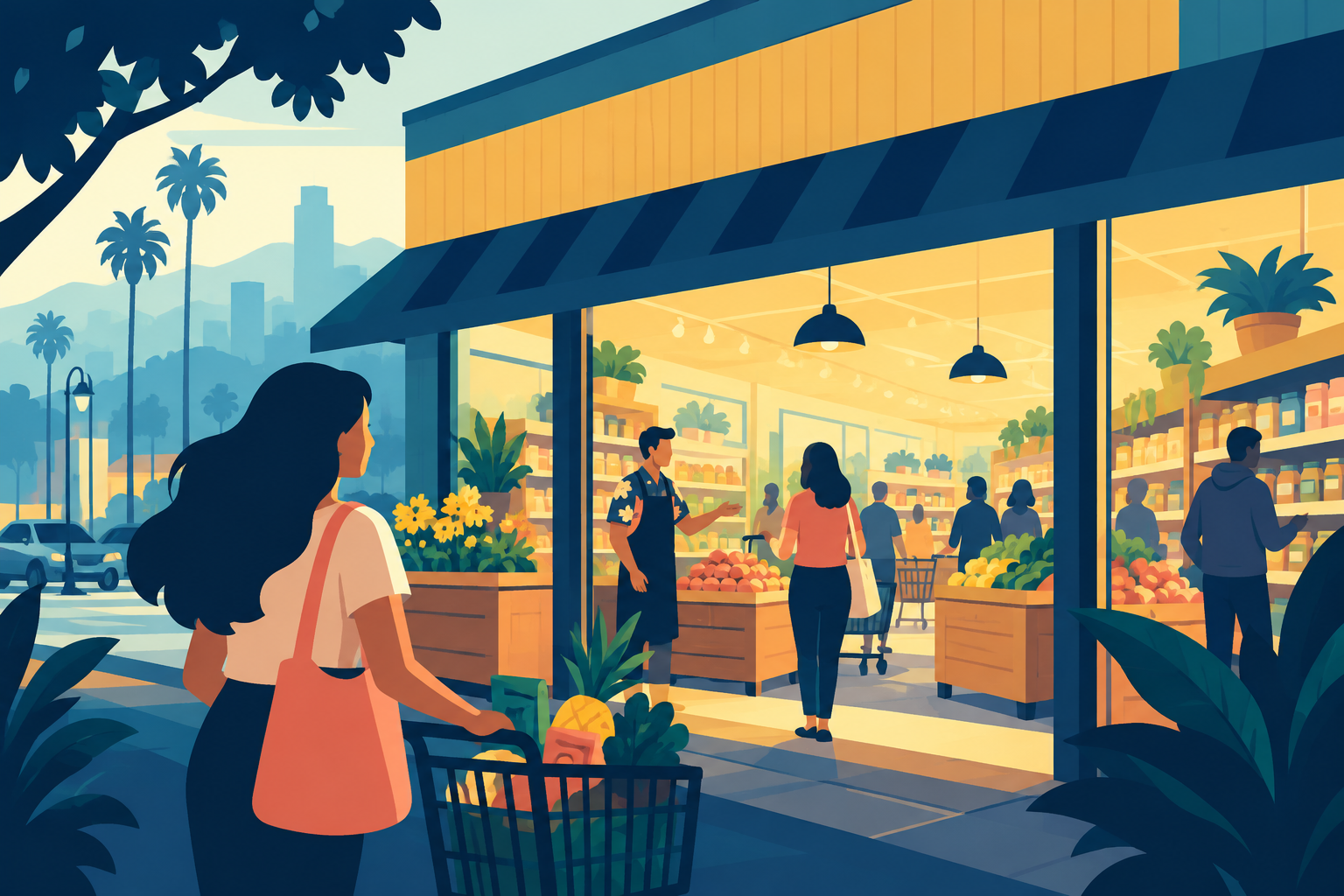
Trader Joe’s shows how a distinctive store experience can build customer loyalty, strengthen brand identity and create a lasting retail advantage.
Looking for a Shorter Overview?
AI Summary
Key Moments
Handwritten Signage
Trader Joe’s uses quirky, hand‑drawn signs to turn product discovery into a branded, engaging experience.Friendly Crew Culture
Informal staff in Hawaiian shirts personalize the store, fostering community and strong customer loyalty.Curated Assortment
Limited SKUs reduce decision fatigue and create anticipation of new, seasonal finds on each visit.Experience as Competitive Advantage
Consistent, fun store experience differentiates Trader Joe’s from price‑focused rivals, becoming a sustainable brand edge.Walk into a Trader Joe’s and it quickly becomes clear that you are not shopping in a conventional grocery store. The handwritten signs, unusual product names, colourful displays, friendly employees, and constant sense of discovery make the trip feel less like a chore and more like an experience. That is the strength of Trader Joe’s Store Experience: it has turned the act of grocery shopping into something people actively enjoy, remember and talk about.
In a category where retailers often compete on price, promotions, convenience, and assortment, Trader Joe’s has built a distinctive position by making the physical store central to its brand. Its approach shows that when every part of a customer’s interaction with a business reinforces the same personality, the experience itself can become a powerful competitive advantage.
How Trader Joe’s Made Store Experience Part of the Brand
Trader Joe’s does not try to make shopping as fast or frictionless as possible. Instead, it deliberately makes the experience engaging. The company itself describes its goal as creating stores that are “rewarding, eventful and fun”, with Crew Members, creative signage, humour and a sense of community all contributing to the environment.
One of the simplest examples is the signage. Rather than relying entirely on standardised supermarket labels, Trader Joe’s uses hand-drawn signs that explain products in an informal, approachable way. The signs often go beyond displaying a name and price, helping customers understand what a product is or how they might use it. This makes something as ordinary as finding an item on a shelf part of the brand experience.
The employees reinforce that personality. Hawaiian shirts, conversations with shoppers, and a noticeably informal tone make the store feel more like a neighbourhood business than a large retail chain. Trader Joe’s has invested heavily in creating a culture where employees contribute to the customer experience rather than simply carrying out transactions. Research and commentary on the brand repeatedly point to frontline service as one of the reasons customers develop such strong loyalty.
Then there is the assortment. A typical Trader Joe’s carries far fewer products than a conventional supermarket, with sources commonly citing roughly 4,000 SKUs compared with much larger supermarket assortments. The result is less choice, but also less decision fatigue. Products are carefully selected, with underperforming items making room for new ones.
That curation creates another important part of the Store Experience: discovery. Customers know that their next visit may reveal something new, seasonal or unexpected. Sampling adds to that sense of exploration, allowing shoppers to try products rather than simply reading a label and deciding whether to buy them. The experience becomes a small form of entertainment, and that gives customers another reason to return.
Also read: Discord: How Community-First Growth Created a New Social Platform
Importantly, the experience is not disconnected from Trader Joe’s commercial model. More than 80% of its products are sold under its private label, while the company buys directly from suppliers where possible and focuses on keeping costs low. It also does not rely on traditional supermarket tactics such as coupons, sales, or loyalty cards. Instead, it promises everyday value.
This consistency is what makes the strategy particularly powerful. The products, prices, employees, signage, store design and merchandising all tell the same story: shopping here should feel different. Even when individual stores incorporate elements of their local communities, the underlying personality remains recognisably Trader Joe’s.
The bigger lesson for brands is that customer experience does not have to sit separately from brand strategy. Trader Joe’s demonstrates what happens when the experience is the strategy. It has made the physical store a place where the brand is experienced rather than merely displayed, creating familiarity without making every visit feel identical.
In an increasingly digital retail environment, that distinction matters. A competitor can copy a product, match a price or reproduce a promotion. It is much harder to replicate a relationship customers have built with a place. Trader Joe’s has made grocery shopping feel personal, surprising, and distinctly human. That is what turns its Store Experience from a retail feature into a genuine brand advantage.