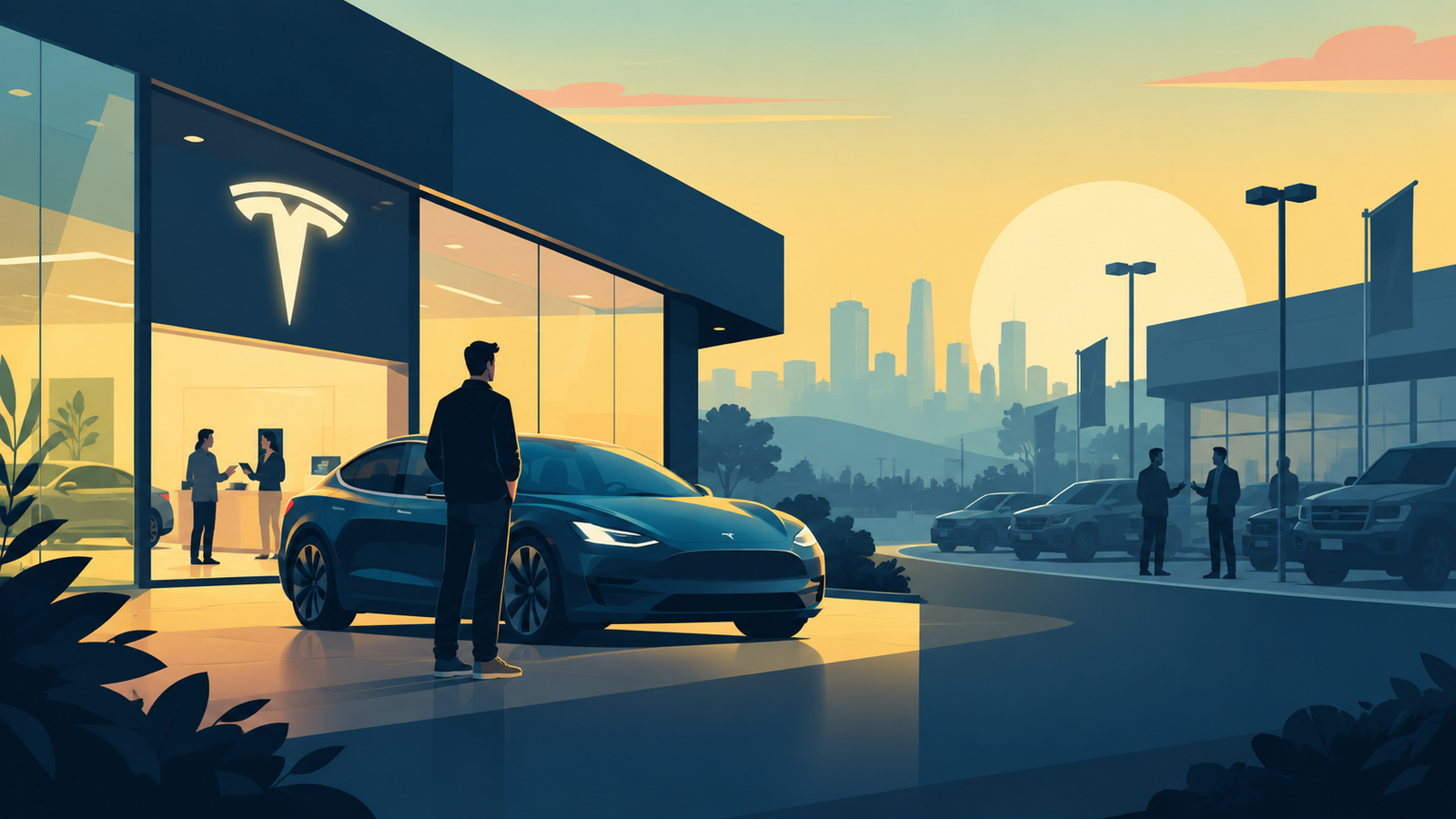
Tesla challenged traditional auto retail with Direct Selling, reshaping how customers buy cars and manufacturers reach them.
Looking for a Shorter Overview?
AI Summary
Key Moments
Full Control Over Pricing & Messaging
Tesla managed the entire customer journey from product interaction through delivery and post‑sale software updates.Legal Battles Over Franchise Laws
Tesla's direct‑sale approach triggered state franchise disputes and legislative resistance from existing dealer groups.Limited Applicability to Legacy Automakers
Because Tesla started without dealers and with a niche EV lineup, its direct‑sale success isn’t automatically replicable for established manufacturers.Questioning the Middleman
True business‑model innovation lies in evaluating whether traditional intermediaries are still needed for every part of the customer experience.For more than a century, buying a car followed a familiar pattern: visit a dealership, compare models, negotiate a price, arrange financing, and drive away. Tesla challenged almost every part of that process. Instead of building a traditional network of franchised dealers, the company developed a model where customers could explore, configure, order, and purchase its vehicles directly through Tesla-owned stores and online channels. This approach made Direct Selling more than a distribution decision. It became part of Tesla’s broader brand experience and one of the ways the company differentiated itself from established automakers.
How Direct Selling Changed the Car-Buying Experience
The traditional dealership model exists for practical reasons. Dealers provide local sales and service infrastructure, carry inventory, arrange financing, and act as the customer-facing arm of the manufacturer. For established automakers with large product ranges and thousands of dealerships, replacing that system is neither simple nor inexpensive. Tesla, however, entered the market without an existing dealer network to protect, giving it more freedom to build its distribution model around its own priorities.
Tesla’s approach was particularly suited to the kind of product it was selling. Electric vehicles required customers to understand unfamiliar concepts such as charging, range, and battery technology. Tesla argued that controlling the sales process allowed it to educate customers directly while maintaining a consistent brand experience. Its 2012 IPO prospectus also pointed to concerns that traditional dealers might have less incentive to prioritize electric vehicles because EVs generally require less routine maintenance than internal-combustion vehicles.
The customer experience was another important part of the strategy. Tesla made it possible to configure a vehicle online, see pricing, place an order, and arrange delivery without going through the conventional back-and-forth of dealership negotiations. Its company-owned stores functioned more as places to experience and learn about the product than as traditional dealerships built around large inventories. This created a buying journey that felt closer to e-commerce than conventional car retail.
That difference also gave Tesla greater control over pricing, messaging, and the customer relationship. Instead of having an independent dealer sit between the manufacturer and buyer, Tesla could manage the experience from the initial product interaction through delivery and, increasingly, ownership. The direct relationship also supported Tesla’s ability to collect customer feedback and connect the vehicle to software-driven services and updates after purchase.
Also read: Slack: How Product-Led Growth Changed Software Marketing
But Direct Selling was never simply a business decision without consequences. Tesla’s model ran into state franchise laws across the United States that were largely built around relationships between manufacturers and franchised dealers. Dealer groups argued that allowing manufacturers to sell directly could undermine the established dealership system, while Tesla challenged restrictions that it believed prevented it from reaching customers on its own terms. The resulting legal and legislative battles have played out differently from state to state.
Importantly, Tesla’s success does not mean that direct sales are automatically the right answer for every automaker. Its circumstances were unusual: it started without a legacy dealership network, initially had a relatively limited product portfolio and occupied a distinctive position in the emerging luxury EV market. Those factors made its model easier to build than it would be for a century-old manufacturer with thousands of existing dealers.
There is also evidence that the model comes with its own challenges. Fisker, another EV startup that initially adopted a Tesla-style direct-to-consumer approach, later moved toward traditional dealerships in the U.S., with its CEO saying direct sales had proved more expensive than expected and that the company had struggled to get vehicles to customers quickly.
That may be the most useful lesson from Tesla. The real innovation was not simply cutting out the middleman. It was questioning whether the middleman was still necessary for every part of the customer journey. Tesla showed that a manufacturer could combine digital ordering, company-owned retail locations, and direct customer relationships to create a fundamentally different buying experience.
For other businesses, the takeaway is broader than automobiles. Direct Selling works best when the company can genuinely improve the customer experience by owning the relationship. Tesla did not merely change where people bought cars; it challenged an established assumption about how cars had to be sold. And sometimes, that is where business-model innovation begins: not by improving the old system, but by asking whether the old system is still necessary.