Discover how Behavioral Economics helps marketers understand consumer decisions and create smarter, more effective strategies.
Looking for a Shorter Overview?
AI Summary
Key Moments
Core Definition
Behavioral Economics combines psychology and economics to explain why people make seemingly irrational decisionsLoss Aversion
People feel the pain of losing something more strongly than the pleasure of gaining something of equal valueSocial Proof
Reviews, testimonials, and customer ratings reduce uncertainty by showing others trust productsEthical Integration
Behavioral insights should enhance customer experience without manipulating or exploiting cognitive biasesFor decades, marketing was built around a simple assumption: consumers evaluate information logically, compare options, and choose the product that offers the greatest value. In reality, very few purchase decisions happen that way. People are influenced by emotions, habits, mental shortcuts, social influence, and the way choices are presented to them. That is precisely where Behavioral Economics changes the conversation.
Behavioral Economics combines psychology and economics to explain why people often make decisions that appear irrational from a traditional economic perspective. Instead of assuming consumers always make perfectly logical choices, it recognises that biases, emotions, and context shape behaviour every day. For marketers, this provides a far more realistic understanding of how people discover, evaluate, and buy products. Rather than relying on assumptions, brands can design experiences that align with how consumers actually think and behave.
Why Behavioral Economics Makes Marketing More Effective
The biggest advantage of Behavioral Economics is that it helps marketers move beyond demographics and understand decision-making itself. Two customers with similar age, income, and interests can respond very differently to the same campaign because their perceptions, emotions, and cognitive biases differ. Recognising these behavioural patterns allows marketers to create messages that resonate more naturally.
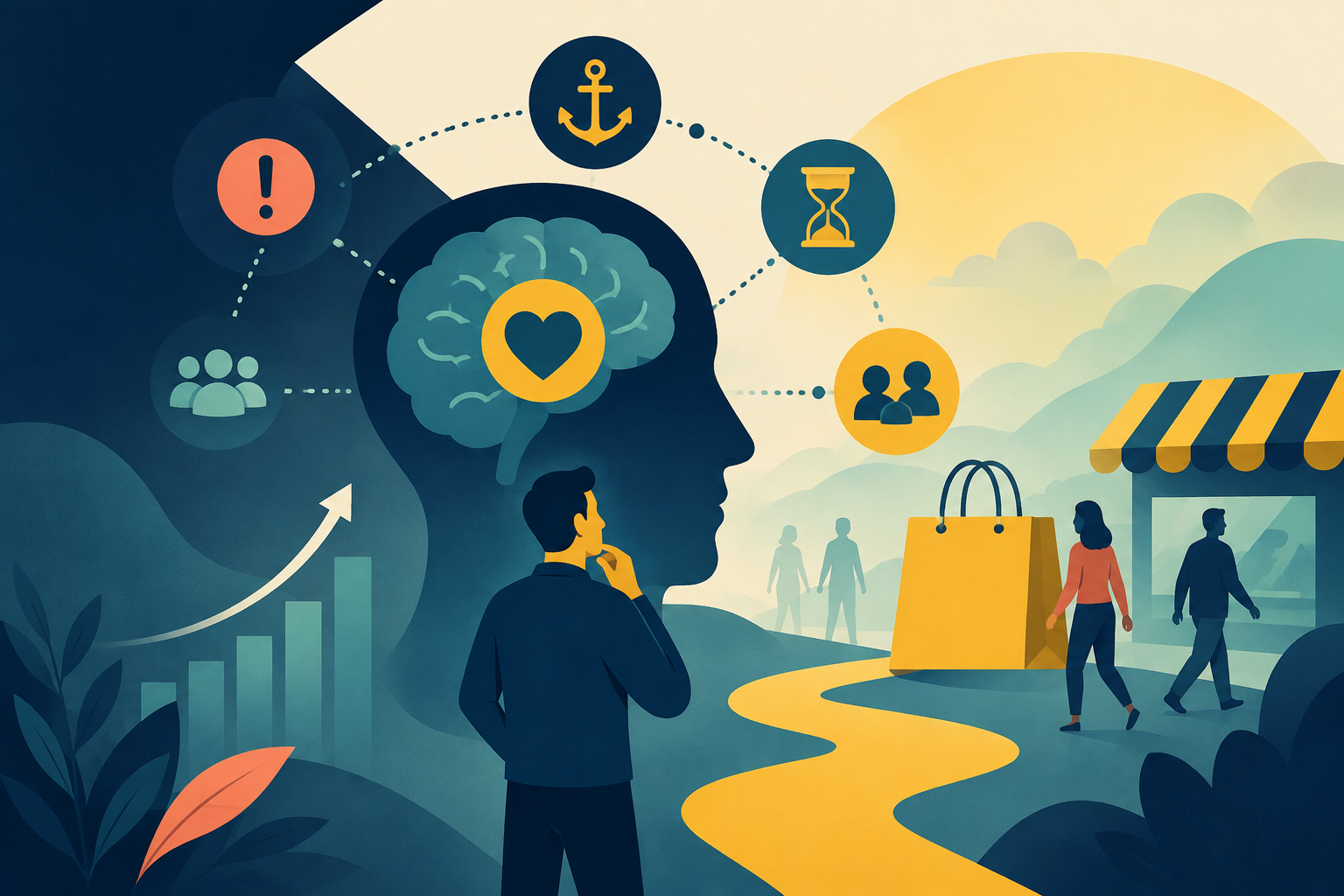
One of the best-known concepts is loss aversion, the tendency for people to feel the pain of losing something more strongly than the pleasure of gaining something of equal value. This is why messages like “Don’t miss out” or “Offer ends tonight” often outperform messaging that simply highlights benefits. Consumers are frequently more motivated to avoid losing an opportunity than to gain a new one.
Another powerful principle is anchoring. People rely heavily on the first piece of information they receive when making comparisons. Premium pricing tiers, original prices shown beside discounted prices, or high-end product options can all serve as anchors that influence how customers perceive value. The anchor changes the reference point against which every subsequent option is judged.
Social proof is another behavioural principle that has become central to modern marketing. Reviews, testimonials, customer ratings, and user-generated content reduce uncertainty because people naturally look to others when making decisions. Seeing that thousands of customers trust a product often provides reassurance that no advertisement alone can achieve.
Scarcity also plays an important role. Limited availability or genuine time-sensitive offers can increase perceived value by creating urgency. However, marketers must use this responsibly. Artificial scarcity may deliver short-term conversions, but repeated misuse damages credibility and erodes trust over time.
Behavioral Economics also highlights the importance of framing. The way information is presented often influences decisions as much as the information itself. Describing a product as “95% customer satisfaction” creates a different emotional response than saying “5% of customers were dissatisfied,” even though both statements communicate the same fact. Small changes in presentation can significantly affect perception.
Importantly, these principles are not isolated tactics to boost conversions. They work best when integrated into a broader marketing strategy that genuinely understands customer motivations. Behavioural insights should inform product positioning, pricing, customer journeys, website design, advertising, and even customer service. They help marketers remove friction, simplify decisions, and create experiences that feel intuitive rather than persuasive.
Also read: Why Brand Equity Determines Long-Term Business Value
At the same time, ethical responsibility cannot be ignored. Behavioral Economics gives marketers powerful tools to influence decision-making, but influence should never become manipulation. Misleading pricing, fake urgency, deceptive defaults, or exaggerated social proof may generate immediate results, yet they undermine long-term brand trust. Sustainable brands use behavioural insights to help customers make better decisions, not exploit their cognitive biases.
Perhaps the most valuable lesson is that consumer behaviour is rarely fixed. Preferences evolve, market conditions change, and different audiences respond differently to the same behavioural cues. That is why continuous testing remains essential. Marketers should experiment with messaging, pricing, layouts, and calls to action while measuring what genuinely improves customer experience and business outcomes rather than assuming one behavioural principle will always work.
In today’s crowded marketplace, attention is limited, and choices are endless. Brands that understand how people think have a significant advantage over those that only focus on what they sell. Behavioral Economics offers marketers a practical framework for understanding real human behaviour, enabling them to create more relevant campaigns, stronger customer relationships, and better business results. Ultimately, the most effective marketing is not about convincing people to behave differently. It is about understanding why they behave the way they already do.