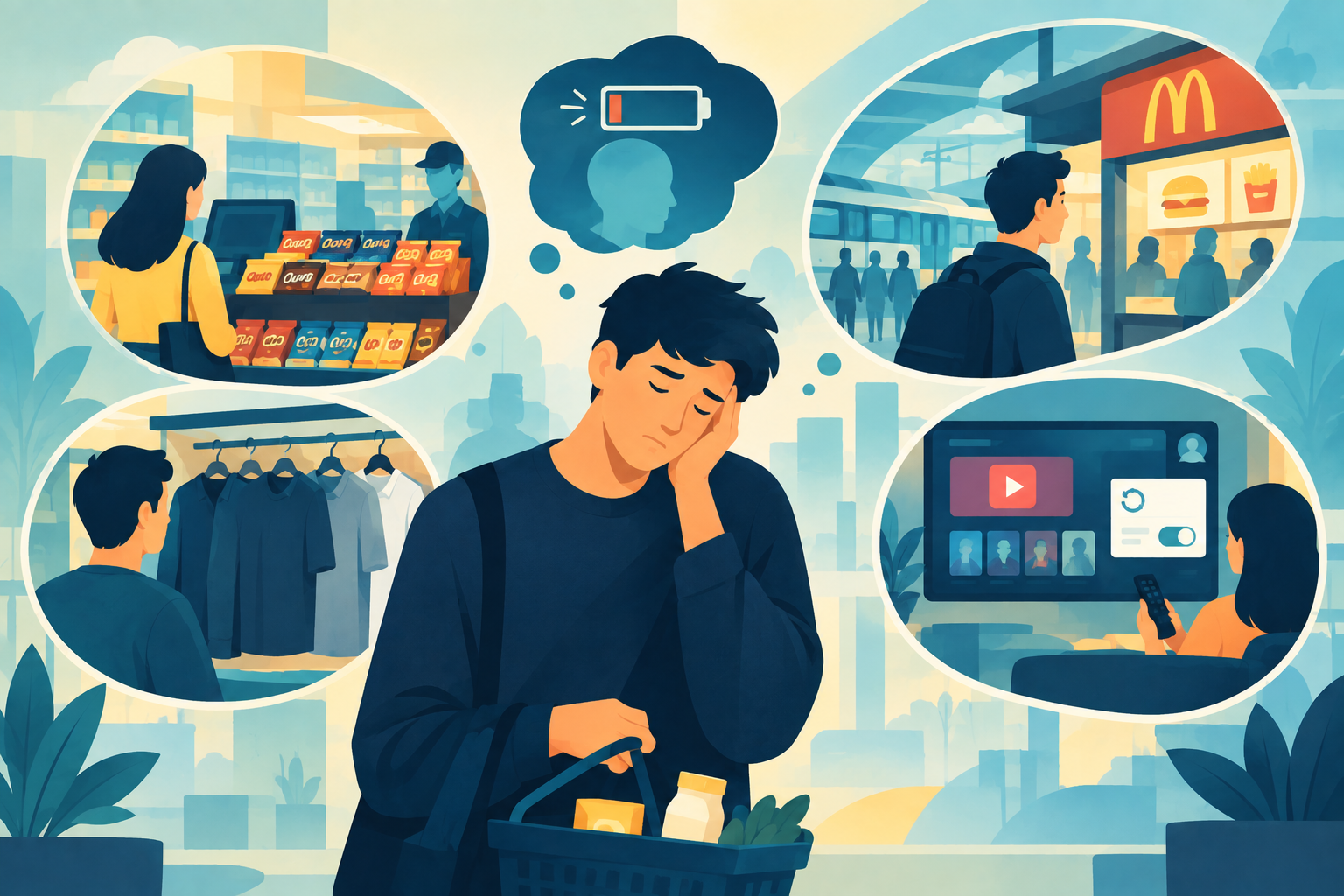
Mental exhaustion is dangerous. See how mastering decision fatigue turns tired buyers into an unstoppable success.
Looking for a Shorter Overview?
AI Summary
Key Moments
Decision Fatigue Takes Hold
After countless tiny decisions, mental energy depletes, driving people toward familiar, low-effort choices like known food stalls or brands.Retail Checkout Exploitation
Supermarkets place high-margin items near registers where exhausted shoppers are less likely to evaluate health or price, boosting impulse purchases.Routine Optimization by Leaders
Executives cut daily decisions by standardizing attire and habits, freeing cognitive resources for strategic choices.Brands That Reduce Fatigue
Meal-kit and curated subscription services solve decision fatigue by delivering ready-made solutions, turning chores into effortless experiences.After a long workday, people often leave the office around 6 p.m. and pass through busy train stations filled with food stalls. Even when many new options are available, hungry commuters may ignore them and choose a familiar chicken sandwich from a shop they already know.
This behavior is often linked to Decision Fatigue. Making choices throughout the day requires mental energy, and by evening, people may feel too tired to evaluate unfamiliar options.
Psychologist Roy Baumeister of Florida State University studied this limitation and found that adults make hundreds of small decisions during a typical workday. As mental energy declines, Decision Fatigue encourages people to choose familiar options instead of processing new information.
Danger of Decision Fatigue in Retail Aisles
Supermarket owners often use this natural limitation to increase sales. They place chocolates and other snacks near the checkout counters, where customers see them after spending a long time walking through the aisles.
By then, shoppers may have compared prices, read ingredient labels, and calculated their total spending. This extended shopping process creates Decision Fatigue by the time they reach the checkout.
Tired customers may be less willing to think about health concerns or additional costs, making them more likely to pick up familiar chocolate bars and add them to their baskets. Retail research supports the link between Decision Fatigue and reduced careful decision-making, showing why checkout displays can encourage extra purchases.
Highly successful business leaders often recognize the effects of Decision Fatigue and simplify their daily routines. Steve Jobs was known for wearing the same style of black shirt and blue jeans, while Mark Zuckerberg often wears similar gray T-shirts. By keeping several identical outfits, they avoid spending mental energy deciding what to wear each morning.
This allows them to save their attention for important business decisions later in the day. Everyday shoppers follow a similar pattern in supermarkets by repeatedly choosing the same brands of soap, toothpaste, or other household products. Familiar choices reduce Decision Fatigue and make daily routines easier.
Restaurant chains benefit greatly from customers experiencing Decision Fatigue. After driving for six hours, highway travelers are often tired and hungry. When they see unfamiliar local restaurants alongside a recognizable McDonald’s sign, many choose the familiar option immediately.
Customers already know the menu, prices, and taste, so ordering requires very little mental effort. Trying a new restaurant would mean reading an unfamiliar menu and comparing new choices.
As we discussed in our recent article about Choice Overload, too many unfamiliar options can make decisions more difficult. Familiar brands attract tired travelers because they offer a predictable and effortless choice.
Software companies can also benefit from customers experiencing Decision Fatigue. Streaming services often charge monthly fees through automatic card payments, while canceling may require users to navigate through several settings and confirmation screens.
Many people may want to cancel a service to save money, but after a long workday, the process can feel like too much effort. Tired users often postpone the task and later forget about it, allowing the automatic payments to continue. By making the familiar option easier than cancellation, companies can retain subscribers with minimal effort from the customer.
Smart brands do not simply take advantage of customer exhaustion; they help reduce it. Meal-kit delivery services and curated fashion boxes are popular largely because they eliminate Decision Fatigue.
Instead of asking tired professionals to visit a crowded supermarket, choose a recipe, and compare dozens of ingredients, meal-kit companies deliver a pre-portioned box with simple instructions. By removing the mental effort involved in planning and shopping, these services turn everyday chores into easier experiences. When a business presents itself as a solution to mental exhaustion, customers may be willing to pay more for the relief of making one less decision.
Loved this article? Read more insightful articles on Brand Custodian.
–Written by Rajnish Kumar, a copywriter and strategist with a background in fast-paced journalism, who explores the gap between what brands promise and how consumers actually behave.



