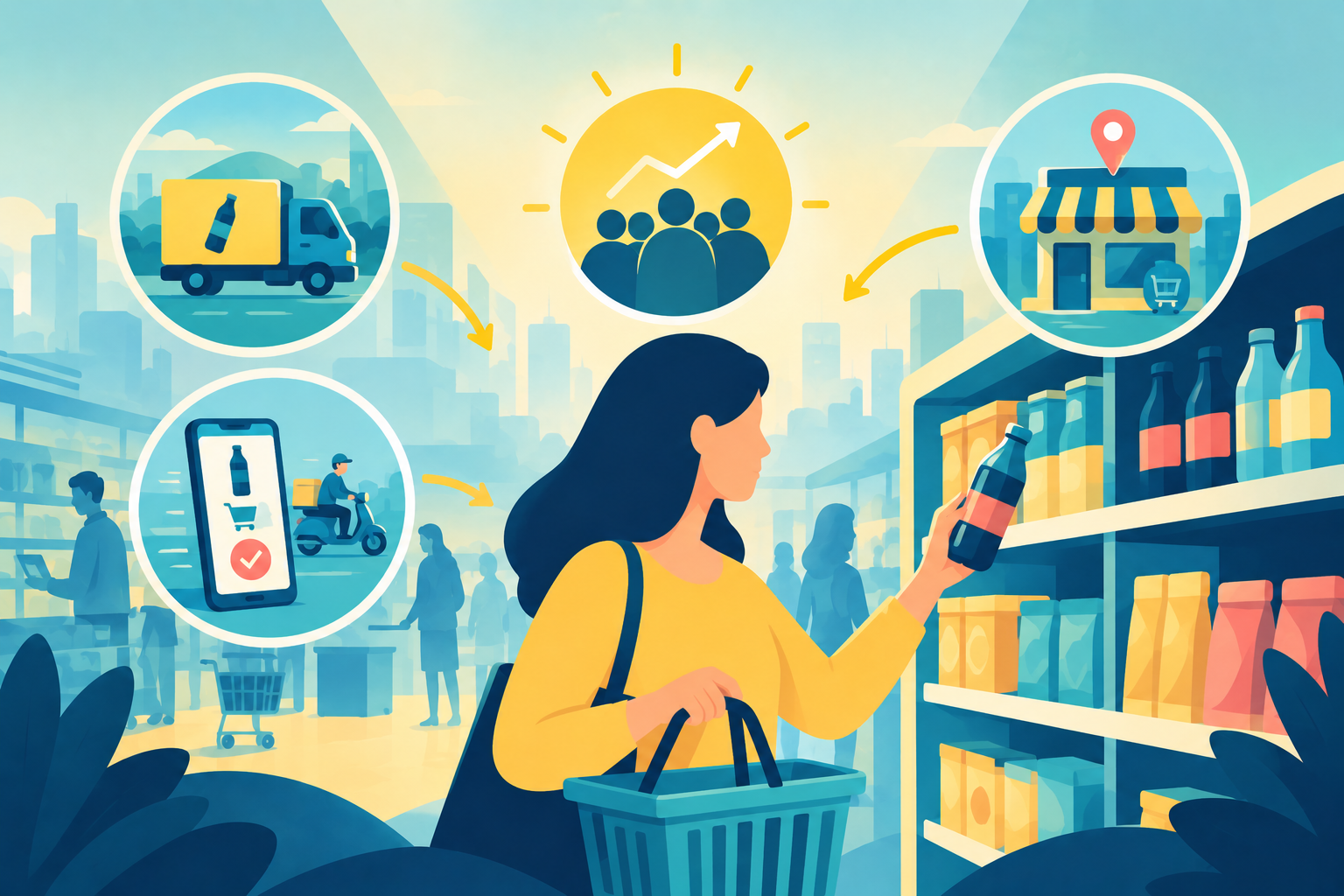
Empty shelves are dangerous. See how mastering product availability turns simple logistics into an unstoppable success.
Looking for a Shorter Overview?
AI Summary
Key Moments
Coca‑Cola’s Distribution Advantage
Decades‑old strategy of placing bottles everywhere showed that product availability can be more powerful than advertising.Parle‑G Village Presence
By flooding remote shops with yellow packets, Parle‑G achieved massive daily sales while keeping ad spend low.Checkout Refrigerator Impact
Supermarket coolers near the till turn thirsty shoppers into impulse buyers without any campaign.Shelf‑stock Gap Penalty
When a brand misses a shelf, nearly 31% of shoppers switch stores, erasing even strong marketing efforts.Decades ago, Coca-Cola executives introduced a strict company rule: a Coca-Cola bottle should be within reach of every person on Earth. To make that possible, the company invested in thousands of delivery trucks rather than relying solely on television advertising. This practical approach highlights why product availability has such a strong influence on daily sales.
Brands may invest heavily in digital advertising, but customers can still choose a competitor if the product is unavailable at their local shop. Research from the Ehrenberg-Bass Institute supports this idea, showing that Physical Availability plays an essential role in driving market sales.
High product availability can encourage customers to try a new product simply because it is right in front of them. When a business makes an item easy to find, its physical presence can generate sales without the need for additional promotion.
Mechanics of Product Availability
Many well-known companies understand the power of physical availability. Parle-G, for example, is sold in almost every small village shop across India. Compared with competing snack brands, the company keeps its advertising costs relatively low while still generating significant daily sales. Its success is largely built on strong product availability.
Delivery trucks carry the brand’s familiar yellow packets to remote rural areas where competing biscuits may not be available. When a hungry shopper visits a small village shop and finds Parle-G as the only biscuit option, they are likely to buy it immediately.
In this way, product availability can reduce the need for expensive promotional campaigns. A smart business owner may choose to invest more in delivery drivers and distribution than in advertising agencies.
A large supermarket offers another clear example of how physical availability drives sales. Beverage companies often pay high fees to place refrigerators near the checkout counter, where shoppers are most likely to notice them. While waiting to pay, a thirsty customer may not walk through the entire store looking for a preferred drink. Instead, they are likely to pick up whichever cold bottle is closest.
This strategic product availability can lead to additional daily purchases. Beverage brands pay to keep these refrigerators fully stocked each morning because they know that having products readily available at the checkout can increase sales. At that moment, shoppers are not thinking about television commercials. They are simply responding to the convenient product placed in front of them.
When a well-known brand fails to deliver products to a store, it can lose customers immediately. Retail experts like Thomas Gruen, Daniel Corsten, and Sundar Bharadwaj cited that nearly 31% of shoppers switch stores when they encounter an empty shelf. This statistic shows how poor product availability can undermine even a strong marketing strategy.
As discussed in our recent article about Marketing Assets, small details can help build customer loyalty. However, even attractive packaging has little value if the store has no products to sell. Most shoppers will not wait three days for an everyday item such as bathing soap. If their preferred brand is unavailable, they are likely to choose an unfamiliar product placed beside the empty space. Strong product availability helps businesses avoid losing these everyday sales.
This principle also applies to online shopping platforms. Imagine someone opening a grocery app to buy washing powder and searching for a heavily advertised brand. If that product can only be delivered in two days, but a competing brand can arrive within ten minutes, the shopper will likely choose the faster option.
In this case, quick delivery creates strong digital product availability. The competing company did not necessarily run a better social media campaign. It simply made its product easier to get at the moment the customer wanted it.
Complete product availability ensures that a product is available whenever a shopper is prepared to buy. A product that is available immediately is far more likely to generate a sale than one that is out of reach.
Loved this article? Read more insightful articles on Brand Custodian.
–Written by Rajnish Kumar, a copywriter and strategist with a background in fast-paced journalism, who explores the gap between what brands promise and how consumers actually behave.



