AI is changing how marketing gets done, not making marketers redundant. Why strategy, judgement and human oversight still matter.
Looking for a Shorter Overview?
AI Summary
Key Moments
Strategic Shift with AI
AI automates tasks, but marketers now focus on strategy, tool selection, and ensuring outcomes serve business and customers.Human Accountability
Organizations remain responsible for AI outputs, requiring oversight for accuracy, ethics, and brand alignment.Orchestration Role
Marketers evolve from executors to orchestrators, connecting AI capabilities to overall marketing strategy.Outcome‑Centric Measurement
Success is judged by brand strength, audience relevance, behavior change, and business growth—not just activity metrics.There is a growing perception that marketing is becoming less important because artificial intelligence can now do so much of the work. AI can write content, create visuals, analyse data, personalise communication, generate campaign ideas and automate a growing number of activities that once required significant time and effort from marketing teams. It is therefore easy to assume that, as these capabilities improve, the need for marketers will gradually diminish.
But that is a myth.
AI has undoubtedly changed the way marketing gets done, and its impact will only grow. But the evolution of the tools does not make the marketer redundant. If anything, it changes the nature of the marketer’s role. The focus moves away from simply getting things done and towards deciding what should be done, why it should be done, which tools should be used, and whether the outcome actually serves the business and the customer.
Marketing was never just about execution. Execution has always been one part of a much larger process.
Before a campaign is created, there needs to be a strategy. Someone has to understand the business objective, identify the audience, understand the market, define the positioning, and determine what the brand should ultimately stand for. These decisions require context and judgement. AI can support them with research, insights and recommendations, but the responsibility for making the right strategic choices still rests with people.
This becomes even more important as organisations begin adopting multiple AI tools. The challenge will not be finding an AI tool that can perform a particular task. There are already plenty of them. The real challenge will be knowing which tool is right for the problem at hand, how it fits into the existing marketing ecosystem, and whether the output it produces is genuinely useful.
A marketer who understands the business can make those choices. They can distinguish between technology that creates real value and technology that simply creates more noise. They can also connect individual AI capabilities to a larger marketing strategy rather than using them as isolated productivity tools.
This is where the role of the marketer starts to look less like that of an executor and more like that of an orchestrator.
Execution, without doubt, is where AI can make a tremendous difference. A marketer can use AI to accelerate research, develop content variations, create campaign assets, analyse customer segments, automate repetitive activities and produce reports. Work that previously took hours can often be completed in a fraction of the time.
That should be seen as an opportunity rather than a threat.
If AI can take away some of the repetitive work, marketers have more time to focus on the work that requires judgement, creativity and human understanding. The objective should not be to resist automation because it changes familiar ways of working. The objective should be to use automation intelligently so that marketing professionals can spend more of their time on higher-value activities.
However, speed should not be confused with quality.
AI can produce ten versions of an idea in the time it takes a person to produce one. But that does not necessarily mean one of those ten versions is the right idea. Someone still needs to understand the brand, the audience, and the context well enough to decide what works and what does not. Someone needs to recognise when something technically correct is creatively wrong, when something persuasive crosses an ethical line, or when a piece of communication simply does not sound like the brand.
The same applies to analytics.
AI will make it considerably easier for marketing teams to process data, identify patterns, and generate insights. But having more sophisticated analytics does not automatically lead to better decisions. A dashboard can tell us that engagement has increased, but it cannot, on its own, tell us whether that engagement is meaningful for the business. A campaign may generate impressive numbers and still fail to influence the customers who matter. Another campaign may generate fewer clicks but contribute significantly to brand consideration or revenue.
Also read: What If Your Competitor’s Biggest Strength Is Your Opportunity?
The marketer’s role is to put those numbers into context and ask the right questions. What are we actually measuring? Does this metric reflect the objective we started with? What does the data tell us about customer behaviour? And, most importantly, what should we do differently because of what we have learned?
There is another reason why human involvement will remain essential: accountability.
AI can generate an answer, an image, a campaign or an analysis, but the organisation is still responsible for what it puts into the world. Accuracy, compliance, privacy, intellectual property, brand guidelines and ethical considerations cannot simply be outsourced to a machine. AI can make mistakes with remarkable confidence, and the fact that an algorithm produced something does not make the organisation any less responsible for publishing it.
This is why the human-in-the-loop is so important. The marketer becomes the person who validates, challenges and improves what AI produces. They provide the context that the machine may not have. They question the assumptions behind an output. They ensure that efficiency does not come at the expense of accuracy or trust.
And then comes perhaps the most important part of marketing: understanding whether all of this activity actually worked.
The success of marketing cannot be determined simply by how much content was produced, how quickly a campaign was launched or how many AI tools a team adopted. The real question is whether the marketing activity achieved its intended purpose. Did it strengthen the brand? Did it reach the right audience? Did it change behaviour? Did it create demand? Did it contribute to business growth?
AI will certainly help marketers answer these questions faster and with greater depth. But humans still need to decide what success means and how marketing performance should be interpreted in the context of the wider business.
This is why I believe the future of marketing is not about humans competing with AI. It is about marketers becoming better at working with AI.
The marketer whose role is limited to execution will inevitably see more of their work automated. But the marketer who understands strategy, technology, customers, data, and business outcomes will become even more valuable. Their role will evolve from creating every asset themselves to directing the systems, people and technologies that create them.
In that sense, AI is not making marketing less important. It is making good marketing more demanding.
When execution becomes easier, the quality of the thinking behind that execution matters more. When everyone has access to similar AI tools, differentiation will come from the questions we ask, the choices we make, and the way we connect technology to a genuine understanding of customers and the business.
Perhaps that is the real irony of the AI revolution. As machines become increasingly capable of doing marketing tasks, organisations will need marketers who are increasingly capable of thinking beyond those tasks.
Because marketing needs AI.
But AI-enabled marketing needs marketers even more.
Marketing needs marketing.
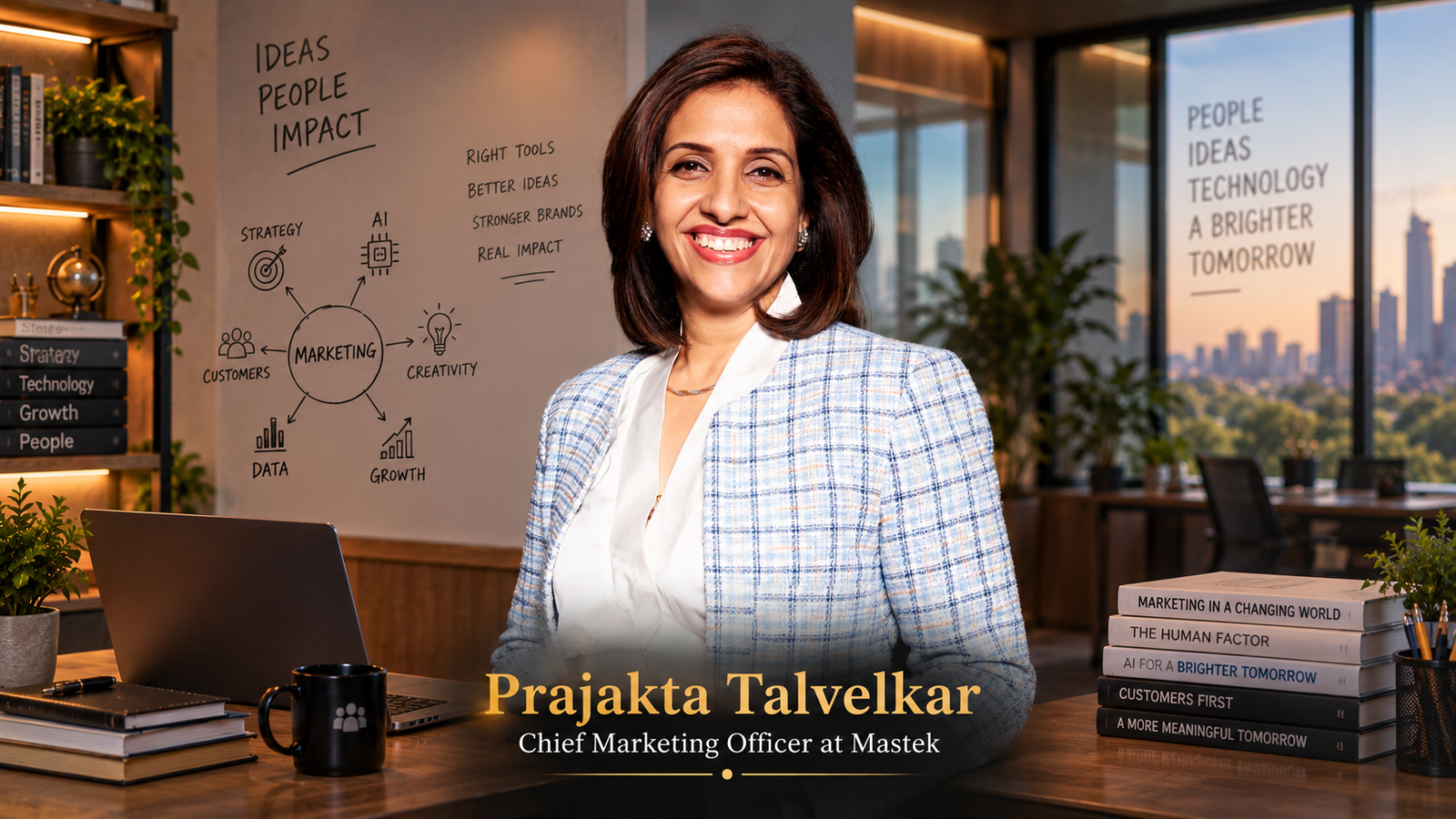
– Written by Prajakta Talvelkar, the Chief Marketing Officer at Mastek, with over two decades of experience across marketing, sales, consulting and alliances in the technology industry. She has held leadership roles across global organisations, including Capgemini and Bristlecone, and brings extensive experience in shaping marketing strategy, driving growth, and connecting technology with business outcomes. An alumna of IIM Calcutta, Prajakta is passionate about marketing, technology, and the evolving role of AI in business.