Why do millions use Canva instead of complex software? Discover how design accessibility drives massive user growth.
Looking for a Shorter Overview?
AI Summary
Key Moments
Drag‑and‑Drop Simplicity
Users create designs by dragging ready‑made elements, eliminating the need for technical knowledge.Pre‑made Templates & Asset Library
Thousands of templates and millions of photos are built‑in, so creators never leave the interface.Freemium Business Model
Free basic tools attract millions, while a low‑cost subscription unlocks premium photos and editing features.Instant Online Sharing
Works can be shared via a link, removing file attachments and software barriers.In 2007, a college student named Melanie Perkins taught graphic design in Australia. Her students faced a major problem: they had to read thick manuals just to draw a simple box on a computer screen. Old software took months to learn, so Melanie solved this frustrating issue with design accessibility. And in 2013, she built a new website called ‘Canva’.
This simple rule means an ordinary person can make a beautiful, professional-looking poster in five minutes without reading a single instruction book. Today, millions of ordinary people use this website to create pictures for their small businesses.
Mechanics of Design Accessibility at Canva
Before this website came along, making a birthday card on a computer was very difficult. A person stared at a blank white screen. He had to click dozens of small, hidden buttons just to change the text colour.
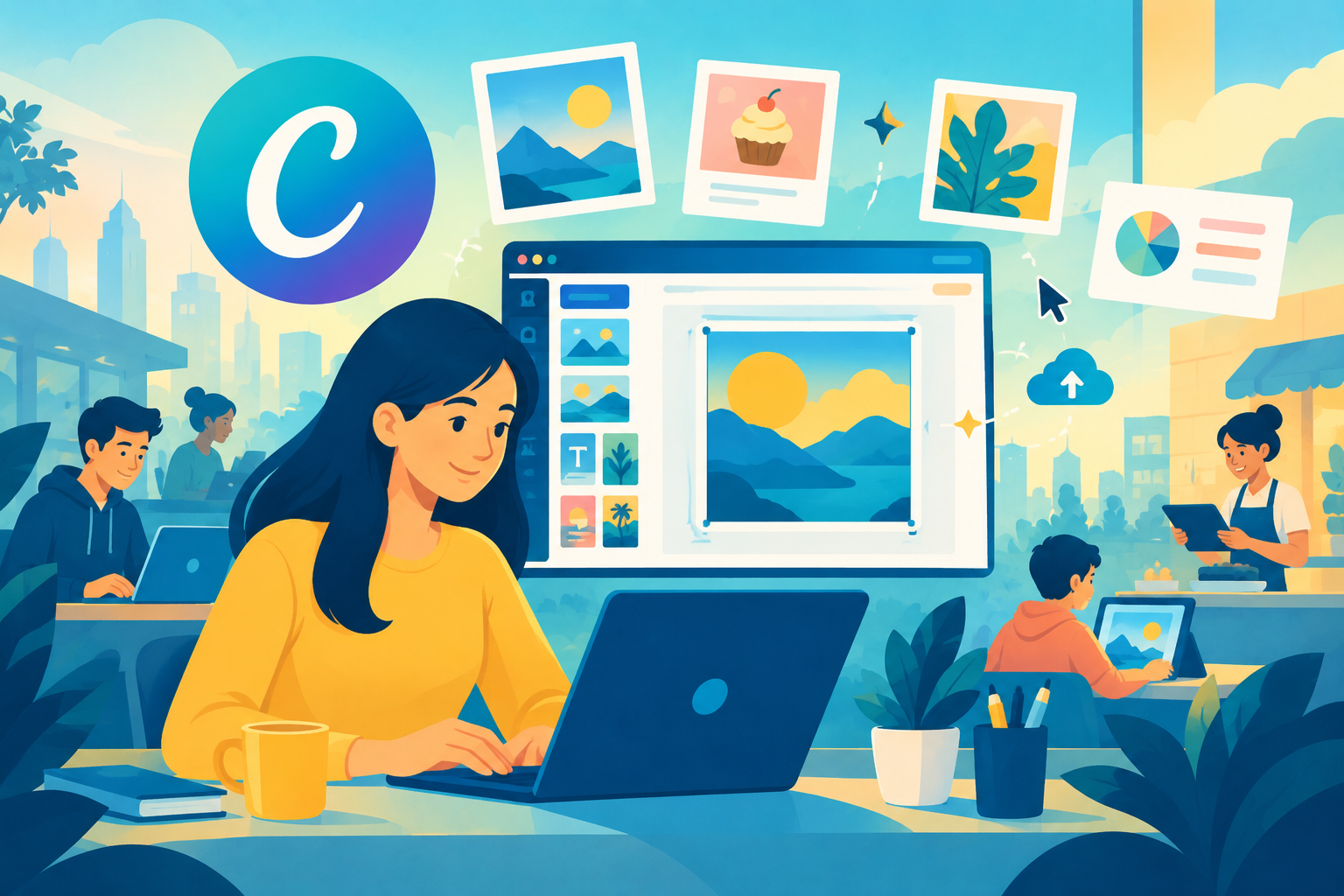
Melanie got rid of all these confusing buttons and built a screen with large, ready-made pictures on the left side. A buyer only has to drag a ready-made box onto the middle of the screen and change the words. And the poster is completely ready in a few minutes.
This simple drag-and-drop action is the physical proof of design accessibility. The company has pre-made thousands of beautiful templates. A bakery owner does not need to know all the technical details of making a template for his store. He just picks a pre-made menu picture, deletes the old words, and types in his own cake prices. Canva completely removes the frustrating computer work.
Old software forced users to buy expensive photos from other websites. They had to download the photo to their hard drive and then upload it into the design program. Canva engineers fixed this by putting millions of photos and text styles directly in the same window. A person searches for a picture of a coffee cup, clicks it, and it instantly appears on their poster. This quick, physical choice adds to overall design accessibility.
Canva also improved how people share their work. In the past, a user had to save a huge file on his computer and email it to his boss. The other person could not open it without the expensive software. Melanie moved the whole process online. Now, a worker just sends a web link. The boss clicks the link and sees the picture instantly. This clear Design Accessibility makes busy office workers very happy.
The owners used a very simple rule to make a profit. A regular person can use the basic tools for free. A shop owner pays a small monthly fee to use special photos or editing tools. This payment system shows exactly how Design Accessibility brings in huge cash. A business gets millions of people to try a free tool, and then users gladly pay the subscription fee to get extra digital tools.
Regular people suddenly found it easy to create professional-looking images. By 2024, Canva had more than 170 million people using the website every month. The company now makes nearly two billion dollars in cash every year. This massive user growth was driven solely by design accessibility. Even a young student can use Canva to make a science project look amazing.
Old computer companies sold expensive software for decades and ignored everyday buyers. But Canva kept gaining more daily users because buyers always choose the tool that requires the least physical effort.
Also read: How Canva Branding Became the Default Design Brand
This daily choice shows exactly how valuable Design Accessibility is in the real world. A business makes huge money today by removing unnecessary buttons from the computer screen.
Loved this article? Read more insightful articles on Brand Custodian.
–Written by Rajnish Singh, a feature writer at Brand Custodian who explores the gap between what brands promise and how consumers actually behave.