Ryanair turned Low-Cost Positioning into a powerful brand identity by making affordability the foundation of its entire business model.
Looking for a Shorter Overview?
AI Summary
Key Moments
Standardized Fleet for Cost Control
Ryanair centered its operations on the Boeing 737, simplifying training, maintenance and deployment to maximize utilization and keep fares low.Strategic Airport Selection
The airline chooses smaller, lower‑cost airports instead of major hubs, reinforcing its affordable‑transport promise.Unbundled Services & A La Carte Pricing
Ryanair stripped traditional free services and charges for extras like baggage and seats, separating transport cost from optional comforts.Continuous Improvement Program
The “Always Getting Better” initiative refines customer experience and digital journey while preserving the core low‑cost model.There are plenty of airlines that sell cheap tickets. Far fewer have made being cheap such a central part of who they are. Ryanair is one of them. Over the years, the airline has turned Low-Cost Positioning from a pricing strategy into a complete brand identity, built around the idea that passengers who want the lowest possible fare should not expect unnecessary extras. From the airports it chooses to the aircraft it operates and the way it communicates with customers, almost every part of the business reinforces that promise.
That clarity is important because Ryanair did not invent the low-cost airline model. Its transformation was heavily influenced by Southwest Airlines, whose operating model demonstrated how a carrier could simplify its fleet, turn aircraft around quickly, avoid unnecessary services and keep fares low. Michael O’Leary studied Southwest’s approach and adapted many of its principles to the European market. What followed was not simply a cheaper airline, but one of Europe’s most recognisable examples of strategic positioning.
Low-Cost Positioning Became More Than a Price Tag
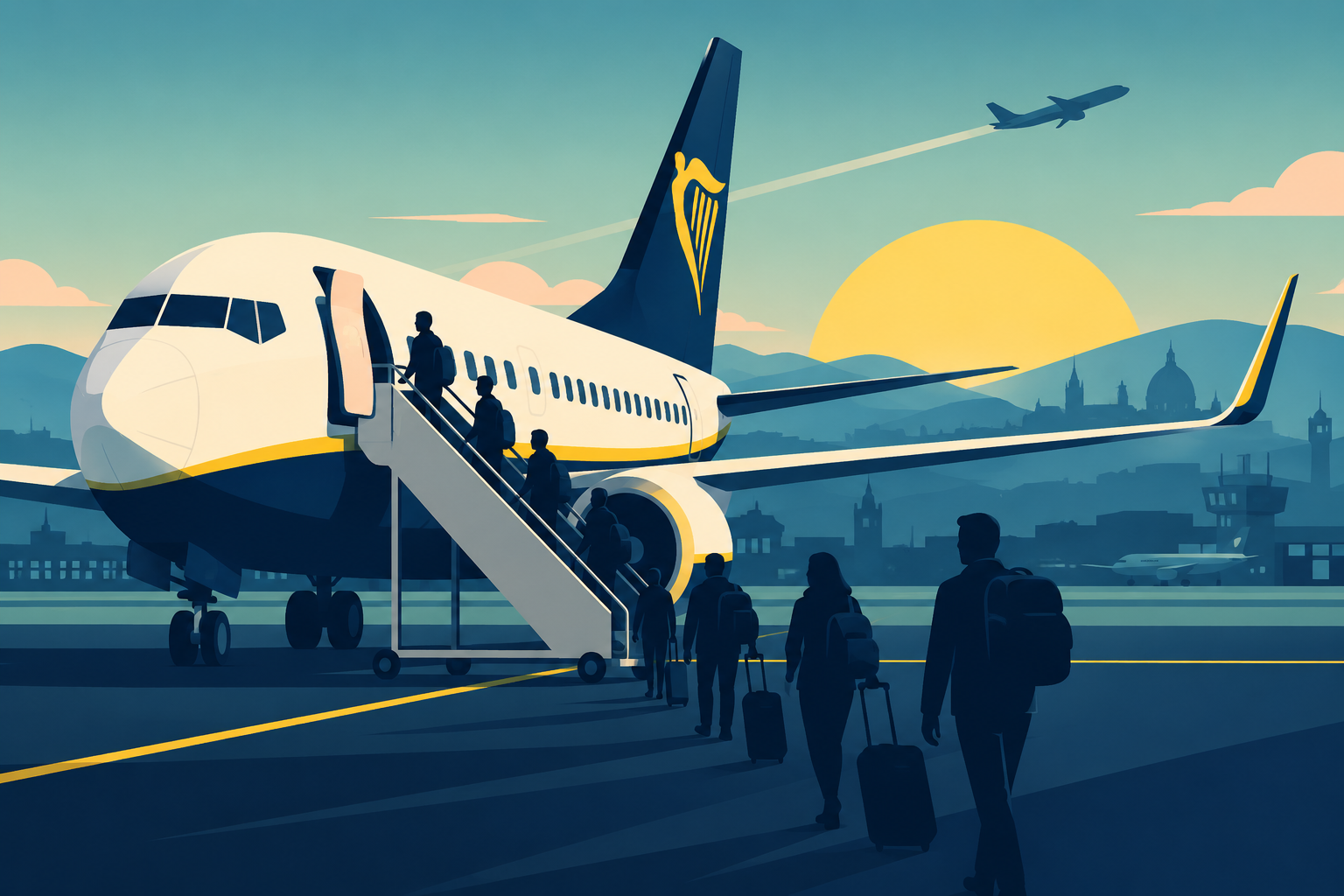
Ryanair’s Low-Cost Positioning works because it is embedded in the way the company operates, rather than being treated as a marketing message added after the fact. A major part of this is fleet standardisation. For years, Ryanair built its operation around the Boeing 737, allowing the airline to simplify crew training, maintenance and aircraft deployment. Standardisation also helped the airline maximise aircraft utilisation and keep turnaround times short.
The choice of airports follows the same logic. Instead of relying primarily on expensive, congested major airports, Ryanair has historically used smaller airports where landing costs can be lower and operations can be more efficient. These decisions may sometimes mean that an airport is farther from the city it claims to serve, but that trade-off is consistent with what the brand is offering: affordable transportation rather than a premium travel experience.
The same philosophy extends to the customer experience. Ryanair stripped away many of the services traditionally associated with air travel and introduced charges for extras such as checked baggage, seat selection and other services. The basic fare remained the centre of the proposition, while customers could decide what additional features they actually wanted to pay for. In effect, the airline separated the cost of transportation from the cost of optional comforts.
This approach also created a very distinctive brand personality. Ryanair has never tried to pretend that it is a luxury airline. Its famously provocative communication, particularly under O’Leary, often attracted criticism, but it also made the airline difficult to ignore. Brand strategist Denise Lee Yohn argued that Ryanair’s strength came partly from knowing exactly whom it was targeting and being comfortable with the fact that it would not appeal to everyone. The brand stood for low fares, and its experience reflected that promise.
That distinction matters. Many companies try to appeal to everyone and gradually lose any clear reason for being different. Ryanair did almost the opposite. It built a proposition around a very specific customer priority: price. Its willingness to make trade-offs visible helped customers understand what they were getting. The airline was effectively saying: if keeping the fare low matters more to you than having a traditional full-service experience, Ryanair is built for you.
Also read: Reddit: How User Communities Became the Product
There was, however, a recognition that an aggressive Low-Cost Positioning could come with a cost to the brand. By 2013, Ryanair had become Europe’s largest airline by international passengers, but its service reputation remained poor. This led to the “Always Getting Better” programme, which sought to improve aspects of the customer experience and digital journey without abandoning the underlying low-cost model. The important point was not to become a conventional full-service airline, but to make the existing proposition easier and more customer-friendly.
That is perhaps the most useful lesson from Ryanair. Low-cost positioning does not mean simply charging less. It means deciding what the brand will prioritise, what it is willing to remove, and how the entire business can support that choice. Ryanair made cost efficiency its operating principle, then allowed that principle to shape its pricing, service, distribution, communication and even its personality.
The result is a brand that is difficult to separate from the idea of low-cost air travel. Ryanair may not be loved by everyone, and it has never tried to be. Its strength comes from being exceptionally clear about what it is—and building the business around that decision.