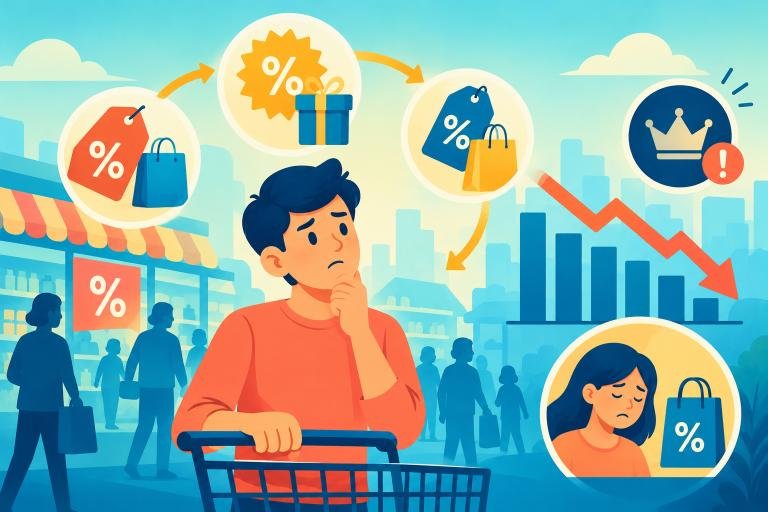
Are endless discounts hurting you Discover why promotional dependency is the ultimate margin risk.
Looking for a Shorter Overview?
AI Summary
Key Moments
Discount volume trade-off
A 5% discount typically requires a 20% sales increase to maintain profit margins.Brand perception erosion
Frequent deep discounts lower premium brand image and make customers question product value.Customer loyalty breakdown
Heavy promotions attract price‑sensitive shoppers who rarely stay loyal once prices return.Difficulty reversing dependency
Once buyers habituate to sale prices, returning to regular pricing becomes challenging for brands.Retailers may use frequent discounts to boost short-term sales, but relying on them too often can lead to Promotional Dependency. Customers may start waiting for sales instead of buying at regular prices, which can reduce future revenue and profit. Understanding why Promotional Dependency develops can help businesses plan more sustainable promotions and protect their long-term profitability.
How Brands Stop Training Human Shoppers Into Promotional Dependency
When a business discounts its products every month, customers may learn to wait for the next sale instead of buying at full price. This pattern can create Promotional Dependency and leave stores quieter during regular weeks.
McKinsey’s ConsumerWise data suggests that about 65% to 66% of U.S. holiday shoppers plan to start shopping before Black Friday, taking advantage of early discount events. As customers delay their purchases, retailers may lose full-price sales and rely more heavily on promotions to bring people back.
When a retailer repeatedly discounts high-quality shoes, shoppers may begin to question their value. This kind of Promotional Dependency can weaken a premium brand’s image and make customers more hesitant to pay full price.
As we discussed in our previous article about Price Elasticity, pricing influences how people judge a product. Frequent discounts may reduce perceived quality, making it harder for a brand to attract customers who value premium products.
A retailer may need to sell far more products after cutting prices just to maintain the same profit. Bain’s analysis suggests that a 5% discount can require a 20% increase in sales volume to offset the lower price. If sales do not rise enough, Promotional Dependency can shrink profit margins because production costs remain unchanged.
Heavy discounts can attract shoppers who are mainly interested in low prices and may not return when products go back to full price. This kind of Promotional Dependency can make it harder for retailers to build lasting customer relationships.
BCG’s research warns that heavy discounting can harm long-term customer value. Frequent, broad promotions may train shoppers to focus on discounts rather than a brand’s products, making them less likely to buy when prices return to normal.
BCG also recommends keeping promotions within a reasonable “fair deal” range. Discounts that go too deep can erode profit margins without building lasting loyalty. Personalised offers, by contrast, can deliver a higher return on investment than mass promotions, while reducing discount leakage and rewarding customers more selectively. Retailers should consider whether promotions are bringing in loyal customers or simply generating one-time sales before investing heavily in them.
A loyal customer may feel frustrated after paying full price for a television if the retailer sharply discounts it the following week. This kind of Promotional Dependency can make customers feel unfairly treated and weaken their trust in the brand.
PwC reports that only 40% of consumers feel they are becoming more loyal to brands, while 90% of business executives believe customer loyalty is increasing. This gap points to a difference between how companies view loyalty and how customers experience it. Retailers can help protect customer trust by planning promotions carefully and considering how discounts affect recent buyers.
After relying on deep discounts for too long, a business may struggle to return to its regular prices. Customers who have grown used to sale prices may resist paying more, making Promotional Dependency difficult to reverse.
Also read: How Can First-Party Data Help Brands Build Better Customer Relationships?
Simon-Kucher’s Global Pricing Study found that nearly 80% of companies raised prices in response to inflation and rising costs, aiming to protect their profit margins. This figure does not mean that 80% of companies fail to restore prices after promotions. Setting clear pricing policies and using discounts selectively can help retailers protect their margins and avoid training customers to wait for a sale.
Loved this article? Read more insightful articles on Brand Custodian.
–Written by Rajnish Kumar, a copywriter and strategist with a background in fast-paced journalism, who explores the gap between what brands promise and how consumers actually behave.