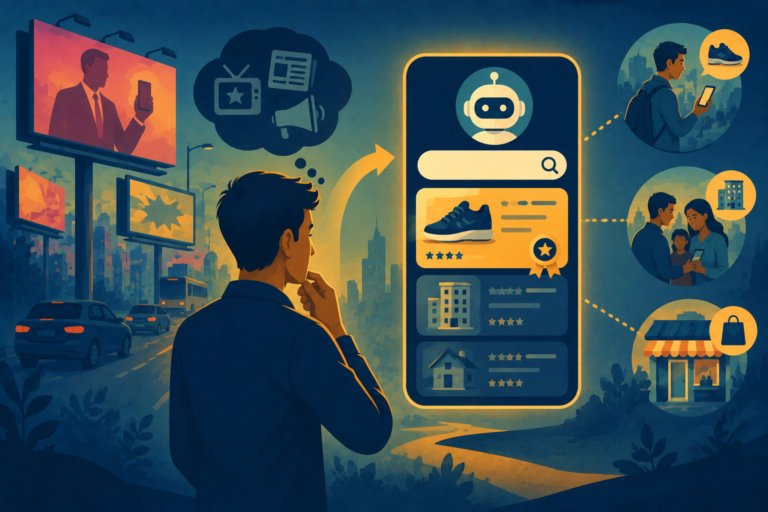
How Generative Search is reshaping marketing by rewarding trust, credibility, and useful content over clicks and rankings.
Looking for a Shorter Overview?
AI Summary
Key Moments
AI‑driven search redefines decision‑making
Generative Search now provides consolidated, AI‑generated answers, reducing the need for manual research across multiple sites.Credibility becomes the new competitive advantage
Brands must create consistent, trustworthy content to earn AI recommendations and stand out in search results.Traditional metrics lose prominence
Clicks and rankings are no longer the sole measure of marketing success; inclusion in AI‑generated answers is critical.Long‑term relationship building outweighs short‑term tactics
Sustained brand presence through helpful content and genuine customer trust drives better AI and consumer engagement.Last Sunday, I was trying to decide where to take my parents for dinner. It sounded like a simple plan until I actually started looking.
One restaurant had excellent reviews but seemed too expensive. Another looked beautiful in photos, but the recent customer comments weren’t very encouraging. A third one seemed perfect until I realised it was much farther away than I expected.
Within a few minutes, I had Google Maps open, a couple of food blogs, Instagram pages, and several review websites. The funny thing was that the more information I collected, the more confused I became.
Out of curiosity, I opened an AI assistant and typed, “Suggest a family restaurant with good North Indian food, a peaceful atmosphere, and reasonable prices.”
A few seconds later, I had a thoughtful answer. It didn’t just list restaurants. It explained why each place suited what I was looking for, pointed out the kind of ambience I could expect, and even suggested which option would be better if I wanted a quieter evening with my family.
I remember looking at the screen for a moment, not because the answer was extraordinary, but because of everything I hadn’t done. I hadn’t opened fifteen different websites, watched YouTube reviews, or spent another half hour comparing opinions. Somehow, I had reached a decision without following the routine I’d become so used to over the years.
That experience stayed with me for the rest of the day.
For years, searching the internet had felt like walking through a crowded marketplace where every shopkeeper wanted your attention. Every website promised the best answer, every advertisement wanted a click, and every article tried to convince you that it had the most reliable information.
This time, it felt different.
Instead of wandering through that marketplace myself, it was almost as if someone had quietly walked through it on my behalf, gathered the most useful information, and returned with a simple recommendation.
It made me realise that the way we search for information is changing much faster than we often notice. That’s what made me think about Generative Search.
Why Generative Search Is Quietly Changing Marketing Strategy
The more I use Generative Search, the more I feel that it isn’t just changing search engines. It’s changing the way people make decisions.
Earlier, searching meant collecting information from different places and putting it together ourselves. One website explained the product, another compared alternatives, a YouTube video shared personal experience, while customer reviews helped fill in the gaps. We did most of the research manually, even if we never really thought about it.
Today, much of that work happens before we even see the answer. As users, that feels incredibly convenient because it saves both time and effort.
But when I started looking at it from a business perspective, it raised a completely different question. If people are no longer opening ten different websites before making a decision, what happens to the marketing strategies businesses have relied on for years?
For the longest time, success was often measured by clicks, website traffic, and search rankings. Those things are still important, but they no longer feel like the entire picture. It seems increasingly important for businesses to become sources of information that deserve to be included in the answer itself, rather than simply becoming another link waiting to be clicked.
I’ve realised that I already respond to brands this way in my own life. When an AI recommends a company I’ve heard about before—one that I’ve seen consistently across articles, reviews, videos, or conversations with friends—I naturally feel more comfortable considering it.
That familiarity isn’t created by a single advertisement or one clever marketing campaign. It comes from years of small interactions that slowly build trust without us even noticing. A helpful blog post, an honest customer review, a useful video, good customer support, or simply seeing the same brand deliver consistently over time all become tiny pieces of a much bigger picture.
I think that’s why Generative Search rewards stronger brands. It doesn’t simply reward whoever spends the most money trying to attract attention. Instead, it benefits businesses that have spent years creating useful content, earning genuine customer trust, maintaining accurate information, and building a reputation people are willing to talk about.
AI doesn’t invent credibility. It learns from the credibility that already exists across the internet. The richer and more consistent that information is, the easier it becomes for AI to understand, trust, and recommend a brand when someone asks a relevant question.
Also read: How Consumer Behaviour Continues to Evolve in the AI Era
Maybe that’s the biggest lesson about Generative Search.
The technology behind search may be evolving at an incredible pace, but human behaviour hasn’t changed nearly as much. We still trust honest recommendations more than flashy advertisements. We still value brands that answer our questions instead of simply trying to sell us something.
Generative Search is simply reflecting those preferences in a new way.
In the years ahead, the brands that stand out may not be the ones shouting the loudest online. They’ll be the ones that have quietly earned trust, shared useful knowledge, and built a reputation strong enough to become part of the answers people receive before they even think about visiting a website.
– Written by Bhavya Singhal, an Emerging Journalist and a Digital Media and Communication student exploring branding, marketing strategy, and consumer psychology through practical observations and real-world examples.