Explore how customer trust, confidence and experience shape service businesses and influence why customers return.
Looking for a Shorter Overview?
AI Summary
Key Moments
Opportunity in Plain Sight
Most valuable opportunities come from observing existing customer behavior rather than chasing trends.Story Over Features
Differentiation only matters when customers understand why it matters to them.Product as Marketing
The product itself serves as the brand's most powerful marketing tool through authentic customer interactions.Trust Beyond Attention
Building genuine trust requires meaningful interactions, not just impressions and reach.When I started Style of Meraki, I was not thinking about marketing frameworks, positioning statements or brand differentiation. I was thinking about jewellery.
I had noticed a friend buying expensive artificial jewellery and found myself wondering why natural gemstones could not be made available at a similar price point. I had always been fascinated by gemstones, but I also understood that for many people, they could feel expensive, unfamiliar or difficult to understand. That question eventually led me to start Style of Meraki.
Over time, I realised that I was not just building a jewellery brand. I was also trying to change the way people perceived a category. And that taught me some lessons about marketing that I probably would not have understood if I had started with a marketing plan instead of a product.
Sometimes the opportunity is hiding in plain sight
As marketers, we often look for opportunities in trends, competitor activity, consumer research, and changing technology. All of these are useful, but I have found that some of the most interesting opportunities can come from simply observing what people are already doing.
The idea for Style of Meraki came from one such observation. My friend was buying artificial jewellery at a relatively high price, and I started wondering why natural gemstones could not be an alternative. The more I thought about it, the more I realised that the issue was not necessarily a lack of interest in natural gemstones. There was also a perception around them. They seemed expensive, unfamiliar and, in some ways, reserved for people who already knew about jewellery.
That changed the way I looked at the opportunity.
Instead of asking how I could convince people to buy something they had never considered, I started thinking about what was stopping them from considering it in the first place.
That is a question I think more brands should ask. What looks like a lack of demand can sometimes be a lack of accessibility, understanding, or familiarity.
A good product still needs a simple story
One of the things I have learnt while building Style of Meraki is that having something different is not enough. People need to understand why that difference matters to them.
Natural gemstones have many qualities that make them interesting, but not everyone knows what those qualities are. If someone has never bought a gemstone before, telling them that the stones are natural does not automatically give them a reason to care.
That meant I had to think beyond the product itself. How do I make someone curious about gemstones without making them feel like they need to become an expert first? How do I talk about the product in a way that feels inviting rather than intimidating?
This is where I think marketing plays a very important role. Good marketing does not always make a product sound more impressive. Sometimes it simply makes the product easier to understand.
When consumers can quickly understand what you offer, why it is relevant to them, and what makes it different, you have already removed one of the biggest barriers to purchase.
The product has to live up to the promise
It is easy to talk about differentiation in marketing. It is much harder to build it into the product.
I have always believed that the jewellery itself has to make someone want to wear it. The story around natural gemstones can create interest, but ultimately, the design has to stand on its own.
This taught me that the product is often a brand’s most important marketing tool.
If the product is genuinely distinctive, every customer interaction can reinforce the brand. Someone wearing the jewellery becomes a form of visibility. When a customer recommends it to a friend, it becomes an endorsement. A person discovering a design online and wanting to know more becomes another opportunity to tell the brand story.
We sometimes separate product, marketing, and customer experience into different boxes. As a founder, I have realised that consumers do not see those boxes. They simply experience the brand.
That makes the product itself incredibly important.
Trust takes longer than attention
When I started Style of Meraki, exhibitions were an important part of the journey. Meeting customers in person gave me the opportunity to understand what they liked, what they asked about, and what made them hesitate.
Those conversations taught me something easy to forget when we look at marketing through the lens of impressions, reach, and engagement.
Attention is not the same as trust.
Someone can see your product on Instagram and forget about it five minutes later. Another person might see it at an exhibition, ask questions, touch the product, speak to you, follow the brand online, and come back weeks later to make a purchase.
Both people have interacted with the brand, but the second interaction has created much more confidence.
For a growing brand, I think this matters enormously. Not every interaction needs to result in a sale. Sometimes the job of marketing is simply to make the next interaction easier.
The customer sees you. Then they remember you. Then they understand you. Then they trust you enough to buy from you.
That process cannot always be rushed.
Going digital does not mean losing what makes you different
As Style of Meraki grew, I had to learn how to take the brand beyond physical exhibitions and into the digital world. Social media, websites and online communication opened up an entirely new way of reaching customers.
But digital also brings a challenge that every growing brand faces: it is very easy to start looking like everyone else.
Every category has its own familiar formats. In jewellery, it can be product photographs, reels, influencer collaborations, festive campaigns and promotional offers. These formats can be useful, but they can also make brands increasingly difficult to distinguish from one another.
That made me realise that the channel should change, but the core reason for choosing the brand should not.
Whether someone discovers Style of Meraki at an exhibition, through Instagram, or through a recommendation from a friend, I want the same underlying idea to come through: natural gemstone jewellery can be beautiful, contemporary and accessible.
Digital should amplify what makes a brand different. It should not erase it.
Accessibility can be a brand idea
Looking back, I think accessibility became one of the most important ideas behind Style of Meraki, even though I did not necessarily think of it that way when I started.
Accessibility is not only about price. It can also mean making something easier to understand, easier to discover, and easier to imagine as part of everyday life.
There are many categories that people admire from a distance but do not necessarily feel comfortable entering. They may think something is too expensive, too complicated, or simply not meant for them.
That is where brands can create an interesting opportunity.
Instead of constantly trying to make a product feel more exclusive, perhaps the question should sometimes be: how can we make more people feel that this product is for them?
That does not mean making the product ordinary. It means removing some of the unnecessary distance between the consumer and the category.
Also read: When Brands Chase Every Trend, They Risk Losing What Makes Them Distinctive
What I have learnt about marketing
Building Style of Meraki has changed the way I think about marketing. I have learnt that you do not always need a bigger campaign to make a brand grow. Sometimes you need a clearer reason for people to care.
You do not always need to create a new consumer need. Sometimes you need to look more closely at an existing one.
You do not always need to tell people why your product is different. Sometimes you need to build that difference into the product itself.
And you do not always need to push consumers towards an immediate purchase. Giving them enough reasons to understand, remember, and trust your brand can be just as important.
When I look back at the question that started Style of Meraki, it was a fairly simple one: why should natural gemstones feel inaccessible when people are already willing to spend money on jewellery?
I did not know where that question would lead at the time. But building a brand around it has taught me something I now carry into everything I do in business: sometimes the best marketing opportunity is hiding inside the assumption that everyone has simply accepted.
The job of a brand is to notice it, question it, and, if there is a better way, build something around it.
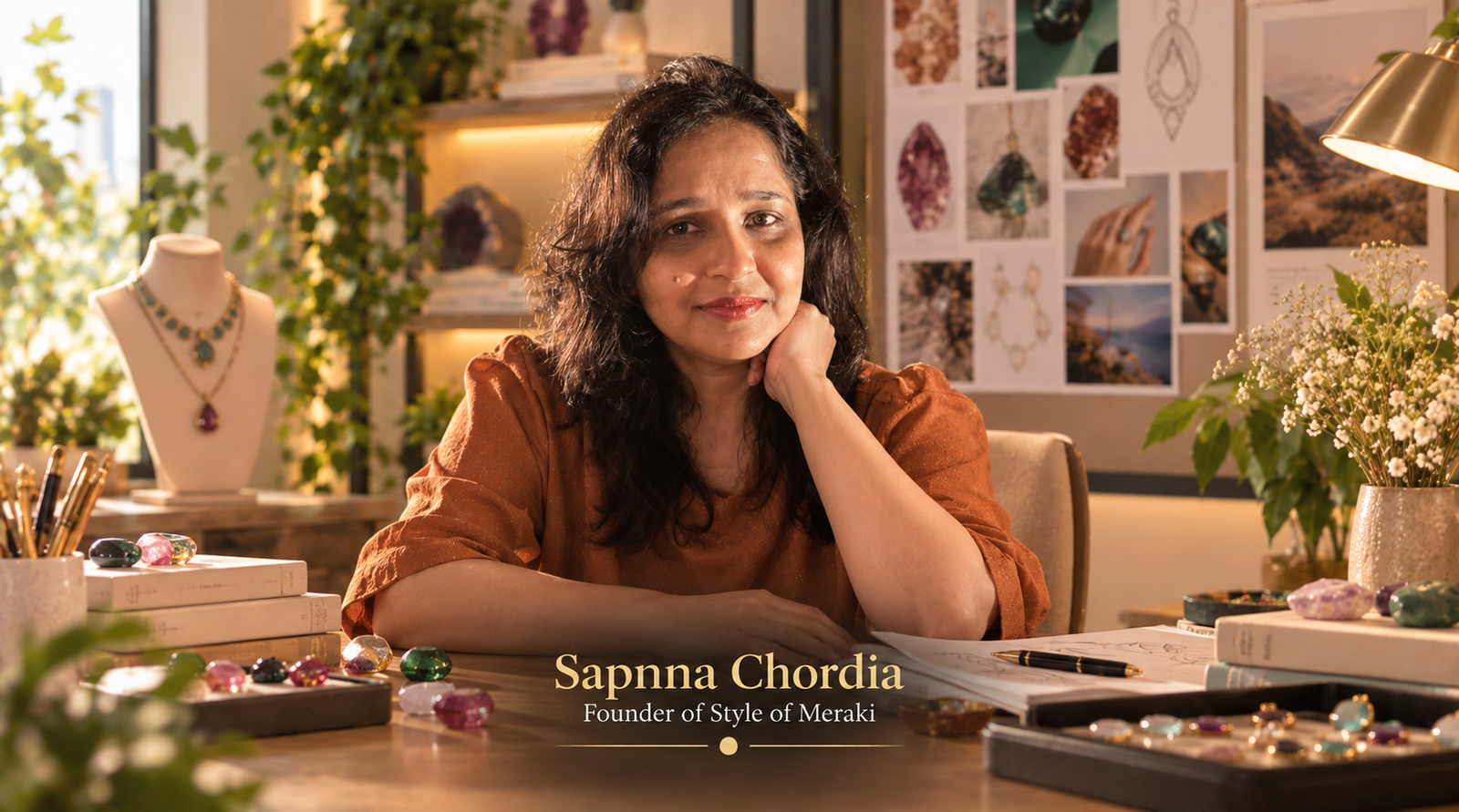
– Written by Sapnna Chordia, founder of Style of Meraki, whose journey with gemstones began in 2003 and evolved into a passion for creating meaningful, accessible jewellery. With a focus on natural gemstones, beauty, and purpose, Sapnna creates pieces that reflect individuality, intention, and the energy of the stones.