A textbook is boring, but a game is addictive. See how Duolingo mastered gamification to build a massive global business.
Looking for a Shorter Overview?
AI Summary
Key Moments
Owl Reminder System
The green owl sends gentle push notifications to keep users engaged daily.Streak Addiction
The fire streak icon motivates users to study every day, even late at night, to avoid resetting progress.Social Leaderboard & Competition
Public leaderboards rank users weekly, leveraging competition to increase study time.Monetization via Hearts
Paid hearts allow uninterrupted practice, turning free gameplay into a $500 million revenue stream.Learning a new language is usually very boring. A student sits in a quiet room with a heavy grammar book and tries to memorise foreign words. Most people quit after just one week. But in 2011, a computer science professor named Luis von Ahn changed all that with ‘gamification’.
He is the same person who helped invent those security letters for websites to prove you are human. He knew exactly how to keep people looking at a computer screen. He built a free language learning app called Duolingo with that strict rule of gamification.
This simple rule turns a dull school subject into something that feels exactly like playing a video game. Today, millions of people tap their phone screens to learn French or Spanish instead of playing ordinary mobile games.
How Gamification Keeps People Playing
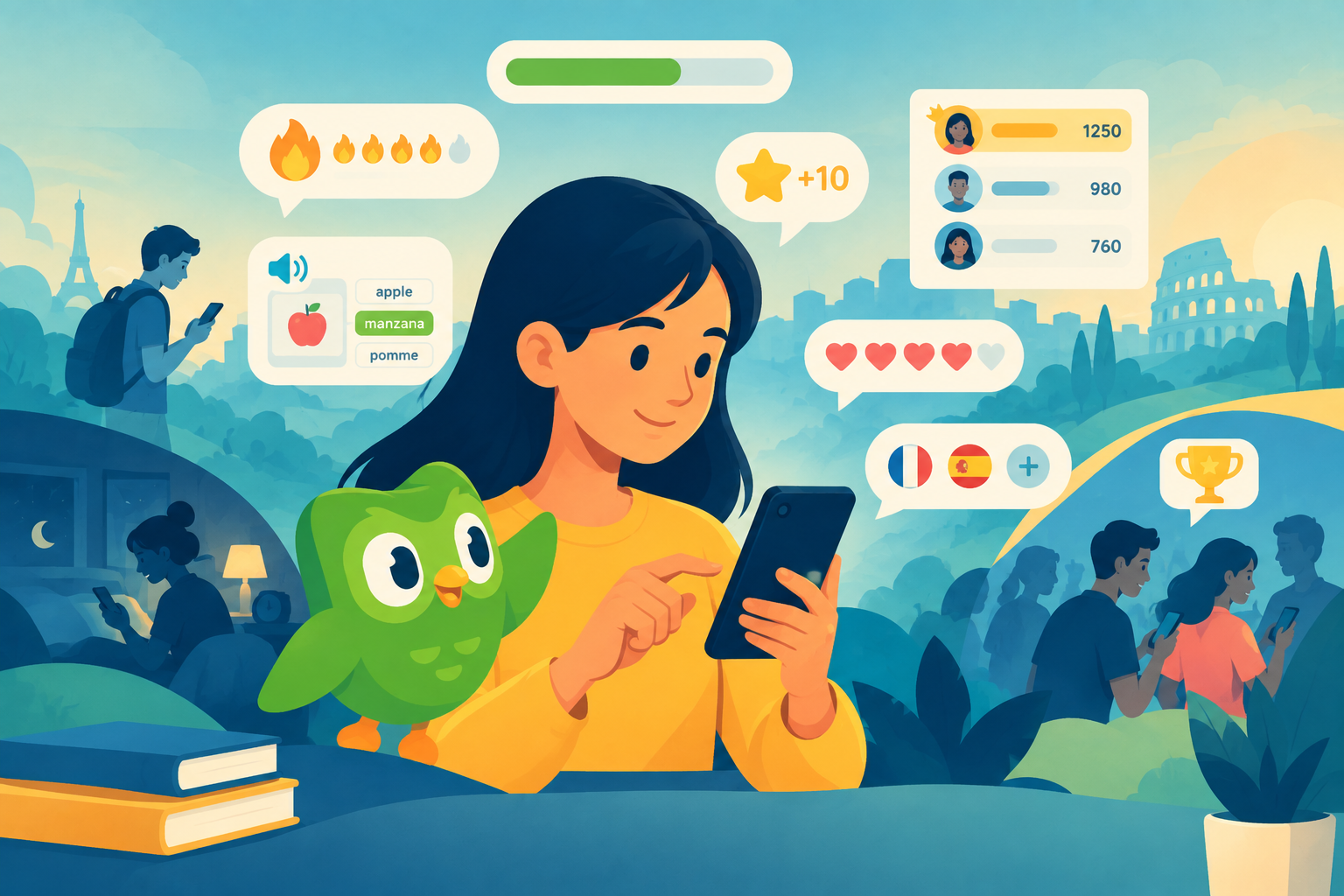
Luis knew that humans are easily distracted. To solve this, his team drew a bright green cartoon owl named ‘Duo’. The bird acts like a digital teacher. If a user forgets to open the app for a day, the phone screen instantly lights up with a message from the green owl. The owl asks the person to come back and finish a quick lesson.
This gentle reminder is a basic part of gamification. The message encourages the person to keep learning. Because of this simple physical action, Duolingo has over thirty million people opening the app every day.
Another feature uses a daily fire symbol called a ‘streak’. A student completes one short lesson. A small fire icon lights up on the screen with a number. When a person studies for ten days in a row, the number changes to ten. And if a user misses just one single day, the fire goes out, and the number drops back to zero.
This ‘streak’ system shows how gamification changes daily human habits. Nobody wants to lose the progress they’ve worked hard for. A person will sit on their bed at midnight and type Spanish words just to keep that streak going.
Inside the actual lesson, the phone screen feels very playful. The user does not read long pages of text; instead, he taps small word boxes, speaks into the phone microphone, and matches pictures. When he gets an answer right, the app plays a happy ringing sound. A green bar also moves across the top of the screen to show his progress.
The user earns digital points for correct answers. These points show how gamification works. Earning points makes the human brain feel very happy, just like scoring a goal in a real football match.
Office workers also added a public scoreboard to the app. Every week, fifty random users are grouped into a digital league. A student can see exactly how many points the other forty-nine people have. And when a user earns more points, their name moves to the top of the rankings.
This public ranking is another clever part of gamification. People naturally do not want to lose to other people. A mother might spend an extra twenty minutes learning Japanese just to pass a stranger on the weekly scoreboard.
This rule generates a lot of cash for the company. The basic app is completely free to use, but the software gives users only five red hearts. Each vocabulary mistake breaks one red heart. When all five hearts are gone, the user has to stop playing and wait for hours or watch long video ads to earn a heart back. Anyone who wants to play without stopping pays a monthly fee.
Also read: What Duolingo Brand Voice Teaches About Standing Out
This payment system shows exactly why gamification is brilliant. A business gets millions of people to play a free game every day, and users gladly pay the fee to avoid forced pauses. In 2023, the company earned over five hundred million dollars from these monthly fees.
Many old schools still force students to read thick paper books. They wonder why students do not pay attention. But Duolingo proved that making education feel like a fun toy actually works in the real world. Honest gamification helps ordinary people learn difficult subjects by turning daily study time into a simple phone game.
Loved this article? Read more insightful articles on Brand Custodian.
–Written by Rajnish Singh, a copywriter and strategist with a background in fast-paced journalism, who explores the gap between what brands promise and how consumers actually behave.