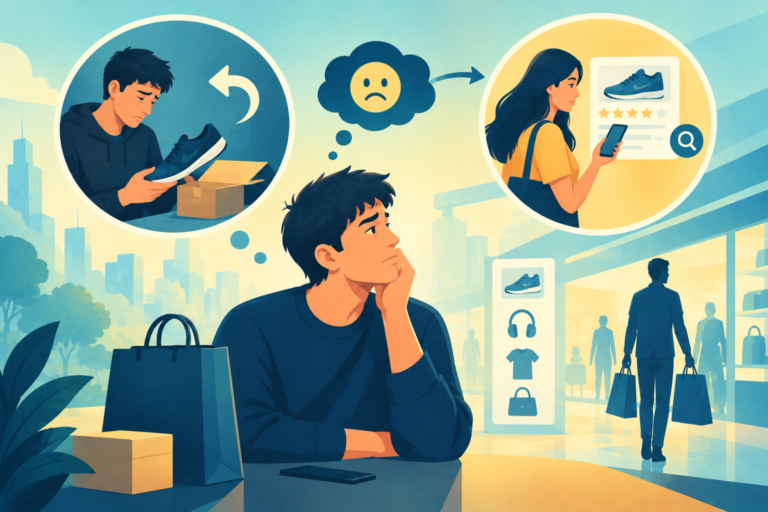
Social Proof explains how others’ choices, reviews, and opinions influence our decisions, especially when we are uncertain.
Looking for a Shorter Overview?
AI Summary
Key Moments
Crowd Wisdom for Uncertainty
When unsure, people rely on others' choices as a shortcut to reduce perceived risk.Impact of Reviews and Ratings
Customer reviews and ratings serve as powerful signals that shape purchasing decisions.Similarity Boosts Influence
Social proof is strongest when the source resembles the receiver, making recommendations feel more relevant.Risks of Manipulated Proof
Exaggerated popularity claims or fake reviews can mislead, highlighting the need for authentic evidence.Imagine walking into a restaurant you have never visited before. One place is almost empty, while another has people waiting outside for a table. Without knowing anything about the food, service, or prices, you may instinctively assume that the crowded restaurant is the better choice. The same thing happens when we check product reviews before buying, choose a film because everyone is talking about it, or feel more confident about a brand because people we know already use it. Social Proof is the psychological tendency to look at what other people are doing, choosing, or approving of when deciding what we should do ourselves. It becomes especially influential when we are uncertain or unfamiliar with a situation.
This behaviour is not limited to shopping. We constantly look to other people for clues about what is appropriate, popular, safe, or worth trying. When there is no obvious answer, the actions of others can become a shortcut for making our own decisions. If many people appear to have made the same choice, we often assume they know something we do not. That assumption can make a decision feel less risky and more reassuring.
How Social Proof Shapes Consumer Decisions
Consider a person searching for a new pair of headphones online. Two products have similar specifications and prices, but one has hundreds of customer reviews and a high rating, while the other has barely any feedback. The first product is likely to feel like the safer option. The buyer has no personal experience with either product, so the experiences of previous customers become a useful source of information. Reviews, ratings and testimonials work as signals that help reduce uncertainty.
This is one reason Social Proof has become such an important part of marketing. Businesses can show genuine customer experiences, case studies, testimonials, ratings, user-generated content and endorsements to demonstrate that other people have already trusted their offering. The influence can become even stronger when the people providing the proof are similar to the potential customer. A small-business owner may pay more attention to another business owner describing how a service helped them than to a generic advertisement making the same claim. Similarity makes the experience feel more relevant and easier to relate to.
Also read: Why Brand Recognition Matters When Consumers Are Choosing Quickly
Popularity itself can also become a signal. Labels such as “bestseller,” “most popular” or “trending” tell consumers that other people have already chosen the product. A busy restaurant, a popular book or a product with thousands of reviews can therefore attract more attention simply because its existing popularity suggests that the choice has already been tested by others. Research cited by Coveo found that labelling a restaurant dish as one of the most popular increased orders of that dish, showing how popularity can influence decisions.
However, Social Proof does not always lead people towards the right decision. The crowd can be wrong, and people can follow one another even when there is little reliable evidence behind the behaviour. Social proof can also be manipulated through exaggerated popularity claims, misleading testimonials or fabricated reviews. In these situations, the same psychological shortcut that makes genuine recommendations useful can make misleading information persuasive.
There is also an interesting difference between positive and negative social proof. Seeing many people praise a product can increase confidence, while seeing repeated complaints can quickly create doubt. Even a small amount of negative feedback can make consumers reconsider a purchase because it introduces the possibility that their expectations may not be met. This is why completely hiding negative feedback can sometimes appear less credible than presenting a balanced picture of customer experiences.
For businesses, the lesson is not simply to show that “everyone is buying this.” Effective social proof works because it provides believable evidence from real people and relevant experiences. Customer stories, honest reviews and credible recommendations can answer the questions a potential buyer may already have: Has this worked for someone like me? Can I trust this brand? Am I making a sensible choice?
Ultimately, Social Proof reminds us that our decisions are rarely made in isolation. We may believe we are choosing based entirely on our own preferences, but the behaviour and opinions of people around us often provide the reassurance that moves us from uncertainty to action. The crowd does not always know best, but when we do not know what to choose, we naturally look around to see what everyone else is doing.