Discover how category entry points help brands win recall by owning buying moments instead of competing on product features.
Looking for a Shorter Overview?
AI Summary
Key Moments
Traditional USP's Decline
Unique selling propositions are becoming irrelevant as products become identical across competitors.Category Entry Points Definition
CEPs are specific real-world triggers that make buyers think about your brand first.Quick-Commerce Application
Swiggy Instamart, Zepto, Blinkit differentiated themselves by targeting specific consumer emergencies.Customer-Centric Approach
Successful brands stop talking about themselves and instead focus on understanding customer pain points.If we look at what marketing professors have taught us, it comes as no surprise that one of the first lessons is that every brand needs a unique selling proposition. A USP.
If you wanted to sell soap, it needed a special ingredient. If you wanted to sell software, it needed a feature nobody else had.
But let’s be brutally honest. What happens when your product is exactly the same as your competitor’s?
Today, features are copied in a matter of weeks. The smartest marketers aren’t fighting over features anymore. Instead, they are completely changing the battlefield.
They are fighting over category entry points.
Category Entry Points: The Death of the USP
But first, let’s look at what category entry points actually are.
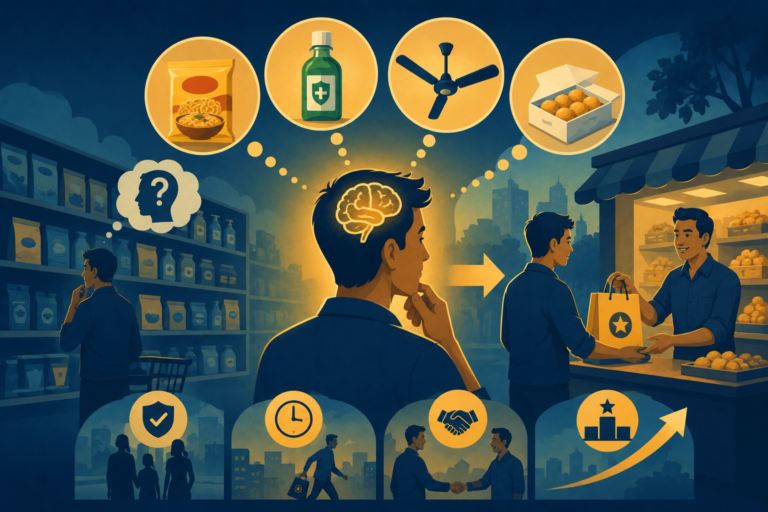
They are the specific, real-world cues that trigger a buyer to think about your brand. They are the moments in a customer’s life when a problem suddenly arises.
Instead of trying to convince a customer that your brand is “the best,” you just need them to remember you first when a specific situation happens.
Think about Eno.
Eno doesn’t waste millions of rupees trying to convince you that it has a scientifically superior formula to every other antacid on the market. It doesn’t talk about its corporate purpose.
Instead, it owns a specific moment.
You just ate two plates of heavy, greasy Chole Bhature at a wedding, and your chest starts burning. That is the cue. And the moment that cue happens, your brain instantly screams, “Eno.”
They own the moment, so they own the market.
The Quick-Commerce Masterclass
You can see this exact shift happening right now in the Indian quick-commerce war.
Swiggy Instamart, Zepto, and Blinkit are essentially selling the exact same groceries at the exact same prices. If they relied on a traditional USP, they would simply bleed money fighting over tiny, margin-destroying discounts.
So what did they do to differentiate themselves from the competition?
Any guesses?
Yes, you guessed it.
They shifted their entire advertising focus to their own distinct category entry points.
Blinkit didn’t just advertise “fast delivery.” It flooded the internet with campaigns tied to hyper-specific emergencies.
Forgot your charger at home while heading to the office? Blinkit.
Suddenly have guests arriving in ten minutes and no snacks? Blinkit.
Need a printout of your resume right before an interview? Blinkit.
They aggressively mapped out the chaotic, everyday frictions of an urban Indian consumer. And when you successfully map your product to a specific real-world emergency, price becomes completely irrelevant.
Also read: The Barbie Movie Marketing Phenomenon Was Years in the Making
Stop Talking About Yourself
So where do most B2B and D2C brands get it completely wrong?
The simple and most straightforward answer is that they spend all their time talking about themselves.
They talk about their founders, their award-winning design, and their seamless user interface.
But the customer does not care about your interface or how many awards you have in your office showcase.
If you want to win today, you have to stop asking, “How do we make people like our brand?”
Instead, ask, “What is the exact situation the customer is in right before they need us?”
That is the only question that matters.
If you sell enterprise HR software in Gurugram, your cue isn’t “We have a great payroll dashboard.”
Your cue is, “It is the 28th of the month, the finance team is panicking, and the legacy software just crashed again.”
Stop trying to be everything to everyone. Find the specific, painful moments of friction in your buyer’s life and master your category entry points.
— Written by Rajnish Singh, a copywriter and strategist with a background in fast-paced journalism, who explores the gap between what brands promise and how consumers actually behave.