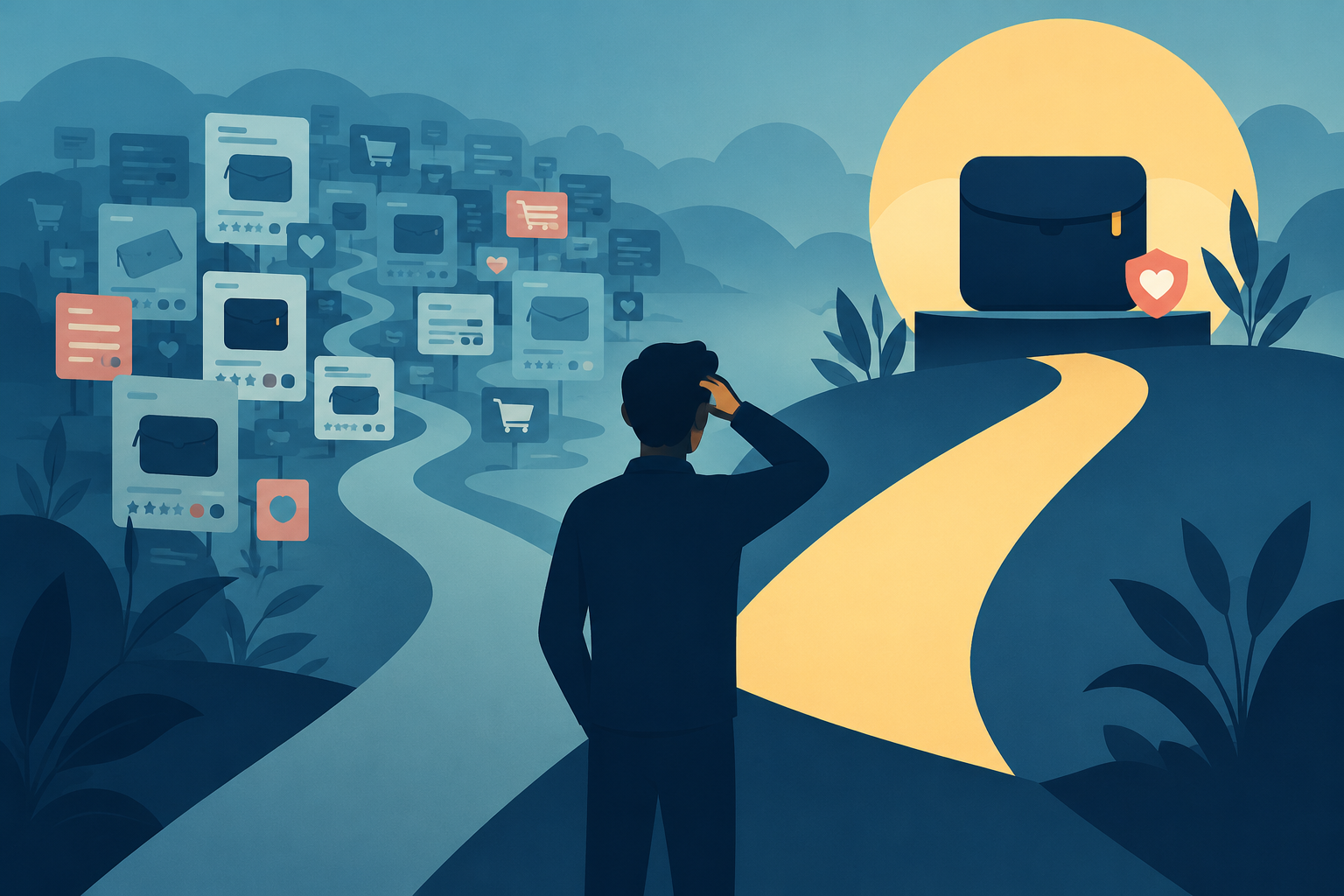
Learn how decision fatigue influences buying behaviour and why familiar, trusted brands often become consumers' easiest choice.
Looking for a Shorter Overview?
AI Summary
Key Moments
Decision Fatigue Drives Familiar Choices
When mental energy depletes, consumers favor known brands over thorough comparison.Paying for Certainty
Shoppers choose recognizable brands to avoid the cognitive load of exhaustive evaluation.Trust as Mental Shortcut
Repeated positive experiences create automatic trust, making strong brands more resilient to competition.Simplification Wins
Leading brands succeed because they reduce decision effort, offering peace of mind in an overchoice environment.A few weeks ago, I was trying to buy a laptop sleeve. It wasn’t an important purchase, so I assumed I’d be done in five minutes. I opened an online shopping app, typed in the size I needed, and was immediately greeted with hundreds of options. Different colours, different materials, different sellers, and every listing claimed to be the best.
At first, I genuinely tried to make the right choice. I opened one product after another, compared ratings, zoomed in on the pictures, and read reviews from strangers I’d never meet. For a while, it felt productive. But after twenty minutes, every laptop sleeve started looking exactly the same, and I realised I wasn’t getting any closer to making a decision.
Then something changed. I stopped trying to find the perfect option. I simply wanted the decision to be over. So I picked one from a brand I’d heard of before, placed the order, and closed the app. It wasn’t because I had proved it was the best. It was because my brain had reached a point where familiarity felt more valuable than another twenty minutes of comparison.
That small purchase stayed with me for the rest of the day. I realised I hadn’t paid extra for better stitching or stronger material. At that moment, I had paid for certainty. I had paid for the comfort of not having to think anymore.
The more I thought about it, the more I realised this probably happens far more often than we notice. We like to believe every buying decision is logical and carefully researched. But by the time we decide what to buy, we’ve already spent the entire day making dozens of other decisions without even realising it.
That’s exactly where decision fatigue begins to shape the brands we choose.
Why Decision Fatigue Gives Strong Brands an Advantage
From the moment we wake up, we’re constantly making decisions. What should I wear? Which email should I reply to first? Should I take this route or that one? What should I order for lunch? Most of these choices seem small, but together they quietly drain our mental energy throughout the day.
By the time we’re standing in front of a supermarket shelf or scrolling through an online store, our brains are no longer looking for more decisions. They’re looking for fewer. They want a shortcut that feels safe enough to trust without starting the entire thinking process again.
That’s why familiar brands become so powerful. A recognised logo, a product we’ve used before, or a company someone once recommended instantly reduces the effort required to make a choice. The brand doesn’t necessarily prove it’s the absolute best. It simply removes enough uncertainty for us to feel comfortable moving forward.
Also read: Why Figma Branding Never Relied on Traditional Advertising
I’ve started noticing this in my own shopping habits. Sometimes I’ll reach home and realise I never seriously looked at half the alternatives available. It wasn’t because they were poor products. I simply didn’t have the patience to compare every feature, every review, and every tiny difference. Choosing the familiar brand allowed me to move on with my day.
I think that’s something many businesses underestimate. They spend enormous amounts trying to convince customers that they’re better than every competitor. But many customers aren’t searching for perfection. They’re searching for confidence. They just want to feel that they’re making a decision they probably won’t regret.
That’s why decision fatigue quietly makes strong brands even stronger. Every positive experience, every recommendation, and every consistent interaction add another layer of trust. Over time, that trust becomes a mental shortcut. Instead of asking, “Which option is the best?” customers begin asking, “Which one already feels familiar?”
Maybe that’s the biggest lesson. Strong brands don’t always win because they have dramatically better products or lower prices. They often win because they make life just a little easier. In a world where we’re surrounded by endless choices every single day, the brand that helps people think less often becomes the brand people choose more.
– Written by Bhavya Singhal, an Emerging Journalist and a Digital Media and Communication student exploring branding, marketing strategy, and consumer psychology through practical observations and real-world examples.