Learn why brand salience drives purchase decisions better than awareness, and how brands stay top of mind when buyers act.
Looking for a Shorter Overview?
AI Summary
Key Moments
Critical gap between brand awareness and salience
Awareness only means recognition, but doesn't drive purchase decisions.Bisleri exemplifies peak brand salience
The brand owns the mental trigger for immediate water purchases in emergency situations.Viral marketing creates views without revenue
Influencer campaigns generate awareness but fail to build actual buying triggers.Need to link products to specific buying moments
Successful brands associate solutions tightly with real-world friction points.Let’s start with a simple task. Ask any average CMO what their primary goal for the quarter is, and they will usually say “increasing brand awareness.”
They want millions of impressions. They want their logo plastered across IPL jerseys and massive billboards in Mumbai. They want to trend on Twitter.
But here is the harsh reality.
Awareness just means people know you exist. It absolutely does not mean they are going to buy from you.
In a brutally crowded market, being famous is no longer enough. You have to be thought of at the exact right time.
Brand Salience: The Difference Between Famous and Profitable
Let’s get the definitions straight. Awareness is a completely passive state.
Everybody in India knows what Snapdeal is. The brand awareness is incredibly high. But when you need to buy a pair of running shoes on a Thursday afternoon, do you actually open their app?
Probably not.
That is the dangerous gap between awareness and brand salience.
Salience is the psychological reflex that happens the moment a customer realizes they have a problem. It is not about whether they recognize your logo in a multiple-choice survey or a sterile focus group.
It is about whether your brand automatically pops into their head when their wallet is already out on the table.
The Bisleri Reflex
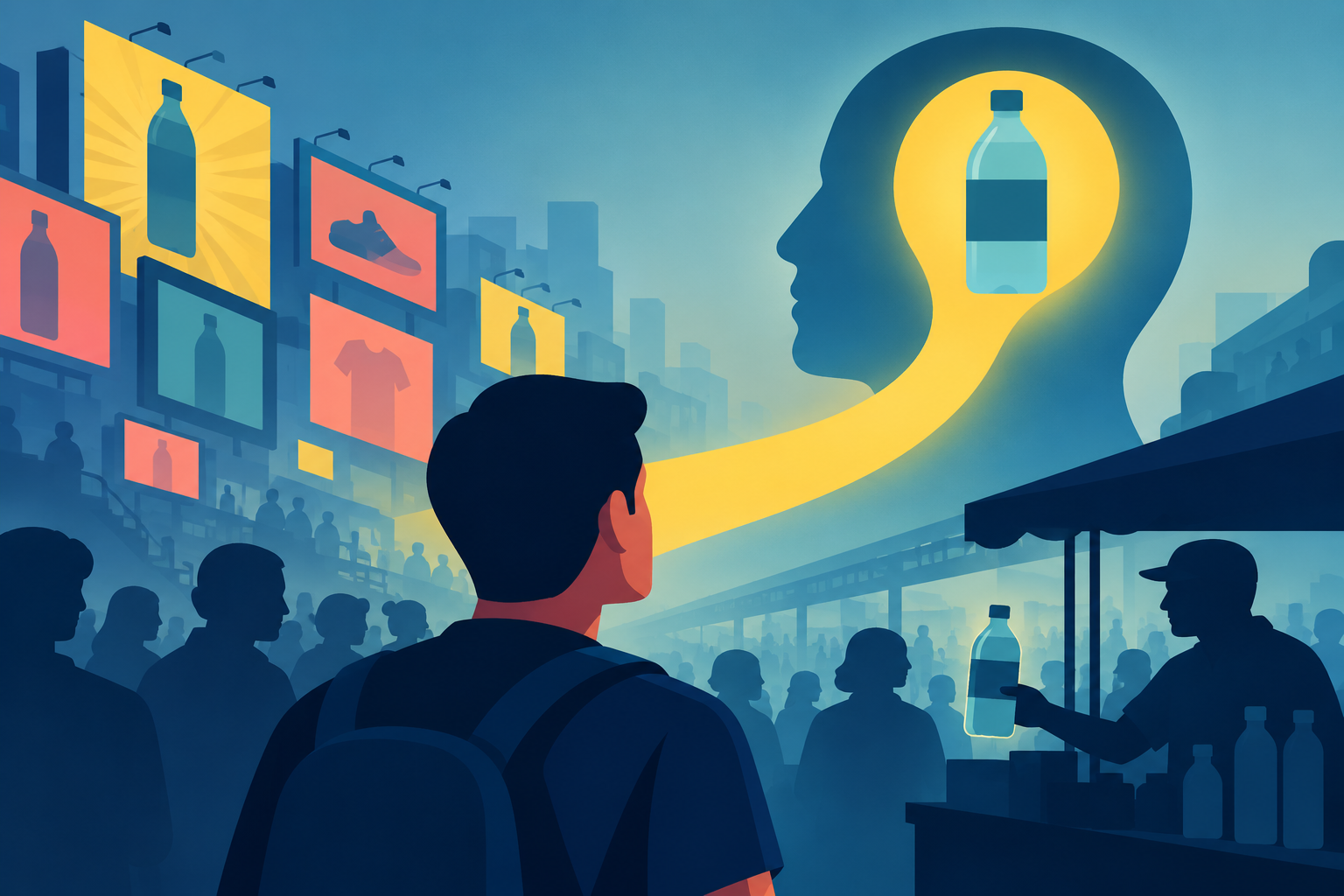
Think about how you buy water at a crowded railway station in Patna.
You are sweating, you are exhausted, and you are terrified of getting sick from tap water. You walk up to the platform vendor, and you do not ask for “packaged drinking water.”
You ask for a Bisleri.
The vendor might hand you a Kinley, an Aquafina, or some hyper-local brand you have never heard of. And because you are intensely thirsty, you will probably still drink it.
But the mental trigger was owned entirely by one company. That is what peak brand salience looks like.
They don’t just own market share. They own the neurological real estate of a very specific urban emergency: “I am away from home, and I need clean water right now.”
Also read: What Makes a Strong Employer Brand in an Era of AI Hiring
The Viral Marketing Trap
This is exactly why most influencer campaigns and viral stunts fail to generate actual revenue for B2B and D2C brands.
A brand will spend fifty lakh rupees to get a Bollywood celebrity to do a quirky dance challenge on Instagram.
And it works. It gets ten million views. The awareness metrics spike massively for a weekend, and the agency gets an award.
But what happens next?
Monday morning rolls around. The consumer goes back to their normal life, faces a real-world friction point, and completely forgets the brand even exists.
Because a catchy audio track does not build brand salience. It creates cheap entertainment, not mental availability.
If you don’t aggressively link your product to a specific, recurring buying situation, all those millions of views are completely useless.
Stop Buying Eyeballs
We need to stop measuring marketing success by how many people simply looked at our logo today.
Instead, ask yourself what specific moment of friction your brand is supposed to solve. If you sell accounting software to small businesses in Delhi, you don’t need a million followers on social media.
You just need to be the very first name the founder thinks of when their current CA makes a massive tax mistake on the 31st of March.
You have to build tight, unbreakable associations between a real-world problem and your exact solution.
To win in today’s economy, stop trying to make everyone look at you.
Just focus on being impossible to ignore when it is actually time to buy. That is the true, undeniable power of brand salience.
– Written by Rajnish Singh, a copywriter and strategist with a background in fast-paced journalism, who explores the gap between what brands promise and how consumers actually behave.