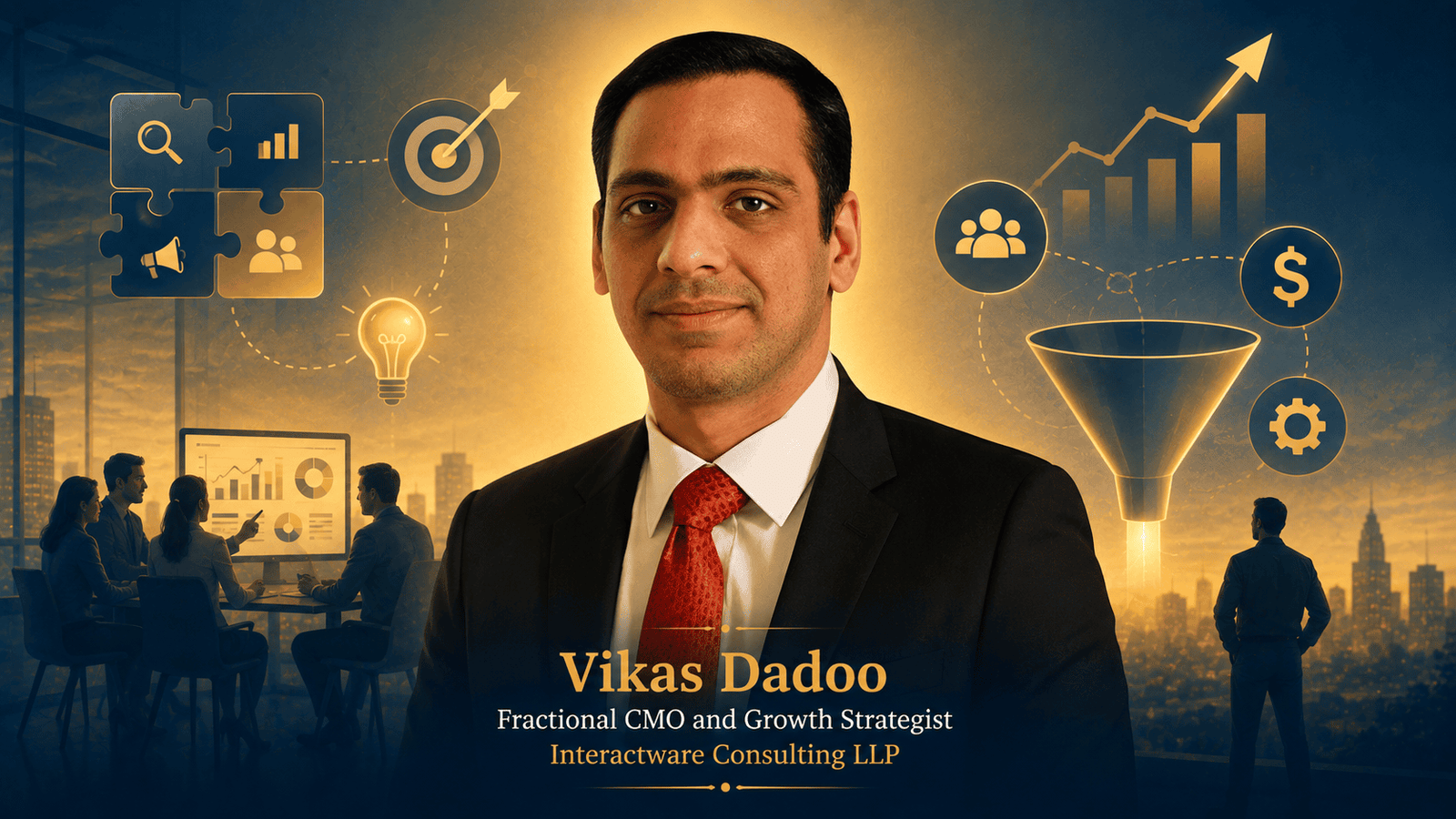
Why modern CMOs need a Growth Strategist to bridge the gap between marketing execution, business strategy and revenue growth.
Looking for a Shorter Overview?
AI Summary
Key Moments
Revenue Gap Identified
Marketing’s fragmented channels create a Revenue Gap, preventing overall growth despite individual successes.Measurement Gap Highlights
93% of CMOs report significant gaps in attribution, brand impact, and retention, limiting visibility into true performance.Growth Strategist Value
A Growth Strategist provides cross‑functional oversight, diagnosing bottlenecks and aligning all channels to revenue outcomes.AI Shifts Competitive Edge
As execution becomes commoditised, strategic judgment and holistic growth insights become the new differentiator.Imagine you’re building your dream home. You hire the best architect, contractor, electrician, plumber, carpenter, and interior designer.
Individually, everyone does an excellent job. But every homeowner knows that the success of the project doesn’t depend on the quality of any one specialist. It depends on how well all these specialists work together to create one coherent home.
Modern marketing has reached a similar stage.
Walk into almost any ₹100-crore company today, and you’ll find a CMO supported by specialist teams and agencies—SEO experts, performance marketers, social media agencies, content creators, CRM and marketing automation platforms, analytics tools, and creative partners.
Every team is naturally focused on optimising its own metrics. SEO teams improve rankings, performance marketers optimise ROAS, social media teams drive engagement, CRM teams improve email/WA performance, while creative agencies focus on developing the most compelling campaigns and creatives.
Each contributes value. And yet, when the homeowner asks, “Is the project coming together the way we envisioned?”, no individual specialist can answer with confidence.
Similarly, when the CEO asks, “How much revenue growth can marketing genuinely take credit for last quarter?” the room goes quiet.
The Challenge Is Industry-Wide
If this challenge feels familiar, you’re not alone. Industry research suggests it’s becoming one of the defining problems facing modern CMOs.
A recent industry benchmark of over 250 senior marketing leaders found that CMOs are struggling to connect fragmented data sources into a single, actionable view of what’s actually driving results.
Closer to home, the India CMO Index 2026, built from anonymous responses of 121 Indian CMOs, found that 93% report meaningful measurement gaps spanning attribution, brand impact, and retention.
Seeing the Whole Picture
Today’s CMO is responsible for brand strategy, stakeholder management, budgets, managing specialist teams and agency partners, AI adoption, team leadership, and, increasingly, demonstrating business impact and growth.
Likewise, specialist teams and agencies are doing exactly what they’re hired to do: optimise KPIs in their area of expertise.
The challenge is no longer executing individual marketing activities. It’s connecting them into one revenue engine. This is the Revenue Gap, and it’s one of the most expensive blind spots in Indian business today.
As a result, marketing leaders often spend valuable time reconciling different agency reports, debating attribution, or trying to understand why healthy channel metrics aren’t translating into stronger pipeline or revenue. The issue isn’t capability.
What’s missing isn’t effort. It’s someone who can interpret the complete revenue picture and guide better decisions.
The Role of a Growth Strategist
This is where a Growth Strategist adds value—not by managing channels or coordinating agencies, but by bringing strategic oversight across the entire marketing ecosystem. Working alongside the CMO and leadership team, they diagnose growth bottlenecks, challenge assumptions, identify opportunities, and translate fragmented marketing activities into a coherent revenue strategy.
While specialists optimise individual channels, a Growth Strategist evaluates how those channels collectively influence pipeline, customer acquisition, and revenue growth.
Their role is to:
- Growth Diagnosis: Look beyond channel metrics to identify where growth is slowing—whether it’s messaging, targeting, lead quality, customer journey, sales hand-offs, or channel mix.
- Strategic Insight: Instead of reviewing isolated dashboards, interpret data across SEO, performance marketing, CRM, and sales to uncover patterns, challenge assumptions, and recommend strategic actions instead of tactical optimisations.
- Revenue Alignment: Ensure specialist teams optimise not just their own KPIs but their contribution to pipeline quality, customer acquisition, and profitable growth.
A Growth Strategist complements the CMO’s judgement with data-driven insights, independent analysis, cross-industry perspective, and structured strategic thinking.
One of the greatest strengths of an independent Growth Strategist is objectivity. Free from ownership of any particular channel, campaign, or agency, they can evaluate marketing investments and strategic decisions through one lens alone—business impact.
They bring an outside perspective, benchmark performance against other organisations, question long-held assumptions, and identify opportunities that internal teams may overlook.
Having worked across organisations, industries, and business models, a Growth Strategist recognises patterns that are difficult to see from inside the business. They bring proven practices, challenge conventional thinking, and help leadership focus on the few decisions that will create the greatest commercial impact.
Ultimately, they help marketing leaders see the complete picture, ask better questions, and make better growth decisions.
Marketing’s Next Competitive Advantage
As AI makes campaign execution faster and specialist expertise increasingly commoditised, competitive advantage will come from better strategic judgement rather than better execution alone.
Day-to-day execution naturally leaves little time to periodically step back and evaluate the entire growth system.
They need someone who can periodically step back, diagnose what’s really limiting growth, challenge assumptions, connect seemingly unrelated signals across channels, and help leadership make better strategic decisions. That’s the role of a Growth Strategist.
Dashboards tell you what is happening. A Growth Strategist helps leadership understand why it’s happening and what to do next.
– Written by Vikas Dadoo, a Fractional CMO and Growth Strategist with over 20 years of experience helping businesses drive revenue growth through data-driven marketing strategy, integrated systems, and execution. Having worked with global brands, agencies, and founder-led businesses, he now helps leadership teams build scalable revenue growth engines and is an award-winning marketer and international speaker on AI in marketing.